
Blogging about Israel, Zionism and the future.
What would it take to be a light unto the nations?

The phrase “a light unto the nations”—אור גויים—comes from the prophet Isaiah. G-d tells His servant that restoring the tribes of Jacob is “too small a thing” on its own: “I will also make you a light of nations, that My salvation may reach the ends of the earth.” The calling is therefore presented as something larger than Jewish survival or national restoration. The Jewish people are expected to bring something of value to humanity.
We invoke this idea often, particularly when speaking about Israel, but rarely ask what it would require of us in practice. We tend to use it as an aspiration, a description of Jewish accomplishments or even a compliment we give ourselves. I think we should treat it more seriously.
Being a light unto the nations does not mean assuming that Jews are inherently better than other peoples, or that we have already created the society the world should emulate. It means accepting a mission to build a Jewish society and cultivate a Jewish people whose conduct reflects the deepest wisdom of our tradition.
The relevant question is not whether Jews have made exceptional contributions to medicine, science, business, culture and philanthropy. We clearly have. The harder question is whether Jewish life, taken as a whole, offers an example of how individuals, families, communities and nations should live.
That is a test we have never seriously attempted to define or measure.
Defining the mission
Before we can determine whether we are becoming a light unto the nations, we must decide what one would look like.
This should become a broad Jewish communal project involving Torah scholars, rabbis, educators, historians, economists, statisticians, legal experts, social scientists and representatives of Jewish communities across the religious and political spectrum. The objective would be to develop a framework that a substantial majority of Jews could examine and say: Yes, this is a fair description of the people and society we are called upon to become.
It would not be easy. Jews disagree about nearly everything, including how Jewish law and values should apply to modern life. But we are not beginning with an empty page. We possess a remarkably durable moral vocabulary built around justice, honesty, charity, family, responsibility, learning, protection of life, care for the vulnerable, restraint in the use of power and the obligation to confront evil.
Our definition should come from within Judaism. We can use modern social science to measure our performance, but we should not outsource our understanding of goodness to institutions whose values change with political fashion. A people claiming a moral mission must be confident enough to define that mission through its own texts, traditions and historical experience.
What would we measure?
A Jewish measure of a good society would include government, but it could not be limited to government. Judaism places responsibility on individuals, families and communities long before the state enters the picture.
We would examine whether courts are fair, public officials are honest, laws are applied consistently and political power is treated as a public trust. The weekday Amidah describes G-d as מלך אוהב צדקה ומשפט, “a King who loves righteousness and justice.” A society governed through bribery, favoritism or personal connections cannot serve as a moral example.
But honest government cannot be sustained by a dishonest population. We must also ask whether people tell the truth, honor contracts, repay debts, work diligently and deal fairly with employers, employees, customers and business partners.
We would examine the strength of families and the seriousness with which adults accept responsibility for children and elderly parents. Do families transmit learning, values and identity to the next generation? Are children raised with love, discipline and expectations? Do communities help families remain stable when they encounter difficulty?
We would assess how effectively we care for the poor, the widow, the orphan, the elderly, the disabled and those unable to defend themselves. This would include charitable giving, but also whether our institutions preserve dignity, encourage independence where possible and prevent vulnerable people from being abandoned.
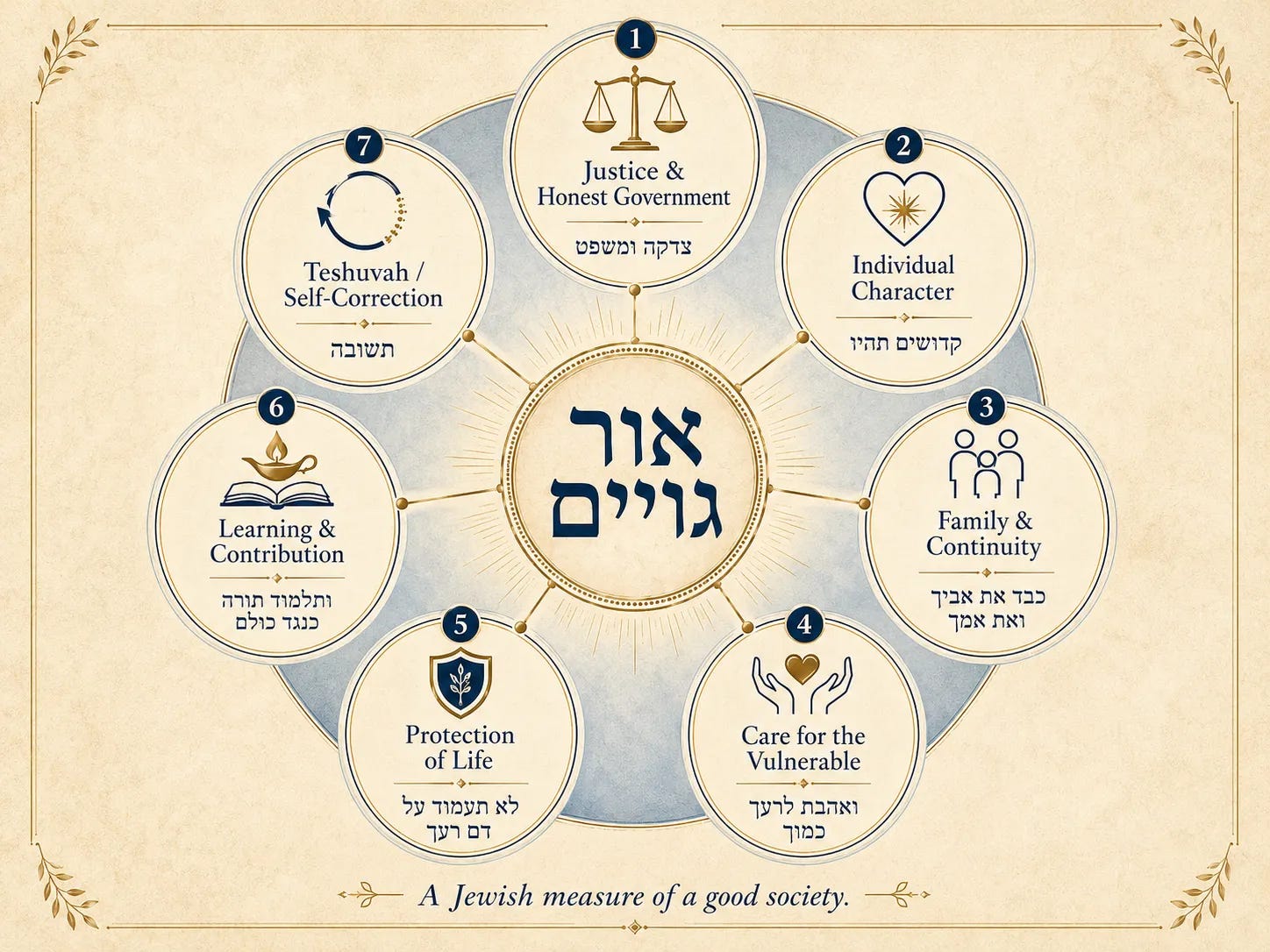
The Mussar tradition would add the cultivation of individual character: honesty, humility, patience, diligence, generosity, courage, gratitude and self-restraint. A good society is not merely one with well-designed public programs. It is one populated by people who behave decently when no law or official is forcing them to do so.
We would measure protection of life, including crime, terrorism, war, road safety and public health. Judaism demands compassion, but also commands לא תעמוד על דם רעך—not to stand idly by the blood of another. A moral society must be capable of protecting innocent people and confronting those who threaten them.
We would also assess contributions to humanity through medicine, science, technology, education, culture and practical solutions to suffering. Finally, we would measure our capacity for teshuvah. No people will always behave well. The question is whether wrongdoing is acknowledged, victims receive justice, failed leaders are held accountable and individuals and institutions genuinely change.
A credible framework would require the input of economists, statisticians, historians, legal scholars and public-policy experts, while also passing the test of experts in Jewish tradition, including respected Torah scholars.
Who exactly are “we”?
The biblical mission belongs to the Jewish people, not merely to the government of Israel. Israel must nevertheless stand at the centre of the exercise because it is where Jews possess sovereignty and can shape an entire society according to Jewish priorities.
For most of our history, Jews lived as minorities under governments created by others. We could build families, schools, synagogues and charitable institutions, but we did not control armies, courts, borders, prisons, national budgets or foreign policy. Israel has restored Jewish responsibility for all of these things.
That makes Israel the principal testing ground for whether Jewish values can guide collective power. At the same time, the conduct of Jews in Toronto, New York, Paris, London, Buenos Aires and Melbourne remains part of the Jewish moral record. The boundary of the exercise should therefore be the Jewish people as a whole, with Israel at its centre.
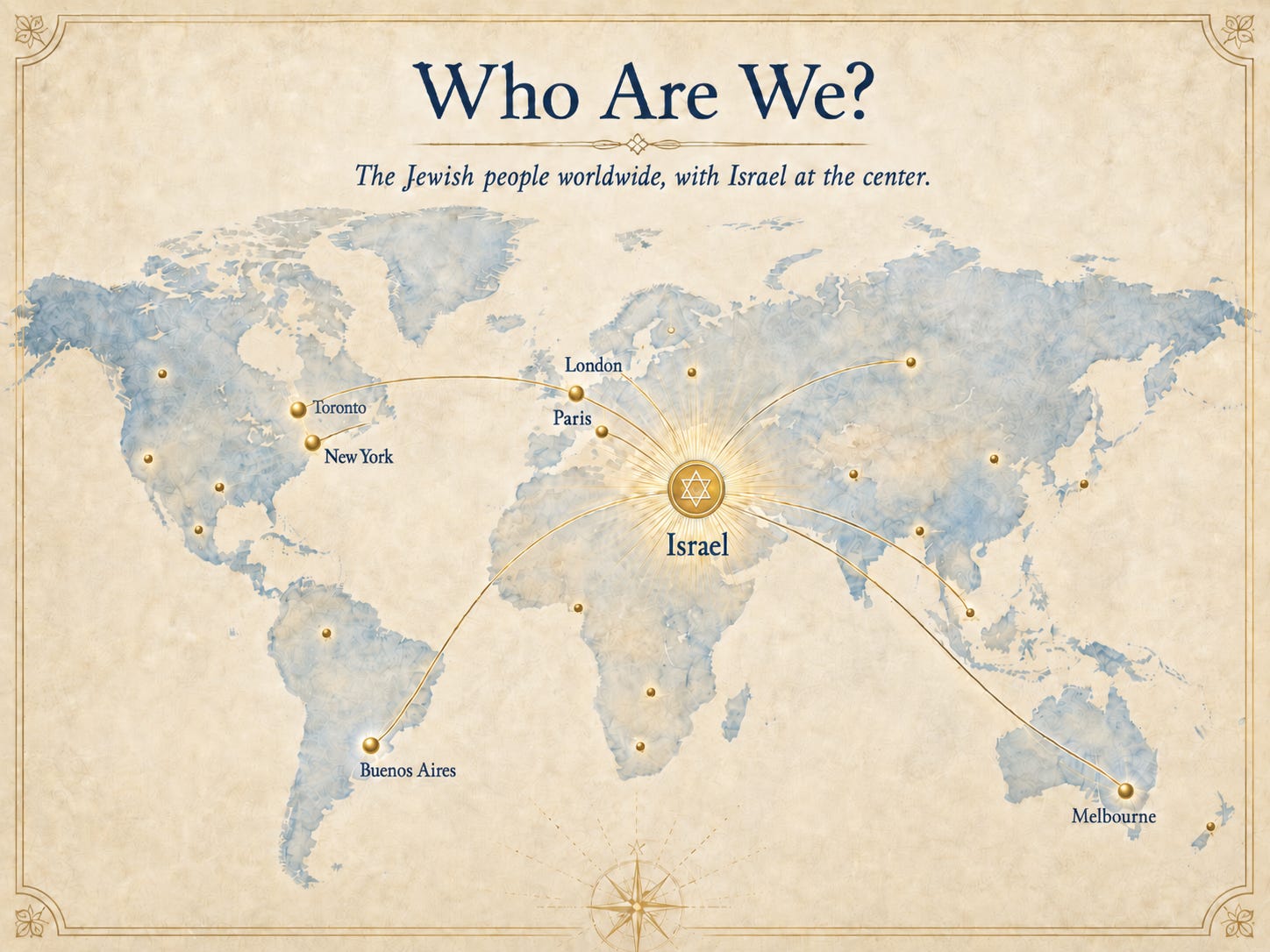
This would also allow useful comparisons within the Jewish world. Which communities are most successful at Jewish education, care for the elderly, business integrity, charitable giving or integrating newcomers? What can Israel learn from Diaspora communities, and what can the Diaspora learn from a society in which Jewish life operates at national scale?
The goal should not be one flattering overall score. It should be an honest profile showing where we are strong, where we are mediocre and where we are failing.
Learning from others without borrowing their compass
Once we have defined our measures, we should examine other countries, religions, peoples and cultures to identify those performing better than we are in particular areas.
This would not mean allowing others to define Jewish morality. The standards would remain ours. But confidence in our tradition should make us willing to recognize when someone else is living up to one of its principles more successfully than we are.
We may find that one country has cleaner public institutions, another safer streets and another a better system of vocational education. A religious community may demonstrate exceptional charitable giving or care for the elderly. A people without a state may preserve family and cultural continuity under extraordinarily difficult conditions. Another culture may cultivate public honesty, diligence, hospitality or respect for learning more consistently than we do.
Our task would be to understand what produces those results and whether the relevant practices could be adapted to Jewish communities or Israel.
The Shanghai model
A useful model comes from China.
In 2003, Shanghai Jiao Tong University published the first Academic Ranking of World Universities, now known as the Shanghai Ranking. Its purpose was to compare Chinese universities with the world’s leading institutions using measurable indicators such as major academic awards, highly cited researchers and publication in leading journals. The ranking has continued annually using a transparent methodology and third-party data.
The system was imperfect, as every serious measurement system will be. But it made the gap visible. Chinese universities could see where they stood, identify institutions performing better and direct sustained effort toward improvement.
That is the part we should imitate.
An independent Jewish institution should produce an annual Light Unto the Nations Benchmark. Its first responsibility would be to lead the communal process of defining the framework. It would then collect evidence, compare Jewish performance with relevant examples around the world and publish an annual assessment.
The report would rate Jewish performance in each category, explain the evidence, identify communities or societies doing better and make a limited number of recommendations for the coming year. The following year’s report would ask whether anything had changed.
The results should be studied by Israeli leaders, rabbis, educators, philanthropists, businesses, communal organizations and Jewish families. Different findings would create responsibilities for different parts of Jewish society. Corruption may require legal and political reform. Business dishonesty must also be confronted by employers, professional organizations and individuals. Weak Jewish education cannot be solved by government alone. Family instability, poverty and social isolation require action from communities as well as public institutions.
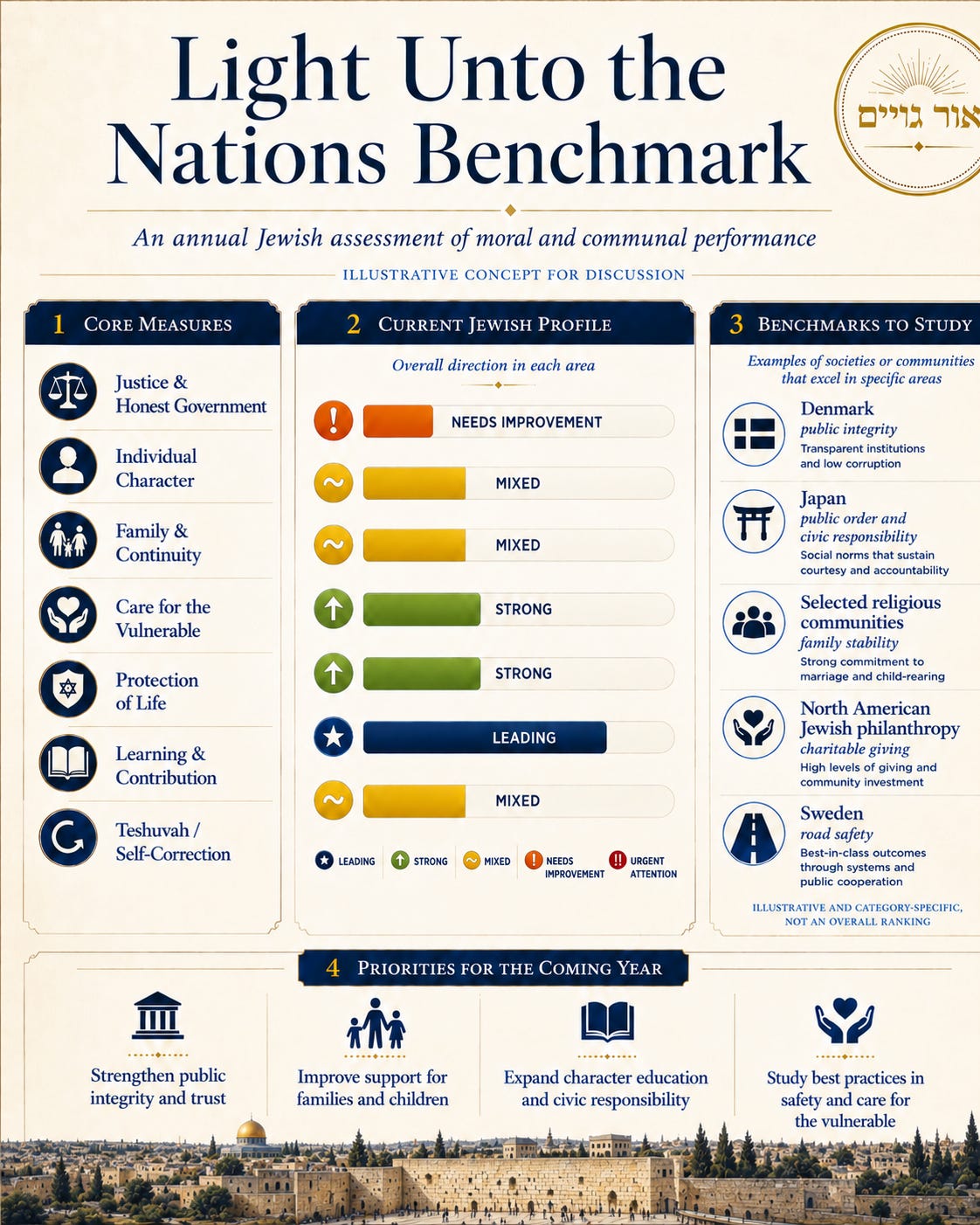
Each year, we would conduct a collective cheshbon hanefesh, an accounting of the soul. Where did we improve? Where did we deteriorate? Which recommendations did we act upon? Who elsewhere in the world is achieving results we should study?
There would inevitably be disagreement about the standards, data and conclusions. That is not a reason to avoid the exercise. The danger would be allowing disagreement to reduce the framework to harmless generalities. To be useful, it must sometimes tell us things we do not want to hear.
Becoming the light
The Jewish people have good reason to believe that we can offer moral leadership. We possess a tradition that has considered justice, charity, family, truth, responsibility, war, peace, learning and the proper use of power for thousands of years. We have survived conditions that destroyed many other peoples, rebuilt communal life repeatedly and regained sovereignty in our ancestral homeland.
But possessing a great tradition does not mean that we consistently live by it. Invoking the phrase “light unto the nations” does not make us one.
If we take the mission seriously, we should define what it asks of us, measure ourselves honestly and learn from anyone doing part of it better. The purpose would not be to advertise Jewish superiority, secure international praise or declare ourselves the winner of a moral competition.
The purpose would be to become better as a people.
Success would not ultimately be a higher score in our own annual report. It would be the creation of a Jewish society that others see and are inspired by—a society that encourages them to become more honest, more responsible, more generous, kinder and more just.
That is what it would mean to become a light unto the nations.
Related Topics
Related Posts