
What Would Moses Say About ‘the Will of the People’?
What Would Moses Say About “the Will of the People”?
Leaders aren’t megaphones; they’re moral compasses. Israel’s founders said as much, the prophets demanded it, and the Torah dramatized it. Invoking “the will of the people” to justify gutting judicial independence flips that calling on its head.
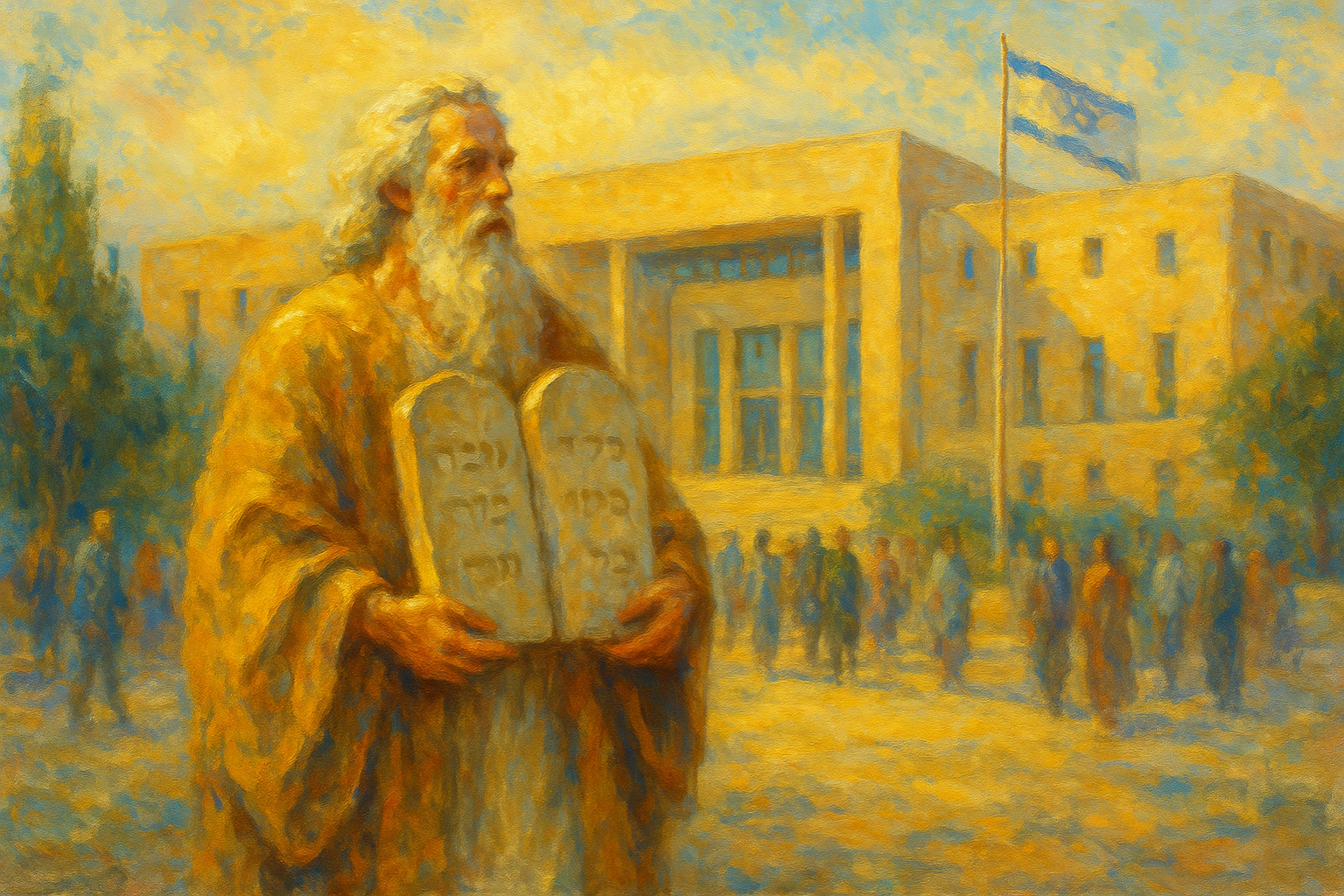
In the wilderness, a populist chant once thundered through the camp: “All the community are holy… you have gone too far!” (Numbers 16). Korach’s rally was canonized not as a model of participatory virtue, but as a cautionary tale about confusing raw numbers with righteous direction. Moses didn’t take a poll to decide the next step; he accepted accountability before God and the people, and he led. The Torah’s message is blunt: leadership is not ventriloquism. It is stewardship—of justice, covenant, and the nation’s future.
Israel’s Declaration of Independence encodes that same charge. It pledges that the state “will be based on freedom, justice and peace as envisaged by the prophets of Israel,” and that it will ensure equality and rights for all its inhabitants. This isn’t a mandate to echo whatever a temporary majority wants; it is a mandate to lead the public toward those prophetic standards.
That is why the current claim—most loudly from coalition figures—that “we were elected, therefore our power moves express the will of the people” is wrong at the root. Democratic legitimacy is not a blank check; it is a conditional trust to govern within guardrails that protect minorities, restrain excess, and preserve the rule of law. In Israel’s system—uniquely lacking a single, entrenched constitution—the independent judiciary is not a luxury; it is the crucial guardrail. Even the Knesset’s own materials describe the courts as the watchdog of the rule of law and rights, reviewing executive actions and securing legality in the absence of a full written constitution.
The Moses Test for Modern Leaders
If we ask, “What would Moses say to leaders who invoke ‘the people’ to aggrandize their own power?” the Book of Numbers already answered: Moses rejects the demagoguery that confuses clamor with calling. He takes responsibility, insists on a truth-testing process, and protects the community from a faction’s overreach. That is the opposite of reshaping the system so that one temporary parliamentary majority can dominate the bench that is meant to check it.
The Founders’ Test for Modern Governments
Israel’s founders embedded prophetic purpose at the center of statehood. The Declaration’s language about freedom, justice, and peace isn’t decorative; it is directional. It obligates governments to lead toward those ends, not merely to mirror back whatever mood prevails. When a coalition tells the courts, in effect, “Sit down, the people already spoke,” it’s repudiating that direction. As the Declaration makes clear, the point of independence was not nationalist self-expression alone; it was national self-discipline—a Jewish state that models justice.
Why Judicial Independence Is Non-Negotiable
Because Israel has no single written constitution, the courts are the main institutional counterweight to the fused executive-legislative power of a coalition government. That’s not a partisan view; it’s Civics 101 in a parliamentary system. The Supreme Court’s willingness to review laws and government actions has long functioned as the practical bill of rights on a single parchment. Weakening that independence is not a tweak—it is a structural tilt that leaves citizens exposed.
We saw how far some were willing to push. In 2024, the Court struck down a key piece of the overhaul that tried to strip it of “reasonableness” review—an unprecedented defense of its own ability to serve as a check. In 2025, the coalition returned with legislation to increase political control over judicial appointments. Both moves targeted the spine of judicial independence. These aren’t sterile legal skirmishes; they are a fight over whether any Israeli, at any time, can rely on neutral adjudication against the government of the day.
“The Will of the People” vs. The Good of the People
Proponents of the overhaul claim that elected leaders embody “the will of the people.” But Moses didn’t treat acclamation as authorization. He treated covenant as authorization. Israel’s founders did the same: they tethered state power to prophetic criteria—justice, peace, equality—so that even when leaders are popular, they remain accountable to a higher civic ethic.
And if we want to talk about the Israeli public’s will, let’s be honest: through years of rolling protests and polling, large segments of Israelis have consistently opposed changes that would hand politicians dominance over the courts. Even as the coalition pressed its case, the claim to represent an undifferentiated public desire has been, at best, contested.
Moses, the Prophets, and Today’s Coalition
Moses’ opposition wasn’t to the people; it was to using the people as a shield for power grabs. The prophets, too, denounced leaders who invoked national myth while neglecting justice, the widow, and the stranger. The Declaration elevates that very prophetic vision as Israel’s north star. So when politicians say, “We are the people’s voice,” and then pursue laws that concentrate power over the judiciary in their own hands, the biblical and founding answer is: No—that is not leadership. It is the Korach mistake in modern dress.
Lead—Don’t Leverage
Leaders worthy of Israel’s tradition don’t leverage public will to weaken checks; they lead public will to strengthen justice. Practically, that means:
- Preserve judicial independence—no coalition control over judicial appointments. If reform is needed, build cross-camp consensus that protects the bench from political capture.
- Affirm the Court’s review powers—especially in a system without a single entrenched constitution. The alternative is unmediated majoritarianism.
- Return to the Declaration’s compass—make every reform answer a simple question: does this advance “freedom, justice and peace… as envisaged by the prophets of Israel”? If not, don’t do it.
A Word to Likud and Its Partners
Likud was once the party that spoke fluently about individual liberty, the dignity of constraint, and the dangers of unbridled state power. It should reclaim that heritage. To insist that “we won an election” is not to pass the Moses Test, the Founders’ Test, or the Prophets’ Test. A coalition that believes in Israel’s future should be first in line to defend the independence of those who will one day judge it.
The Bottom Line
Moses would not bow to the mantra of “the will of the people” when it became a cudgel against justice. He would call leaders to a higher will—the covenantal one. Israel’s founders did the same when they bound the new state to prophetic purpose. Today, honoring both requires rejecting the charade that equates electoral victory with a license to capture the courts. Keep the judiciary independent; keep the balance intact. That is not defying the people—it is serving them.