What Would Rabbi Sacks Have Said?
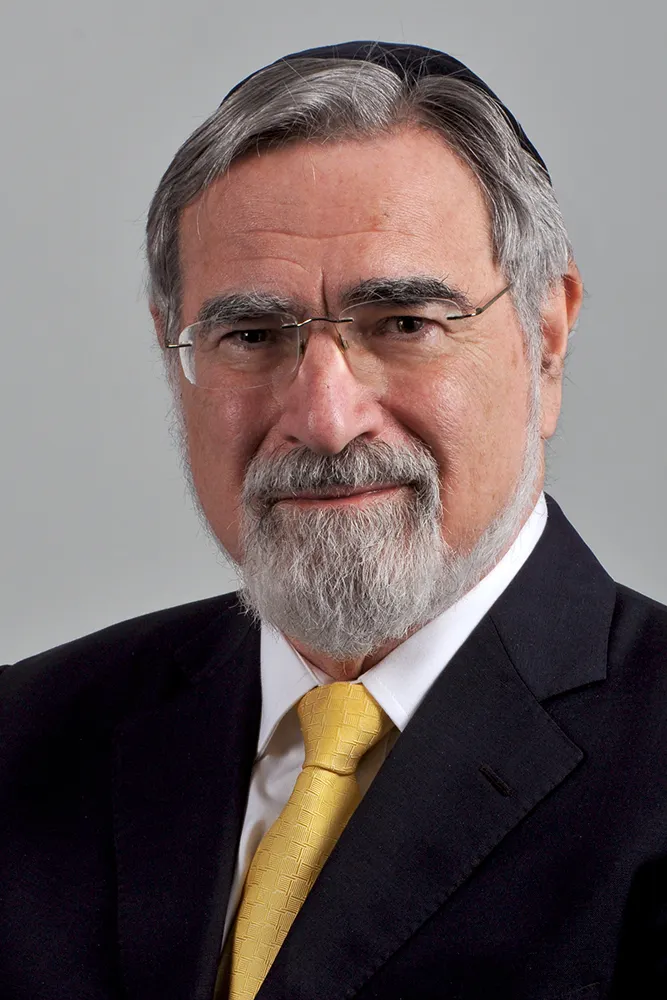
Lord Rabbi Jonathan Sacks passed away on November 7, 2020 at the age of 72. Many of us like myself who religiously read all his books and divrei Torah and eagerly listened to his speeches have experienced an enormous void in our lives since his untimely death.
I especially missed Rabbi Sacks after October 7th, when I was searching for some comfort and inspiration after this horrific massacre. This feeling continued with the explosion of global antisemitism that followed.
I wondered to myself what Rabbi Sacks might have said after October 7th… what words he might have left us with.
Well, I don’t have to wonder. With the help of AI, I was able to have ChatGPT compose an imagined speech from Rabbi Sacks addressing the current situation.
I asked ChatGPT the following: “Based on the writings, lectures, and speeches of Rabbi Sacks, please draft a speech that Rabbi Sacks might have delivered after the October 7th massacre and the increased antisemitism across the globe that followed, had he been alive.
In less than a minute, it provided a comprehensive talk on the subject.
I think this imagined speech accurately captures what made Rabbi Sacks such a great thinker: moral urgency, historical perspective, accessible language, Jewish wisdom, a universal human message, and an ending that challenges the audience to act.
I present it to readers in his memory, with the hope that it provides us with a clearer picture of the current situation for the Jewish community.
October 7 and the Ancient Hatred: A Warning to Humanity
An imagined speech inspired by the teachings and public addresses of Rabbi Lord Jonathan Sacks
Ladies and gentlemen,
There are moments in history when the world reveals itself to us with terrible clarity. Moments when the masks fall away, when the comforting assumptions by which we live are shattered, and when we are forced to confront truths we had hoped belonged to the past.
October 7, 2023, was such a moment.
On that day, Jews celebrating Simchat Torah, the festival of our joy in the Torah, awoke to a nightmare. Men, women, children, babies, and the elderly were murdered. Families were destroyed. Young people gathered to celebrate life were slaughtered. Women were subjected to horrific sexual violence. Innocent people were dragged from their homes and taken hostage.
It was an assault not merely on Israel, not merely on the Jewish people, but on the most basic principles of human civilization.
And then something happened that made an already unbearable tragedy even more painful.
Before the bodies had been buried, before families had learned the fate of their loved ones, before the full horror of the atrocities had been understood, people in cities and universities around the world were celebrating, rationalizing, or minimizing what had happened.
Some denied the evidence. Some justified the murder of innocents as resistance. Some found ways to blame the victims. And some who had spoken eloquently for human rights suddenly discovered exceptions when the victims were Jews.
We must ask ourselves a question that is as disturbing as it is necessary:
What has happened to our moral sense when the murder of Jews can be greeted not with horror, but with celebration?
I have spent much of my life studying antisemitism. I have watched it change its language, its justifications, and its disguises. I have warned that it is a virus that mutates, finding new hosts and new ways of evading the defenses of civilized society.
But even those of us who understood its history could hardly have imagined the speed and intensity with which the old hatred would reappear after October 7.
And so I want to speak today about three things: what October 7 revealed about antisemitism; what the world’s response tells us about the state of our civilization; and what we must do, Jews and non-Jews alike, if we are to ensure that hatred does not have the final word.
The virus has mutated again
One of the most remarkable features of antisemitism is its capacity to contradict itself without embarrassment.
In one century, Jews are accused of being capitalists; in another, communists. They are condemned for remaining separate from society and, simultaneously, accused of secretly controlling it. They are portrayed as weak and cowardly, then as dangerously powerful. They are accused of having no loyalty to the countries in which they live, yet are blamed for exercising collective self-determination in their own ancestral homeland.
No ordinary explanation of human prejudice can account for these contradictions.
The reason is that antisemitism is not fundamentally an argument about Jews. It is an argument that antisemites have with themselves and with the world. It is a way of explaining away complexity, evading responsibility, and finding a scapegoat for problems that are otherwise too difficult to understand.
That is why the hatred survives even when its arguments have been disproved. The arguments are not the cause of the hatred. They are its ever-changing vocabulary.
In the Middle Ages, Jews were hated because of their religion. In the nineteenth and early twentieth centuries, they were hated because of their supposed race. After the Holocaust, such arguments became harder to defend publicly. The language of racial superiority had been exposed in all its barbarity.
But hatred is remarkably inventive.
Today, antisemitism often presents itself in the language of human rights, social justice, and liberation. It does not always announce itself by saying, “I hate Jews.” It may say, “I oppose Zionism.” It may insist that its concern is exclusively political, that it has nothing against Jewish people, only against the Jewish state.
Let us be precise. Criticism of Israel is not, in itself, antisemitism. Israelis criticize their own government. Jews around the world disagree profoundly about Israeli policies. Democratic societies must permit vigorous debate, including criticism of governments and their conduct.
But there is a difference between criticizing a country and denying its people the right to exist. There is a difference between applying moral standards consistently and singling out the Jewish state for a uniquely hostile standard. And there is a difference between defending Palestinian rights and excusing the deliberate murder of Israeli civilians.
We should judge every government by appropriate standards of justice and human rights. Those standards must apply to Israel, to its neighbors, and to every other country.
The test is not whether Israel may be criticized. Of course it may. The test is whether the Jewish people are being denied rights that others take for granted, whether Jews are being held collectively responsible for the actions of a government, and whether violence against Jews is being excused because of their identity.
After October 7, we witnessed a deeply troubling phenomenon: Jews thousands of miles from Israel being made to answer for events in the Middle East; Jewish students being intimidated on university campuses; Jewish institutions requiring heightened security; and Jewish individuals feeling compelled to conceal symbols of their faith.
What does a Jewish student in London, New York, Paris, or Sydney have to do with the decisions of an Israeli government? What responsibility does a Jewish child bear for the actions of a soldier she has never met?
To hold Jews collectively responsible for the actions of Israel is not political criticism. It is collective blame. And collective blame has been one of the oldest instruments in the history of antisemitism.
The virus has mutated again. Our task is to recognize it, not by the labels it gives itself, but by the principles it violates.
October 7 was a test of our moral imagination
There is a question we must ask about the aftermath of October 7. Not only, “Why did this happen?” but also, “Why did so many people struggle to recognize the evil of what had happened?”
We rightly teach that human beings possess dignity. We rightly insist that civilians must not be targeted, that children must not be murdered, that sexual violence must never be used as a weapon, and that hostages must not be taken as instruments of political bargaining.
These principles are not conditional. They do not depend on the nationality of the victim, the identity of the perpetrator, or the political circumstances in which the crime occurs.
If the murder of a child is wrong, it is wrong whether that child is Jewish, Muslim, Christian, or of no faith. If the rape of a woman is evil, it is evil regardless of the flag under which the perpetrator marches. If taking an elderly person hostage is an outrage, it remains an outrage whatever political cause the hostage-takers claim to serve.
The moral test of a civilization is not whether it can condemn the suffering of people with whom it identifies. Almost everyone can do that. The test is whether it can recognize the humanity of people with whom it does not identify.
The Torah begins with a revolutionary proposition: every human being is created in the image of God.
Not only the king. Not only the powerful. Not only the person who shares our beliefs, our language, or our national identity.
Every human being.
The rabbis expressed this idea by teaching that the first human being was created alone, so that no one could say, “My ancestors are greater than yours.” We all descend from a single human family. No life is expendable. No person is merely a symbol of a political cause.
And yet, after October 7, some seemed unable to extend this elementary recognition to Jewish victims.
The problem was not simply a failure of information. It was a failure of moral imagination: the inability, or unwillingness, to see another human being as a human being.
That failure has consequences far beyond the Jewish community.
When political conviction becomes so absolute that it excuses the murder of innocent people, it has ceased to be a moral conviction. It has become an idol.
When a university, a religious institution, or a political movement can explain away the suffering of one group because that group is associated with a disfavored nation, it has abandoned the universal principles it claims to defend.
And when people who would never tolerate a racial slur against one minority remain silent when another minority is threatened, they have made equality conditional.
A principle that applies only to our friends is not a principle. It is a preference.
This is why the response to October 7 matters so much. The tragedy revealed not only the cruelty of the perpetrators but also the fragility of the moral consensus that we had assumed was secure.
We must not abandon that consensus. We must rebuild it.
The hate that begins with Jews never ends with Jews
In my earlier addresses, I warned that antisemitism is not a danger to Jews alone. It is an early warning sign of a society in moral decline.
Why?
Because antisemitism is the ultimate expression of what I have called the inability to make space for difference.
The Jewish people have been a small minority in nearly every country in which they have lived. They have maintained their identity while contributing to the societies around them. They have worshipped differently, observed a different calendar, told a different story about history, and refused, for the most part, to dissolve their identity into that of the majority.
That distinctiveness has too often made Jews a target.
But the ability to live with difference is not a favor that a majority grants to a minority. It is the foundation of a free society.
A society is not truly free because everyone agrees. It is free because people who disagree can live together without fear. It is free because a person can worship differently, speak differently, and maintain a different cultural identity without being threatened or excluded.
The moment a society decides that one minority has no legitimate place within it, the foundations of liberty begin to crumble.
Today it may be Jews. Tomorrow it may be Muslims, Christians, immigrants, or some other group that a majority finds inconvenient. Once we accept the principle that people may be stripped of their dignity because of who they are, we have placed everyone’s dignity at risk.
That is why antisemitism must concern every decent person, whatever their faith or background.
I have often argued that Jews cannot defeat antisemitism alone. The victim cannot cure the crime. The people who are hated cannot, by themselves, persuade the haters to stop hating.
Jewish communities must certainly defend themselves. They must educate their children, protect their institutions, challenge falsehoods, and insist that the law be enforced. But the responsibility for fighting antisemitism cannot be left to Jews alone.
It belongs to all of us.
I want to speak especially to my Christian friends. Your scriptures are intertwined with ours. Your religious heritage has drawn deeply from the Hebrew Bible. The Jewish people are not strangers to the story that helped shape your civilization. When Jews are threatened, this is not someone else’s problem. It is a test of your own moral commitments.
I want to speak to my Muslim friends. The great tradition of Islam contains teachings about justice, mercy, and the sanctity of human life. Muslim communities have themselves suffered from prejudice and suspicion. You know what it means to be judged not as individuals but by the actions of others who claim to speak in your name. That is precisely why you can understand the injustice of holding every Jew responsible for Israel, or every Muslim responsible for Hamas.
We need courageous Muslim voices that condemn antisemitism without qualification, just as we need courageous Jewish, Christian, and secular voices that condemn anti-Muslim hatred without qualification.
And I want to speak to those who have no religious faith. You need not believe in the God of Abraham to recognize the dignity of Abraham’s children. You need not accept Jewish theology to defend the right of Jews to live openly, safely, and freely as Jews.
We can disagree about theology, politics, history, and the future of the Middle East. We can argue passionately about the policies of governments. But we must never allow those disagreements to erase the humanity of innocent people.
The great challenge of our time is not to eliminate difference. It is to learn how to live with it.
That is the dignity of difference. And without it, there can be no lasting peace.
Never again must mean something
After the Holocaust, the world made a solemn promise: Never again.
Those words became a moral commitment, a declaration that the systematic persecution and murder of the Jewish people would never again be tolerated.
But what does “Never again” mean if it is remembered only at commemorations? What does it mean if we teach children about the Holocaust but fail to recognize the language of hatred when it appears in our own time?
What does it mean if we remember the victims of the past but are reluctant to defend the victims of the present?
October 7 confronted us with a painful truth: historical memory does not automatically confer moral wisdom. We can know the facts of history and still fail to learn its lessons.
We cannot simply point to the Holocaust and assume that antisemitism has been defeated. A virus does not disappear because we have identified it once. It must be recognized in each new form it takes.
Nor can we rely on legislation alone. Laws matter enormously. Governments must protect Jewish communities, prosecute crimes motivated by antisemitism, confront threats and intimidation, and ensure that Jewish students can participate fully in educational life. Universities must enforce their rules consistently and protect the freedom and safety of all their students.
But laws cannot, by themselves, create the moral imagination that enables one human being to see another as a person.
That requires education. It requires honest history. It requires religious leaders who teach the sanctity of life rather than the demonization of others. It requires teachers who refuse to let the murder of Jews be excused by political slogans. And it requires citizens willing to speak when silence would be easier.
We must teach our children the difference between criticism and hatred, between protest and intimidation, between defending the rights of Palestinians and celebrating violence against Jews.
We must teach them that human rights are universal or they are meaningless.
And we must teach them that the Holocaust was not simply a tragedy that happened to the Jewish people. It was a catastrophe for humanity, a demonstration of what can happen when prejudice becomes ideology, ideology becomes policy, and policy becomes a machinery of destruction.
But there is another lesson.
The Holocaust must never become the sole definition of Jewish identity. The Jewish story is not only a story of persecution. It is also a story of covenant, learning, creativity, resilience, faith, and hope.
We must remember the victims without allowing the murderers to determine the meaning of our lives.
We must mourn without surrendering to despair.
And we must defend ourselves without abandoning the moral principles that give our lives meaning.
The Jewish response must be courage, not despair
There is a temptation, after October 7 and the events that followed, to conclude that nothing has changed, that the world will always hate Jews, that every generation is destined to relive the tragedies of the generations before it.
I understand that temptation. The history of the Jewish people provides more than enough reasons for sorrow and apprehension.
But I reject that conclusion.
Antisemitism is ancient. It is not eternal.
There is a difference.
If antisemitism were written into the fabric of the universe, there would be nothing we could do about it. But it is a human creation, sustained by human choices. And what human beings have created, human beings can learn to dismantle.
The Jewish people have survived not because history has been kind to them, but because they have refused to let history have the final word.
After destruction, Jews rebuilt. After exile, they created communities. After persecution, they continued to teach their children. They opened books, established schools, cared for the vulnerable, and preserved a faith that insisted that the world could yet become better than it was.
The Jewish response to hatred cannot simply be to ask why the world hates us. It must also be to ask what we can contribute to a world that so desperately needs moral courage.
We should not allow antisemitism to make us ashamed of being Jewish. We should not allow it to persuade us that our identity is a burden. We should not allow it to turn us inward, away from our responsibilities to humanity.
Instead, we must live our values more fully.
We must create Jewish communities in which our children are proud of their heritage, knowledgeable about their tradition, and confident enough to encounter the wider world without fear.
We must support Israel’s right to exist in peace and security, while continuing to recognize the dignity and rights of every human being in the region. The suffering of innocent Palestinians is real and must never be treated as insignificant. The security and dignity of Israelis are equally real and must never be treated as negotiable.
Compassion is not a finite resource. Recognizing one people’s suffering does not require us to deny another’s.
Indeed, it is precisely because Jewish tradition teaches us to remember our own experience of vulnerability that we must never become indifferent to the vulnerability of others.
We must also recover something essential about the Jewish understanding of hope.
Hope is not the belief that everything will turn out well. Hope is the conviction that our actions matter, even when we cannot be certain of the outcome.
The prophet Zechariah tells us, “Not by might, nor by power, but by My spirit, says the Lord.” This is not a denial of the need for physical security or the legitimate defense of innocent life. It is a reminder that force alone cannot build a civilization. Security must be accompanied by justice, and justice by the recognition of our common humanity.
Our task is to build, to teach, to heal, and to create. We must ensure that the Jewish future is shaped by Jewish values, not by the prejudices of those who oppose us.
We must refuse to hand the antisemites a victory more profound than anything they could achieve through violence: the victory of making us abandon who we are.
Three things we must do
Let me end with three practical challenges.
First, we must tell the truth.
We must speak honestly about October 7, about the murders, the sexual violence, the hostages, and the suffering of the victims and their families. We must resist denial, distortion, and the selective application of moral standards.
We must also insist on accuracy and intellectual honesty in every discussion of the conflict. Truth is not the property of one people. It is the common ground on which people of good faith can meet.
A civilization that cannot tell the truth about its victims will eventually lose the ability to recognize its own failures.
Second, we must stand together.
Jewish communities must not be left to defend themselves alone. Religious leaders, university presidents, political representatives, educators, and ordinary citizens must make clear that antisemitism is unacceptable in every setting.
But solidarity must be more than a statement. It must be a presence. It means standing beside a Jewish neighbor who has been threatened. It means challenging a falsehood even when doing so is unpopular. It means ensuring that a Jewish student does not have to choose between personal safety and participation in university life.
And it means building alliances across religious and cultural boundaries, not only when we face a common enemy, but because we share a common humanity.
Third, we must choose hope over hatred.
There is a story I have sometimes told about a Jewish merchant who entered a village where the people despised Jews. They surrounded him, shouting insults. He responded with such generosity that they were left bewildered. Eventually, their hostility lost its purpose.
The lesson is not that victims must purchase the goodwill of their persecutors. They must not. The lesson is that hatred thrives when it succeeds in controlling our response, our identity, and our vision of the future.
We must be firm in confronting evil, but we must not allow evil to become the organizing principle of our lives.
We must not respond to antisemitism with hatred of another people. We must not confuse the extremists who commit or celebrate atrocities with every member of a religion or nationality. We must hold individuals accountable for their actions while refusing to condemn entire communities by association.
This is not weakness. It is moral discipline.
It is the courage to say that our values are not for fair-weather days alone. They matter most when they are tested.
The choice before us
Ladies and gentlemen,
In the Book of Esther, which Jews read on Purim, we encounter one of the oldest recorded expressions of antisemitic thinking. Haman looks at a people whose customs are different and concludes that their difference makes them dangerous.
That reasoning has appeared in many forms throughout history. The names change. The accusations change. The instruments of hatred change. But the underlying fear remains: the fear of a world in which people are permitted to be different.
The answer to that fear is not uniformity. It is the recognition that our differences can enrich the human story.
The Jewish people have carried that message through centuries of exile and persecution. It is a message that belongs not only to Jews but to the world.
October 7 was a day of terrible darkness. The resurgence of antisemitism that followed exposed wounds in the moral life of our societies that many had assumed were healed.
We cannot undo the atrocities. We cannot restore the lives that were taken. We cannot erase the anguish of the families whose loved ones were murdered or taken hostage.
But we can determine what happens next.
We can decide whether the memory of October 7 will deepen our commitment to human dignity or further divide us into tribes that recognize only their own suffering.
We can decide whether the language of human rights will remain a universal moral commitment or become a weapon used selectively against those we dislike.
We can decide whether our universities will be places of open inquiry or environments in which students are intimidated for who they are.
We can decide whether religious faith will be a source of compassion or an excuse for hostility.
And we can decide whether the next generation will inherit a world in which antisemitism is once again treated as normal, or one in which it is recognized, challenged, and rejected.
The hate that begins with Jews never ends with Jews. It is a warning to every society that allows difference to become a reason for exclusion, and exclusion to become a justification for persecution.
The question before us is therefore not simply whether Jews will be safe. It is whether we will build a world in which every human being can live with dignity, without fear, and without having to apologize for who they are.
I want to end with a thought from the Jewish tradition.
The rabbis teach that we are not required to complete the work of perfecting the world, but neither are we free to desist from it.
We may not live to see the defeat of antisemitism. We may not know whether our efforts will be sufficient. But we are responsible for the choices we make, the words we speak, the injustices we challenge, and the courage we show when others are silent.
To the Jewish people, I say: do not let hatred define you. Remember who you are. Teach your children. Strengthen your communities. Live your faith. Build your future.
To the leaders of our societies, I say: do not wait for another tragedy before acting. Protect your Jewish citizens. Enforce your laws. Educate your young. Confront hatred in whatever language it speaks.
And to all people of goodwill, whatever your faith or none, I say: stand with the Jewish people, not because Jews are perfect, not because Israel is beyond criticism, but because no people should have to earn the right to live in safety and freedom.
We cannot promise that hatred will never return. But we can refuse to give it a home in our institutions, our classrooms, our places of worship, or our hearts.
The ultimate answer to the hatred of difference is to honor the dignity of difference. The ultimate answer to those who destroy is to build. The ultimate answer to those who seek to extinguish hope is to create a future worthy of our children.
October 7 must never be forgotten. But neither must it be allowed to convince us that the world cannot change.
For the Jewish people have lived through centuries of darkness and have continued to affirm life. They have carried a message of hope through history, a message that every human being bears the image of God, that justice is possible, that freedom is sacred, and that the future remains open to those who have the courage to build it.
That is our responsibility. That is our challenge. And that is our hope.
May we have the wisdom to recognize hatred before it is too late, the courage to confront it when it appears, and the faith to build a world in which every human being can live without fear.
Thank you.