A New York City Cantor
What’s in a Cantor’s Head?
Legacy, Learning and the Living Voice of Jewish Tradition
Film and Reflection at Stephen Wise Free Synagogue — Thursday, November 20 at 6pm.
What goes through the head of a cantor?
A swirl of prayer modes, ancient motifs, and the heartbeat of a congregation. A cantor’s head carries history, harmony, and hope. The eternal question of how to honor our past while singing a new future.
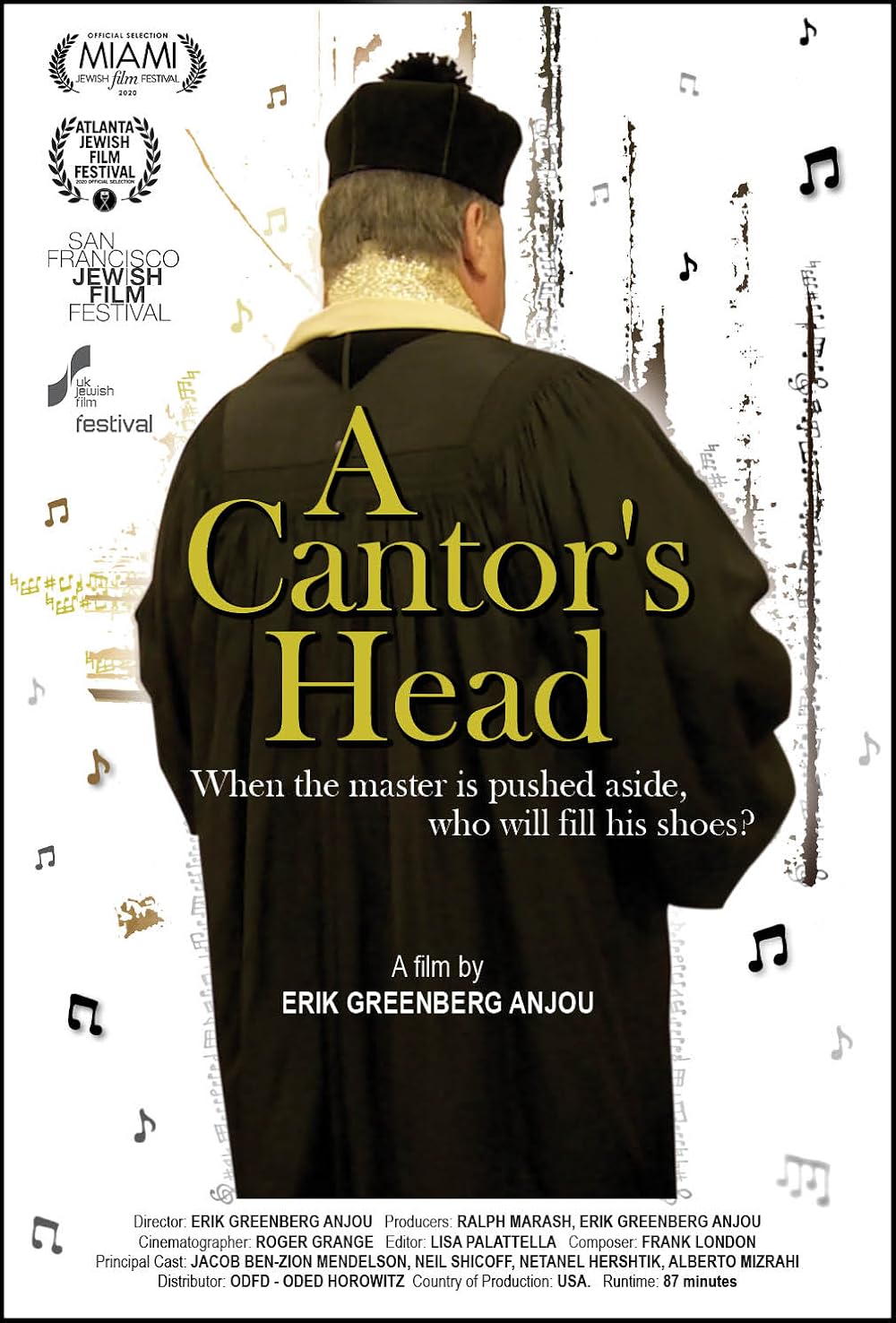
That question is at the center of A Cantor’s Head, the acclaimed film by Erik Anjou that follows the remarkable life and legacy of Cantor Jacob Ben Zion Mendelson, who we all affectionately call “Jackie,” who has been a longtime faculty member and alumnus of the Hebrew Union College’s School of Sacred Music and a beloved teacher to generations of students, including me. Jackie’s life invites us to ask: What sustains a cantor? What motivates us to preserve nusach and to innovate?
Jackie’s tradition reminds us that the cantorate predates even the rabbinate, rooted in the Chazan, the overseer of the sacred rites and the Levites who sang in the Temple in Jerusalem. The cantor’s voice has always been the pulse of Jewish continuity: carrying the people’s prayers from the Temple mount to medieval Europe to the modern synagogue.
It is no accident that Hebrew Union College’s School of Sacred Music, the first cantorial school in America, was founded at a historic crossroads. In 1947, as the State of Israel was being born and the Reform movement prepared to merge the Cincinnati campus of Rabbi Isaac Meyer Wise with Rabbi Stephen Wise’s Jewish Institute of Religion in New York, another revolution was quietly taking place. In the wake of the Holocaust, the Society for the Advancement of Jewish Liturgical Music (SAJLM) formed to preserve the great chazzanut of Europe.
Led by Rabbi D.A. Jessurun Cardozo, Rabbi James G. Heller of Cincinnati, and Rabbi Israel Goldfarb of Brooklyn, with Dr. Josef Freudenthal as treasurer and Dr. Eric Werner as secretary, the Society’s executive committee brought together Jewish leaders and musicians including A.W. Binder, founding music director of Stephen Wise Free Synagogue for over 40 years, alongside Bernard Bamberger, Isadore Freed, Max Helfman, Cantor David Putterman, Dr. Jacob Weinberg, M.J. Yardeini, Joseph Yasser, Cantor Pinchas Yassinowsky, and Rabbi Jacob Singer, a cousin who I discovered was from my Lithuanian lineage of chazzanim originally named Khazan.
Their mission was clear: to found America’s first cantorial school. Faculty met to teach classes and strategize. Early announcements in the New York Times named Temple Emanu-El as the intended home. But when the merger between HUC and JIR began to take shape under Rabbi Nelson Glueck, Dr. Abraham Franzblau, a psychiatrist who championed professional training for synagogue leadership as the dean of HUC’s satellite school in New York, became the first dean of the cantorial school. The Cincinnati administration adopted the SAJLM’s proposal in the spring of 1949. By the fall of 1949, the program formally opened at the Jewish Institute of Religion, as the School of Sacred Music, uniting Zionist ideals, American vision, and the eternal voice of the Temple.
For Jackie and for those of us privileged to study with him, this isn’t distant history. He always reminds us that our work as cantors is sacred continuity: “We are preserving chazzanut for the six million.” That sense of mission has shaped my own journey as a cantor at Stephen Wise Free Synagogue, the congregation and college founded by Rabbi Stephen Wise himself, whose Zionist convictions now feel more resonant than ever. When I recently spoke on an HUC alumni panel for prospective students, I reflected that what I wish I had learned more about was precisely this tension: how the philosophies of Rabbi Isaac Meyer Wise and Rabbi Stephen Wise, one antizionist, one passionately Zionist, were reconciled through that merger, allowing Reform Judaism to embrace Zionism as central to our identity. I feel that legacy profoundly every time I lead our community in song.
For me, the story will come full circle, culminating next spring in a musical program about my hometown of Superior, Wisconsin, a “City of Destiny” that I have called a Crossroads of the North. This is the same town where Jackie’s uncle-in-law, Hersh Leib Chazin, served as our synagogue’s first professional cantor, connecting our families through generations of chazzanim who brought sacred music to America’s farthest corners. Jackie is woven into that fabric: part of my lineage of teachers, part of my community, and part of my heart.
On Thursday, November 20, at Stephen Wise Free Synagogue, we gather to explore A Cantor’s Head as a window into what it means to think, feel, and serve as a cantor today, balancing preservation and creativity, history and hope. The film is humorous, heartfelt, and deeply revealing, but more than that, it asks us what’s in our heads: how each of us can carry forward the melodies, the memories, and the mission of those who sang before us.
Please join us for this special evening of film, reflection, and song to celebrate the living legacy of Cantor Jacob Ben Zion Mendelson, to honor the founders of our cantorial school, and to renew our shared calling to keep Jewish music alive in every generation.
Related Topics