London based entrepreneur, cybersecurity analyst doing a PhD in AI
What’s your exchange rate?
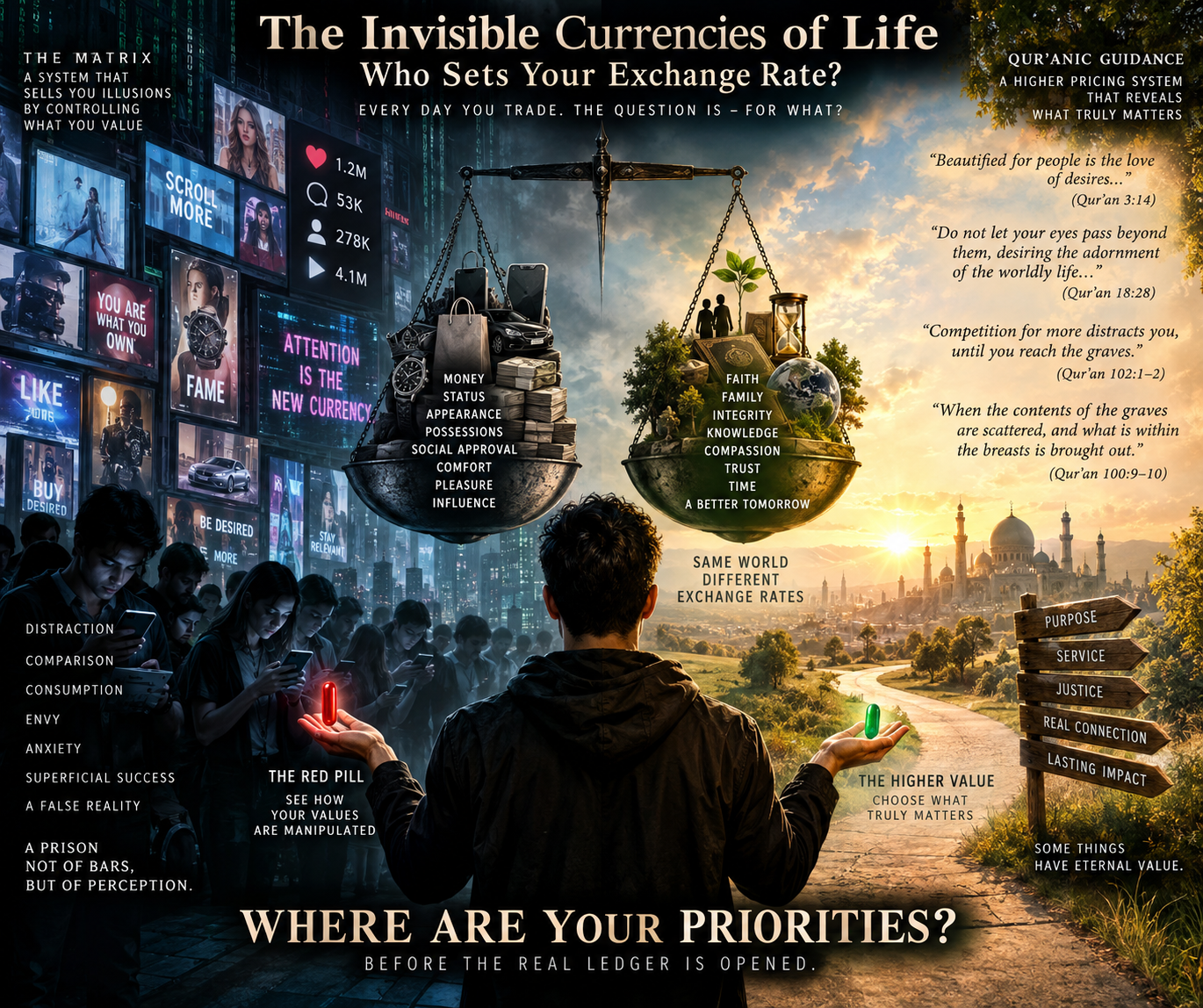
The Invisible Currencies of Life: Who Sets Your Exchange Rate?
There is a frightening possibility hidden inside ordinary life.
We may think we know what matters most to us.
Family.
God.
Children.
Truth.
Health.
Justice.
Love.
The future.
But there is another way to discover our real priorities.
Look at where we put our:
time, money, attention and imagination.
Because every day, we are trading.
Not merely pounds for products.
We trade time for status.
Privacy for attention.
Integrity for acceptance.
Sleep for productivity.
Health for pleasure.
Family for career.
Truth for belonging.
Sometimes even faith for the approval of other people.
There is an invisible economy operating beneath ordinary human life.
And every one of us has an exchange rate.
The real question is:
Who set yours?
The Matrix was really about perception
In The Matrix, Neo initially believes he understands reality.
He has a job.
An apartment.
Friends.
A city.
A computer.
Bills.
Routine.
Everything looks normal.
Then Morpheus presents him with the terrifying possibility that the world through which he has been interpreting everything is itself artificial.
The Matrix is a simulated reality constructed to keep human beings psychologically contained while their physical bodies remain elsewhere. Neo’s liberation begins not when the external world changes, but when he discovers that the framework through which he understood reality was false. (Wikipedia)
That is what makes The Matrix such a powerful metaphor.
The most effective prison is not necessarily one with visible bars.
It is one in which someone else determines what appears desirable, important, frightening, prestigious or normal.
And perhaps modern life contains a softer version of the same problem.
Not because we literally live inside a computer simulation.
But because increasingly we live inside systems competing to determine:
what we notice, what we desire and what we believe is valuable.
Every human being carries an internal pricing system
Imagine that your mind contains a hidden stock exchange.
Every person, object, experience and ambition carries a price.
Money.
Beauty.
Status.
Knowledge.
Children.
Career.
Religion.
Reputation.
Pleasure.
Influence.
Friendship.
Truth.
Your brain is constantly ranking them.
You may verbally claim:
“My family is my highest priority.”
But if nearly every free hour goes elsewhere, your behaviour publishes a different valuation.
You may say:
“My health is priceless.”
But repeatedly exchange tomorrow’s health for today’s pleasure.
You may say:
“I do not care what people think.”
Then spend three hours worrying about whether strangers approved of something you posted.
Economists have a useful concept here: revealed preference.
What people actually choose can sometimes tell us more than what they say they value.
The same idea can be applied morally.
Your calendar is a valuation system.
Your bank statement is a valuation system.
Your screen-time report is a valuation system.
Your search history is a valuation system.
Your attention is perhaps the clearest one of all.
What repeatedly captures your eyes is accumulating currency inside your mind.
The Qur’an asks precisely this question
The Qur’an repeatedly forces human beings to examine their hierarchy of value.
Perhaps one of the clearest examples is:
“Say: If your fathers, your sons, your brothers, your spouses, your relatives, the wealth you have acquired, the commerce whose decline you fear, and the dwellings you delight in are more beloved to you than Allah and His Messenger and striving in His cause, then wait until Allah brings about His command.”
— Qur’an 9:24
The extraordinary feature of this verse is its structure.
It is almost an inventory.
Family.
Wealth.
Business.
Property.
Security.
Belonging.
All legitimate things.
The Qur’an does not say they have no value.
It asks something subtler:
What is their relative value? (The Quranic Arabic Corpus)
This is an exchange-rate question.
What happens when two priorities conflict?
What will you exchange for what?
That is when your real hierarchy appears.
Marketing understands this better than most of us do
Businesses do not merely manufacture objects.
The best businesses manufacture perceived value.
Take two physically similar products.
Put one in ordinary packaging.
Put another beneath cinematic lighting, associate it with athletes, celebrities, sophistication, scarcity and status, and suddenly consumers may experience them differently.
This is not merely philosophical.
Marketing research distinguishes between advertising that informs consumers about a product and advertising that can transform or persuade their evaluation of the brand and even the subsequent consumption experience. Experimental work has also found that advertising can affect perceived quality and willingness to pay. (PubsOnline)
That is extraordinary when you think about it.
Marketing can change the exchange rate.
Yesterday:
“This is a pair of shoes.”
Today:
“These shoes represent success.”
Yesterday:
“This is a watch.”
Today:
“This watch signals who I am.”
Yesterday:
“This is a car.”
Today:
“This is what a successful man drives.”
The atoms of the object may barely have changed.
The symbolic price inside the mind has.
The Qur’an has a word for this: beautification
Consider the wording of Qur’an 3:14:
“Beautified for people is the love of desires—women, children, treasures of gold and silver, fine horses, cattle and cultivated land…”
— Qur’an 3:14
The Arabic begins:
زُيِّنَ لِلنَّاسِ
Zuyyina lil-nās.
“Made beautiful to people.”
The verse does not deny that these things may actually be good.
Children are good.
Property can be good.
Wealth can be useful.
The point is that human perception does something additional.
Things become adorned.
Magnified.
Loaded with desire.
Then the verse immediately recalibrates the valuation:
“…These are the pleasures of worldly life, but with Allah is the finest destination.”
The object has not disappeared.
The exchange rate has been corrected. (Quran)
That may be one of the most important functions of revelation.
The Qur’an repeatedly reprices reality.
Algorithms now participate in that repricing
Social media introduced something unprecedented into ordinary human psychology.
It attached numbers to social approval.
Followers.
Likes.
Shares.
Views.
Comments.
Reach.
Engagement.
Human beings always cared about reputation.
But previously reputation was fuzzy.
Now it has a dashboard.
Imagine telling someone 200 years ago:
“Yesterday 52,416 people looked at my face, 3,107 approved publicly, 419 shared my opinion and my engagement increased by 17 percent.”
It would sound absurd.
Today it sounds normal.
Once social reputation is quantified, however, another process begins.
We optimise for the metric.
A thoughtful argument receives 20 likes.
An angry statement receives 20,000.
You learn something.
Not necessarily consciously.
Outrage has a better exchange rate.
Beauty receives attention.
You learn another thing.
Appearance has currency.
Humiliation goes viral.
Another signal.
Cruelty can purchase visibility.
The algorithm does not necessarily tell us directly what to believe.
It does something potentially more powerful.
It tells us what receives attention.
And humans are extremely sensitive to social signals of value.
Attention is the reserve currency
There is a reason companies compete so aggressively for attention.
It is upstream from almost everything else.
Before someone can persuade you, they must first make you look.
Before you buy the product, watch the video, absorb the political message or imitate the influencer, they must acquire a small portion of consciousness.
Modern advertising research explicitly describes this environment as an “attention economy,” in which marketing messages compete with a growing volume of stimuli for limited human attention. (Harvard Business Review)
But attention has an unusual property.
Money is renewable.
Attention is not.
You can lose £100 and earn another £100.
You cannot earn back Tuesday afternoon.
This makes time and attention perhaps the two most precious invisible currencies we possess.
The Qur’an therefore opens an entire chapter:
“By Time. Surely humanity is in loss…”
— Qur’an 103:1–2
Notice the language.
Loss.
Everyone begins the day with capital.
Twenty-four hours.
And everyone ends the day having spent it.
The only question is:
What did you purchase?
The algorithm of attention
Imagine a crude formula:
Repeated attention → perceived importance → desire → behaviour → habit → character.
This is not a complete psychological theory.
But it captures something important.
What repeatedly enters consciousness often begins to acquire weight.
Look at enough luxury houses and your perfectly adequate home may begin to feel deficient.
Look at enough sculpted bodies and your normal body may begin to feel inadequate.
Watch enough outrage and the world may begin to look permanently hostile.
Watch enough wealth displays and ordinary prosperity can begin to feel like failure.
The feed has not merely shown you information.
It may have altered your baseline.
That is why Qur’an 18:28 contains a remarkably visual warning:
“Do not let your eyes pass beyond them, desiring the adornment of the worldly life…”
It then connects heedlessness with following desire. (The Quranic Arabic Corpus)
The wording about the eyes is striking.
Where the eyes travel matters.
What we repeatedly look toward can become what we repeatedly desire.
Fourteen centuries before the infinite scroll, the Qur’an was already teaching something resembling attention discipline.
This is where The Matrix becomes uncomfortable
In The Matrix, machines construct the environment.
In modern society, no single machine controls the entire system.
Something more complicated happens.
Advertisers want attention.
Platforms want engagement.
Influencers want followers.
Politicians want votes.
Companies want purchases.
Media organisations want audiences.
Individuals want recognition.
Every actor has an incentive to influence your perception.
The result is not one central Matrix.
It is millions of competing micro-Matrices bidding continuously for the inside of your head.
Buy this.
Fear this.
Want this.
Hate this.
Admire this person.
Envy this lifestyle.
Be angry about this.
Look here.
Keep scrolling.
And every successful interruption slightly redistributes your attention.
The invisible currencies
Once viewed this way, human life contains currencies everywhere.
Trust is currency.
It takes years to accumulate and seconds to destroy.
Reputation is currency.
It opens doors before you enter the room.
Attention is currency.
Everyone wants a portion of yours.
Integrity is currency.
You can exchange it for convenience—but rebuilding it may be expensive.
Time is currency.
It is issued once and continuously expires.
Knowledge is currency.
It changes what opportunities become accessible.
Love is currency.
Not because love should be transactional, but because relationships contain deposits and withdrawals.
Social approval is currency.
Entire industries now quantify it.
Even anger has become currency.
It generates clicks.
What makes all of this dangerous is that currencies have exchange rates.
How much truth will you trade for popularity?
How much privacy for attention?
How much family time for career status?
How much conscience for money?
How much peace for the satisfaction of winning an argument?
Every decision publishes a price.
The Qur’an describes bad trades
The Qur’an repeatedly uses commercial language for moral decisions.
Of those who exchange guidance for error:
“Those are the ones who have purchased misguidance in exchange for guidance, but their trade has not profited them.”
— Qur’an 2:16
That is fascinating.
Their lives are described as a transaction.
They owned something.
They exchanged it.
The problem was the valuation.
Perhaps this is how we should understand many moral failures.
A few minutes of gossip purchased using someone else’s dignity.
A moment of pleasure purchased with trust.
A promotion purchased with integrity.
Public approval purchased by saying something we do not believe.
Revenge purchased with years of inner peace.
A bad trade.
And then comes takāthur
Surah al-Takāthur begins:
“Competition for more distracts you, until you reach the graves.”
— Qur’an 102:1–2
More.
More money.
More property.
More achievements.
More followers.
More status.
More recognition.
More influence.
The Qur’an does not condemn achievement itself.
It identifies the psychological trap of accumulation becoming its own objective.
Surah al-Hadid describes worldly life as play, amusement, adornment, mutual boasting and competition in wealth and children, before comparing it to vegetation that flourishes and then withers. (Quran)
Notice again the language:
adornment;
boasting;
competition.
These are mechanisms of perceived value.
Something becomes desirable partly because everyone else appears to desire it.
That sounds remarkably familiar.
So where are your priorities?
The Qur’an says:
“When the contents of the graves are scattered, and what is within the breasts is brought out…”
— Qur’an 100:9–10
وَحُصِّلَ مَا فِي الصُّدُورِ
Wa ḥuṣṣila mā fī al-ṣudūr.
What was hidden inside will be extracted.
Perhaps that includes the hierarchy we concealed even from ourselves.
We said:
God was first.
Family mattered most.
Truth was sacred.
Character mattered more than appearance.
But then the ledger opens.
Hours.
Clicks.
Money.
Words.
Choices.
Sacrifices.
Attention.
And suddenly our true priorities become measurable.
The public self disappears.
The revealed preference remains.
Take the red pill
The famous choice in The Matrix is between remaining inside the comfortable illusion and seeing reality as it actually is.
The Qur’anic version is more profound.
The red pill is not escaping physical reality.
It is escaping false valuation.
Seeing wealth without worshipping it.
Seeing beauty without being enslaved by it.
Using technology without surrendering attention to it.
Enjoying the dunya without mistaking it for the destination.
Owning possessions without allowing possessions to own the heart.
Marketing will continue trying to establish exchange rates.
Algorithms will continue ranking what captures attention.
Society will continue assigning prices to beauty, wealth, status and fame.
But revelation offers another pricing mechanism.
It tells you that the person with ten million followers may possess less true worth than the unknown person with taqwa.
That an hour spent sincerely with your child may be more valuable than an hour accumulating status.
That anonymous charity may outweigh public generosity performed for applause.
That restraint can be more valuable than victory.
That truth can be worth more than belonging.
And that an apparently insignificant good deed can survive longer than an empire.
The Qur’an says:
“Whoever does an atom’s weight of good will see it, and whoever does an atom’s weight of evil will see it.”
— Qur’an 99:7–8
That is the ultimate accounting system.
Social media counts followers.
Companies count revenue.
Advertisers count impressions.
Governments count GDP.
Algorithms count engagement.
God counts atoms.
Perhaps the most important question of modern life, therefore, is not simply:
What do I value?
It is:
Who taught me to value it?
Who set the exchange rate?
My parents?
My culture?
An advertiser?
An influencer?
An algorithm?
My ego?
My fears?
Or revelation?
Because one day the Matrix of social signalling, advertising, status and competition will disappear.
The phone will go dark.
The follower count will stop changing.
The bank balance will belong to someone else.
The house will have another occupant.
The job title will be replaced.
And the Qur’an tells us that what was hidden will finally be brought out.
At that point there will be no marketing.
No branding.
No algorithmic ranking.
No curated profile.
Only the real ledger.
So perhaps the task is to inspect it now.
Look at your calendar.
Look at your spending.
Look at your screen time.
Look at what makes you jealous.
Look at what excites you.
Look at what frightens you.
Look at what you refuse to sacrifice.
There is your invisible economy.
There are your priorities.
There is your exchange rate.
And perhaps the most liberating thing a human being can ever do is discover that the price displayed by the world was never the true value in the first place.
Related Topics
Related Posts