Bridging faith. Defending truth. Confronting hate
Wheaton College’s Asymmetry: Naming Injustice, Except for Jews
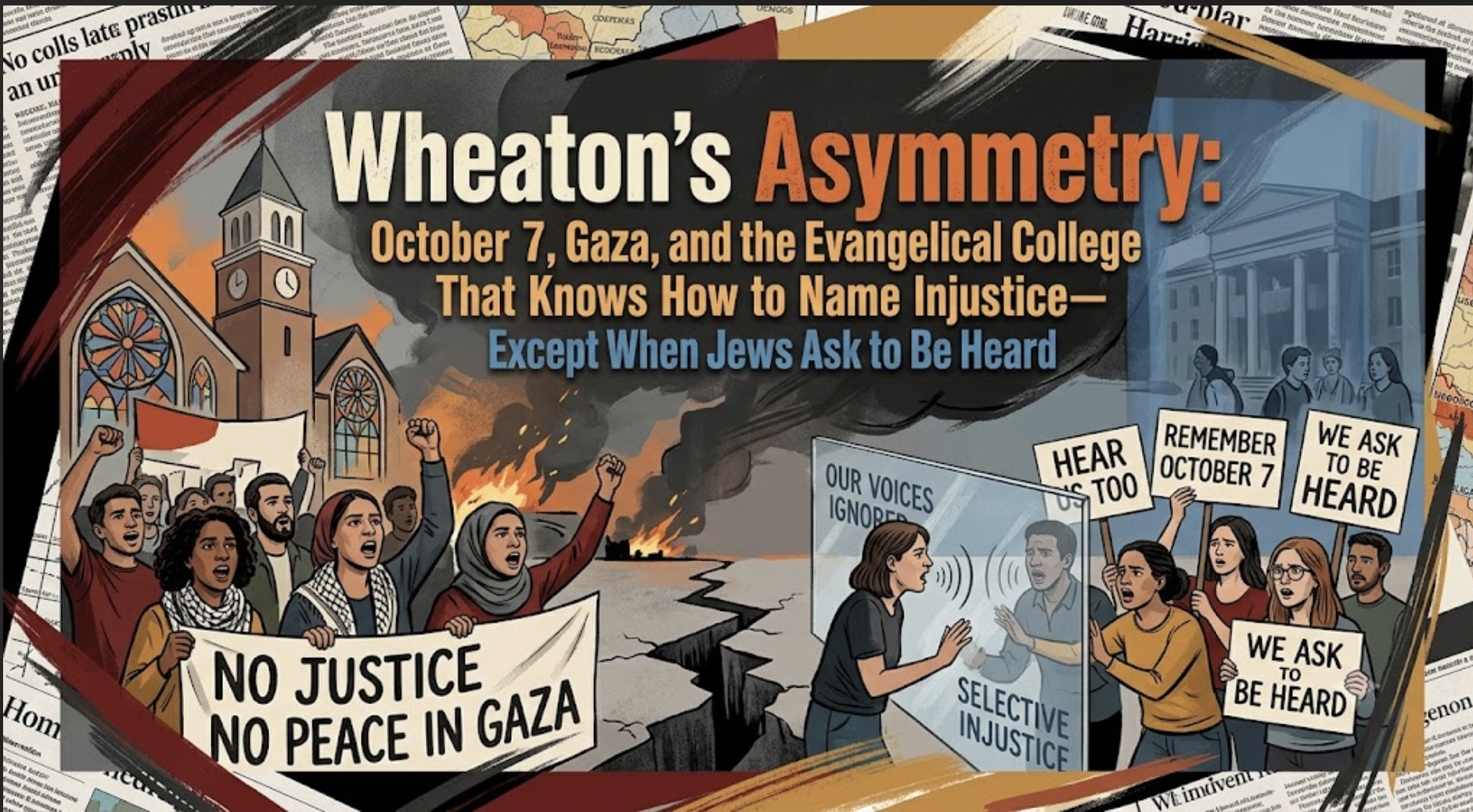
Image created from Google Gemini by Tim Orr
On the morning of March 27, 2024, students walking across Wheaton College’s Quad encountered pairs of shoes placed beside a pile of makeshift rubble and signs listing casualty counts from the Israel-Hamas war. The Wheaton Record described the display as “the first public, collective acknowledgement by Wheaton students or faculty of the casualties of the war in Gaza.” The memorial was organized by an unofficial student group, encouraged by faculty members, and carried what the Record called “the quiet support of the administration.”
That sentence is the beginning of the story.
The point is not that Gaza should not have been mourned. Christians should mourn dead children, displaced families, bombed homes, shattered churches, and the unbearable suffering of civilians. The point is the asymmetry. Five and a half months after October 7, the first public collective campus acknowledgment connected to the war was not a major institutional lament for the Jews murdered, raped, kidnapped, and traumatized by Hamas. It was a Gaza memorial.
The shoes were placed during Holy Week, a season of Christian lament. Faculty helped the students refine the language. The organizers met with Paul Chelsen, Wheaton’s vice president for student development, to review assembly policy. After that meeting and after facilities and campus safety were briefed, the memorial proceeded. In chapel, Chaplain Angulus Wilson mentioned the memorial and invited students to add pairs of shoes. A ministry associate in the chaplain’s office voiced lament for lives lost on both sides of the conflict.
Again, none of that is wrong in itself. It is good to mourn. But it reveals the moral order of visibility. At Wheaton, Gaza became visible on the Quad. Gaza entered chapel. Gaza became an invitation to embodied student participation. Jewish grief, by contrast, appears in the public record more cautiously, more narrowly, and less ceremonially.
That is Wheaton’s asymmetry.
The college knows how to name injustice
Wheaton is not an institution without a moral vocabulary. It knows how to speak. It knows how to repent. It knows how to connect Christian faith to public injustice.
In 2020, after the deaths of Breonna Taylor, Ahmaud Arbery, and George Floyd, Wheaton’s Senior Administrative Cabinet issued a message to the campus community. The cabinet said those deaths “speak to the enduring presence of systemic and institutional racism within our society.” It denounced “systemic racism and police brutality,” stood with African American students, faculty, and staff, and committed the college to identifying and addressing internal policies and systems that hinder marginalized and oppressed groups.
That statement matters because it shows what Wheaton sounds like when it is morally fluent. It can name victims. It can name structures. It can name the community most affected. It can connect a national crisis to the well-being of specific students, faculty, and staff. It can promise institutional self-examination.
Wheaton’s Christ-Centered Diversity Commitment is equally expansive. The college says diversity, inclusion, justice, and unity are central to fulfilling the Great Commission, the Greatest Commandments, and Wheaton’s mission. It acknowledges that its own priorities have not always sustained opposition to discrimination in policy and practice. It repents of racism, sexism, and “other divisive sins,” and pledges resources for underrepresented groups.
The college has also built an administrative structure to support that moral language. Wheaton’s Kingdom Diversity initiative says it exists to enhance belonging, deepen understanding, encourage prayer, and uplift the disadvantaged. Its Office of Intercultural Engagement coordinates with administration, faculty, staff, and students on policies and practices that foster Kingdom Diversity.
This is not thin rhetoric. Wheaton’s Kingdom Diversity Strategic Plan says its inaugural plan included 63 departments contributing 90 plans designed to model inclusive and equitable approaches to engagement, decision-making, and communication.
So the question is not whether Wheaton has the capacity to recognize vulnerable communities. It does.
The question is whether Jewish vulnerability after October 7 has been given the same moral intelligibility.
The policy explanation is not enough
Wheaton does have an institutional-statements policy that complicates the matter. Adopted on December 12, 2022, the policy says that, as a general rule, neither the President nor the Senior Administrative Cabinet will issue public statements on broad political, legal, or social issues or events. It also says Wheaton may still offer prayer, worship, encouragement, and care resources after distressing events.
That policy means one should not simply say, “Wheaton failed to issue an October 7 statement; therefore Wheaton is antisemitic.” That would be too easy and too careless.
But the policy does not settle the deeper question. The policy restricts formal institutional statements. It does not prevent chapel prayers. It does not prevent faculty-sponsored forums. It does not prevent public lament. It does not prevent a Quad memorial. It does not prevent departmental sponsorship. It does not prevent visible pastoral care for Jewish students, Israeli students, alumni, parents, or friends of the college.
Wheaton’s own statements page, as publicly visible, lists a January 31, 2024 response by Dr. Ryken to an online opinion piece and links to the institutional-statements policy. It does not display a comparable public statement naming October 7, Hamas, the hostages, Jewish students, Israeli victims, or antisemitism.
That absence, standing alone, is not proof of malice. But placed beside the visible institutional support for other forms of lament, it becomes evidence of a pattern: Wheaton has not been silent about everything. It has been selective in what becomes publicly mournable.
Gaza became a campus ritual
The March 2024 shoe memorial did not appear in isolation. The Record reported that the student organizers were inspired partly by a March 13 department-sponsored lecture by Daniel Bannoura, a Palestinian theologian, who “explained in strong terms the effects of the violence in Gaza” and condemned what he described as the white American church’s complicity in supporting Israel.
This is theologically significant. Gaza was not merely discussed as a humanitarian tragedy. It entered Wheaton’s campus through a familiar evangelical moral form: repentance for complicity. The American church was implicated. The suffering of Palestinians was framed as a Christian obligation. The shoe memorial then translated that obligation into public ritual.
The memorial did include both Israeli and Palestinian casualties. One organizer said the shoes were placed together to show that “life is life.” The students’ statement deplored atrocities, crimes, and violence perpetrated by both Israeli forces and Hamas with other Palestinian armed groups.
Yet the Record’s framing is still decisive: this was the first public collective acknowledgment of Gaza war casualties. Faculty encouraged it. Administration quietly supported it. Chapel mentioned it. Students were invited to participate physically.
This is what it looks like when Wheaton’s moral imagination activates.
The question is why October 7 did not produce an equivalent public ritual.
The Israeli witness was smaller, later, and framed as “another side”
Wheaton did host an Israeli speaker. On April 4, 2024, more than 40 students gathered in Blanchard Hall to hear Shai Nahon, a tourism business owner from Be’er Sheva and former IDF intelligence officer, share his experience of October 7. The event was hosted by Wheaton’s Center for Faith, Politics, and Economics and moderated by David Iglesias.
That event matters. It shows that Jewish and Israeli trauma were not totally excluded from campus. But the scale and framing matter too.
The Record reported that Iglesias said the event’s goal was to help students understand that “there’s always another side to the story.”
That phrase is revealing. Palestinian suffering came to campus as lament, repentance, and public ritual. Israeli suffering came as “another side.” Gaza was a moral claim. October 7 was a perspective.
Nahon’s testimony was not abstract. He described sirens, bomb shelters, shrapnel near his daughters’ school, and the way Jewish life is shaped by centuries of persecution. He told students that Israel represents for Jewish people a sacred place where they can be safe and Jewish, and that when this safety is stolen, it undermines what Israel is supposed to mean.
That should have been one of the central theological moments of Wheaton’s post-October 7 reckoning: a Jew explaining Israel not as an imperial abstraction, not as a political slogan, but as a place of refuge after millennia of Jewish vulnerability.
Yet the event drew more than 40 students in Blanchard Hall. Less than a year later, a Palestinian Christian theologian would fill a 500-seat auditorium.
Munther Isaac received the major platform
On March 24, 2025, Rev. Dr. Munther Isaac spoke at Wheaton on the theology of “sumud,” or steadfastness. According to the Record, Barrows Auditorium was standing room only. The room’s seating capacity was 500, and people stood along the entire back wall. The event was sponsored by HNGR, Biblical and Theological Studies, Peace and Conflict Studies, and the Jean Kvamme Distinguished Chair of Public Christianity.
The contrast is stark.
Shai Nahon’s October 7 testimony: more than 40 students, one center, Blanchard Hall, framed as another side.
Munther Isaac’s Palestinian Christian lecture: 500-seat auditorium, standing room only, multiple academic sponsors, theological framing, and institutional prestige.
Isaac’s message was not merely devotional. He said he was born into military occupation. He called the current war “a definitive genocide.” He said sumud stands against the Christian Zionism that many Palestinian Christians are used to hearing. He accused the Western church of failing to stand against violence and occupation in Palestine, and he said Western theology has dismissed and erased Palestinians.
Isaac did acknowledge Jewish religious and historical connection to the land. “No one denies that,” he said, according to the Record. But he rejected translating that connection into political arguments that displace Palestinians.
One can believe Isaac should have been allowed to speak. Academic seriousness requires hearing Palestinian Christians, especially at a Christian college. The issue is not permission. The issue is proportion.
Wheaton gave major public and departmental weight to a theological critique of Christian Zionism that described Gaza in genocide terms. Did it give comparable weight to Jewish accounts of October 7, Jewish peoplehood, Jewish fear, antisemitism, Israeli vulnerability, or the meaning of Zionism after the Holocaust?
The public record suggests no.
The pro-Israel response was reactive and marginal
The reaction to Isaac’s lecture illustrates the imbalance. Two days after the lecture, seven Wheaton community members and one Wheaton student protested on the public sidewalk in front of Billy Graham Hall. Their demonstration was not the main event; it was a response to the main event.
One protester said she was grieved by Isaac saying Israel was committing genocide and by the hundreds of people in attendance. A Wheaton graduate student, Dillon Moran, pointed to a December 2024 “Dialogue for Peace” event featuring Messianic Judaism advocate Daniel Juster and said it received less attention than Isaac’s lecture. “Wheaton has this tendency of giving a big platform to certain things,” Moran told the Record. “This is a tough discussion, and we don’t think it’s being well had.”
That is one person’s statement, not a final verdict. But it names the pattern visible in the record: the Palestinian Christian critique receives the auditorium; the pro-Israel response receives the sidewalk.
The official web ecosystem carries the same emphasis
The pattern also appears in Wheaton’s official web ecosystem. In a Stott Fellows reflection hosted on Wheaton’s site, Dr. Jamie Goodwin writes about a peacebuilding summit and asks what it would take to bring real change in the “Palestinian crisis.” She describes reading Munther Isaac’s *Christ in the Rubble* and Kairos South Africa documents, and says summit participants were seeking to “end this injustice in Palestine.”
That language is not, by itself, illegitimate. It may be morally serious. It may be faithful. But it is another instance of Wheaton’s official platforms giving coherent theological and institutional space to Palestinian suffering as injustice.
Where is the equally developed official language for Jewish fear after October 7? Where is the comparable framework for Jewish peoplehood, Jewish indigeneity, Jewish historical trauma, Jewish attachment to land, Jewish students’ vulnerability, or antisemitism as a live campus concern rather than a historical lesson?
This is the asymmetry: Palestinian suffering is interpreted through justice. Jewish suffering is more often routed through complexity.
This is not about silencing criticism of Israel
A serious argument must be clear: criticism of Israel is not automatically antisemitic. The International Holocaust Remembrance Alliance’s working definition says criticism of Israel comparable to criticism of any other country should not be regarded as antisemitic. The Nexus Document likewise distinguishes criticism of Israel from antisemitism, while also recognizing that antisemitism can include systemic conditions that impede Jews from participating as equals.
That distinction matters. Wheaton students and faculty should be free to criticize Israeli policy, mourn Palestinians, challenge Christian Zionism, and listen to Palestinian Christians. None of that is the problem.
The problem is double recognition.
When Palestinians suffer, does Wheaton know how to lament? Yes.
When African Americans suffer racial violence, does Wheaton know how to name systemic injustice, identify the wounded community, and examine itself? Yes.
When diversity, belonging, and justice are at stake, does Wheaton know how to build institutional architecture, strategic plans, offices, and campus-wide commitments? Yes.
When Jews suffer the deadliest day since the Holocaust, does Wheaton know how to make Jewish pain visible with the same institutional confidence?
That is the question the evidence raises.
The article’s charge
The charge is not that Wheaton mourned Gaza. The charge is that Wheaton appears to have mourned Gaza more visibly, more collectively, more institutionally, and more theologically than it mourned October 7.
The charge is not that Munther Isaac spoke. The charge is that his critique received a major, multi-sponsor, standing-room-only platform while Israeli and pro-Jewish perspectives appear comparatively smaller, later, and reactive.
The charge is not that Wheaton has no language opposing antisemitism. The charge is that its opposition to antisemitism appears less institutionally operative when the subject is not Holocaust memory in Europe but Jewish vulnerability in the present, bound up with Israel after October 7.
The charge, therefore, is not explicit antisemitism. It is moral asymmetry.
But moral asymmetry never remains morally neutral. Institutions teach long before they intend to. They teach by what they celebrate, what they lament, what they platform, and what they leave largely unspoken. When an institution consistently recognizes one people’s suffering more readily than another’s, it forms the moral instincts of those who pass through it. Students learn which victims fit the institution’s moral imagination and which do not.
That is why this matters beyond Wheaton. The questions raised by Jews, Israel, and antisemitism are becoming more difficult, not less. Across universities, churches, and public life, debates about Israel increasingly shape the way many people think about Jews as well. Not every criticism of Israel is antisemitic, and serious criticism of any government is both legitimate and necessary. But history also shows that hostility toward Israel can, in some settings, become a vehicle for much older assumptions about Jewish power, Jewish identity, and Jewish legitimacy. Institutions that lack moral clarity when those patterns first appear rarely discover greater courage once the pressure increases.
If Wheaton cannot speak with equal moral clarity about Jewish suffering today, it is difficult to believe it will possess the institutional fortitude to resist those pressures tomorrow. An institution that hesitates to recognize moral asymmetry while it is still subtle will find it far more difficult to oppose antisemitism when it becomes more explicit.
The people most affected by this will not be faculty members or administrators. They will be Wheaton’s students. Young Christians trying to think faithfully about Jews, Israel, the Palestinians, justice, nationalism, and Christian responsibility deserve more than uncertainty on questions of moral importance. Students deserve more than uncertainty about these questions. They need help learning the difference between criticizing the actions of a government and developing prejudice toward an entire people. They also need to understand that compassion for Palestinians should never come at the expense of compassion for Jews. A Christian commitment to justice calls for both. Without that kind of moral guidance, students may leave with more than unanswered questions. They may develop habits of judgment that make today’s forms of antisemitism much harder to recognize.
That is why this matters. Few people become prejudiced all at once. More often, it begins with patterns of sympathy that slowly become uneven. Over time, those habits shape what we notice, whose suffering moves us most quickly, and whose suffering gradually fades into the background.
That was Wheaton’s real test after October 7. The question was never whether the college could denounce hatred in the abstract. It was whether it could recognize Jewish suffering with the same moral clarity, urgency, and compassion it has shown toward other communities experiencing profound loss.
On the public evidence, that test remains unfinished.
Endnotes
- Helen Huiskes, “Students Display Shoes on the Quad as Memorial for Gaza War Losses,” The Wheaton Record, March 29, 2024, https://thewheatonrecord.com/2024/03/29/students-display-shoes-on-the-quad-as-memorial-for-gaza-losses/.
- Wheaton College Senior Administrative Cabinet, “A Message to Campus from Wheaton’s Senior Administrative Cabinet,” Wheaton Magazine, Autumn 2020, https://www.wheaton.edu/magazine/autumn-2020/a-message-to-campus/.
- Wheaton College, “Christ-Centered Diversity Commitment,” accessed June 27, 2026, https://www.wheaton.edu/life-at-wheaton/kingdom-diversity/diversity-commitment.
- Wheaton College, “Kingdom Diversity,” accessed June 27, 2026, https://www.wheaton.edu/life-at-wheaton/kingdom-diversity.
- Wheaton College, “Wheaton College Kingdom Diversity Strategic Plan,” accessed June 27, 2026, https://www.wheaton.edu/life-at-wheaton/kingdom-diversity/diversity-strategic-plan.
- Wheaton College, “Institutional Statements General Policy,” accessed June 27, 2026, https://www.wheaton.edu/about-wheaton/disclosures/institutional-statements-general-policy.
- Wheaton College, “Statements,” accessed June 27, 2026, https://www.wheaton.edu/news/statements.
- Noelle Worley, “Israeli Guest Speaker Shares Perspective of Oct. 7 to Mixed but Respectful Response,” The Wheaton Record, April 19, 2024, https://thewheatonrecord.com/2024/04/19/israeli-guest-speaker-shares-perspective-of-oct-7-to-mixed-but-respectful-response/.
- Orli Strickman and Noelle Worley, “Rev. Dr. Munther Isaac Discusses Theology of ‘Sumud,’” The Wheaton Record, March 28, 2025, https://thewheatonrecord.com/2025/03/28/theology-of-sumud/.
- Kara Grace Hess and Grant Dutro, “Wheaton Professor Prays with Pro-Israel Demonstrators,” The Wheaton Record, March 28, 2025, https://thewheatonrecord.com/2025/03/28/pro-israel-demonstrators/.
- Jamie Goodwin, “Stott Fellows Reflection,” Wheaton College, accessed June 27, 2026, https://www.wheaton.edu/academics/academic-centers/human-needs-and-global-resources-hngr/hngr-programs/stott-endowment-initiatives/stott-fellows/stott-fellows-participant-reflections/dr-jamie-goodwin/.
- International Holocaust Remembrance Alliance, “Working Definition of Antisemitism,” adopted May 26, 2016, https://holocaustremembrance.com/resources/working-definition-antisemitism; Nexus Project, “The Nexus Document: Understanding Antisemitism at Its Nexus with Israel and Zionism,” updated June 2024, https://nexusproject.us/nexus-resources/the-nexus-document/.
Related Topics