
Wheelchair Driving – Not So Easy!!!
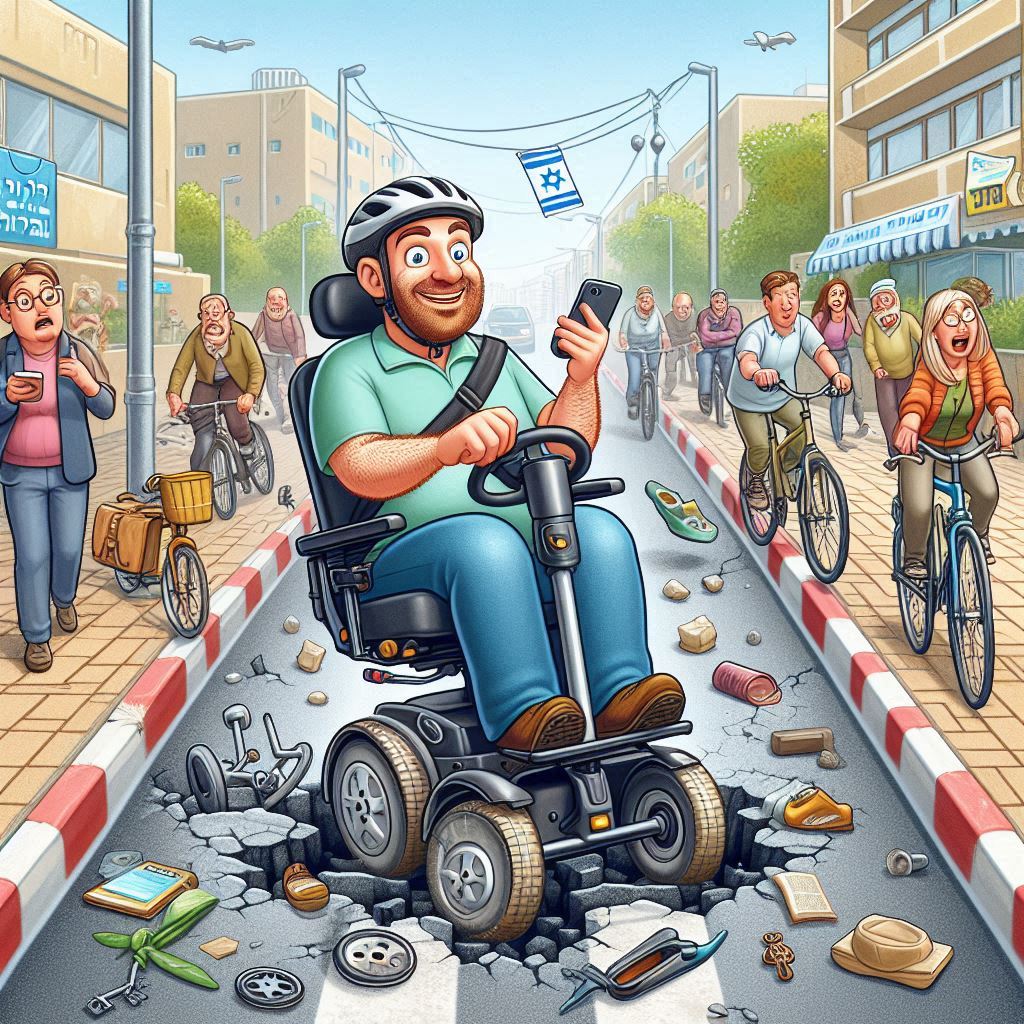
As half of Israel heads for their synagogue and half for a bicycle, my contribution is to another new joy of my life: driving on Israel’s streets with an electric wheelchair. To all the cyclists – take care, as I’ve learned that driving a non-car is not so simple. Same to all those walking or indeed also wheelchairing to the synagogue – myself included. Gemar Chatima Tovah to all.
Having driven Israel’s roads for years, taken a Ferrari through the Italian countryside at insane speeds, and blasted down the Autobahn at over 240 km/h, I figured driving an electric wheelchair would be a piece of cake.
Well… it’s a pretty tough piece of a pretty tough cake.
Turns out, the driver (me), the sidewalks, and other road users all make it a precarious act. I have huge respect for those other wheelchair drivers out there, navigating what’s often more obstacle course than open road.
Driver Error
As a long-time car driver, I’d mastered the art of blaming the other guy. 99.5% of crashes are someone else’s fault, right? But in a wheelchair? It’s almost always me. No one else to point the finger at, unless I start blaming imaginary pedestrians.
My new wheels (plural – I’ve got a heavy-duty one and a lightweight one) came with zero lessons, zero tips. I assumed it’d be easy. Spoiler: it’s not. Here’s why:
• No mirrors, no lights, no reverse sensors. Just me and my joystick skills. Joysticks were for video games where I always crashed going too fast around corners. That hasn’t changed, except now, the consequences are a bit more… concrete.
• Gravity and the power-to-weight ratio. I used to roll my eyes at race drivers droning on about this. Now I get it. At 6’5″ and well over 100kg, going downhill turns me into a runaway missile. Uphill? A tortoise on tranquilizers could lap me.
• No glove compartment. Wheelchair designers seem to think we don’t carry stuff. No spot for a cane, phone, keys, nothing. Try driving one-handed while juggling your essentials. It’s like driving a car during a conference call, dodging traffic, and checking Waze. Impossible.
• Then there’s me – impatient and stubborn as they come. My first drive was straight out of the shop. Assuming the ramp at a mobility store would be top-notch, I went full speed. Nearly flipped the chair. Stellar start!
The Highway (aka The Sidewalk)
Us ex-Brits call the sidewalk the pavement, from the Latin pavimentum, dating back to the 13th century. Fitting, because some of these sidewalks look like they haven’t been touched since then.
Take today, for example. “Driving” through the town where my mother and sister live, I crashed three times:
1. Zebra (pedestrian) crossing disaster. The lip on the other side was too high. My phone and keys flew like confetti, and drivers waited patiently while I scrambled to collect them. People here are less likely to honk at a wheelchair user.
2. No exit strategy. The pavement just… ended with the mere hint of a lip. I took a leap of faith in my ultra-light 14kg chair. It stayed upright. Barely.
3. Surprise pothole. Probably left by cable or fiber work. A car wouldn’t notice it. My wheelchair? Nearly swallowed me whole. It would do a pedestrian’s ankle damage too.
In my small town, some of the sidewalks are so bad I often risk the road. In towns? Not an option.
Advanced Driver Challenges
For car drivers, this means off-road tracks or high-speed country roads. For wheelchair users? It’s supermarket aisles with abandoned trolleys or the dreaded 360-degree turn in disabled toilets – 12 turns, outrageous noise, and zero subtlety. That maneuver requires finesse I’m still unlocking.
Other Road Users
Most people are amazing – helpful, patient, kind. But there are always a few who don’t get it. Parking on the one ramp to a restaurant or blocking a path “just for a moment” assumes I can glide around like a spaceship. Spoiler: I can’t.
Not a Joke
I keep my sense of humor because the alternative is rage or despair. But let’s be real: it’s not funny. Israel needs a serious accessibility upgrade. Sidewalks shouldn’t double as obstacle courses. A little more thought could make a big difference. And new wheelchair users? We’d benefit from some basic training.
Also, the seatbelt. I am skeptical as I think it might squash me in a crash, but after a few near-misses, I’ve started to consider using it. Safety first, right? I will have to tell myself a few more times.
Tips for New Wheelchair Drivers
If you’re just starting out, or think it’ll be a breeze, here are hard-earned tips from someone who’s crashed, cursed, and carried on. I ignored most of these at first. Don’t make my mistakes:
1. Practice in a safe space first
Find somewhere to practice and get a feel for your chair. Learn how it turns, stops, and handles slight slopes before hitting the streets.
2. Master the joystick
It’s sensitive. Small movements go a long way; sudden jerks send you into walls or pedestrians. Practice smooth control.
3. Plan your route
Not all sidewalks are equal. Some are like off-road trails. Check your destination’s accessibility. Try to have a backup route.
4. Carry essentials smartly
Get a small bag that clips to your chair or a small rucksack. I am going to use a crossbody bag for my phone, keys, etc. One-handed driving while juggling stuff is a disaster waiting to happen.
5. Watch for pavement traps
Cracks, potholes, sudden drops – these are your enemies. What’s a minor bump to a pedestrian can be a crash landing for you. Go slow and scan ahead.
6. Practice tight turns
Disabled toilets and narrow shop aisles are not so easy. Master the 3-point pivot (or 9-point) in a safe space first.
7. Don’t be afraid to ask for help
Most people are kind. If you’re stuck, ask. It’s better than tipping over or getting wedged between a bin and a bench.
8. Stay calm and laugh when you can
You’ll crash. You’ll get stuck. You’ll curse curbs. Keep your sense of humor – it’s half the battle. The other half is not giving up.
Using a wheelchair because I can no longer walk meaningful distances or balance has opened new experiences I wouldn’t wish on anyone. But it’s given me huge freedom, and for that, I’m grateful. A few improvements would really help so this is my shout out.
I wish all as positive a year to come as possible in trying times and hope Yom Kippur is meaningful each in their own way – two, four or no wheels.