When a $190M Van Gogh Becomes a Remnant
We usually relate to paintings through what they show. What is painted, and how: the subject, the composition, the brushwork, the color. When we say we know a Van Gogh, we mean we know what it looks like. We have seen the swirling skies and thick yellows in museums, in books, on screens. Even standing before the original, what we look at is the image. It is as if the image rose above the material it was laid on, as if canvas and paint were only the vehicle that carried it to us. But an object can carry a history that nothing in its image shows.
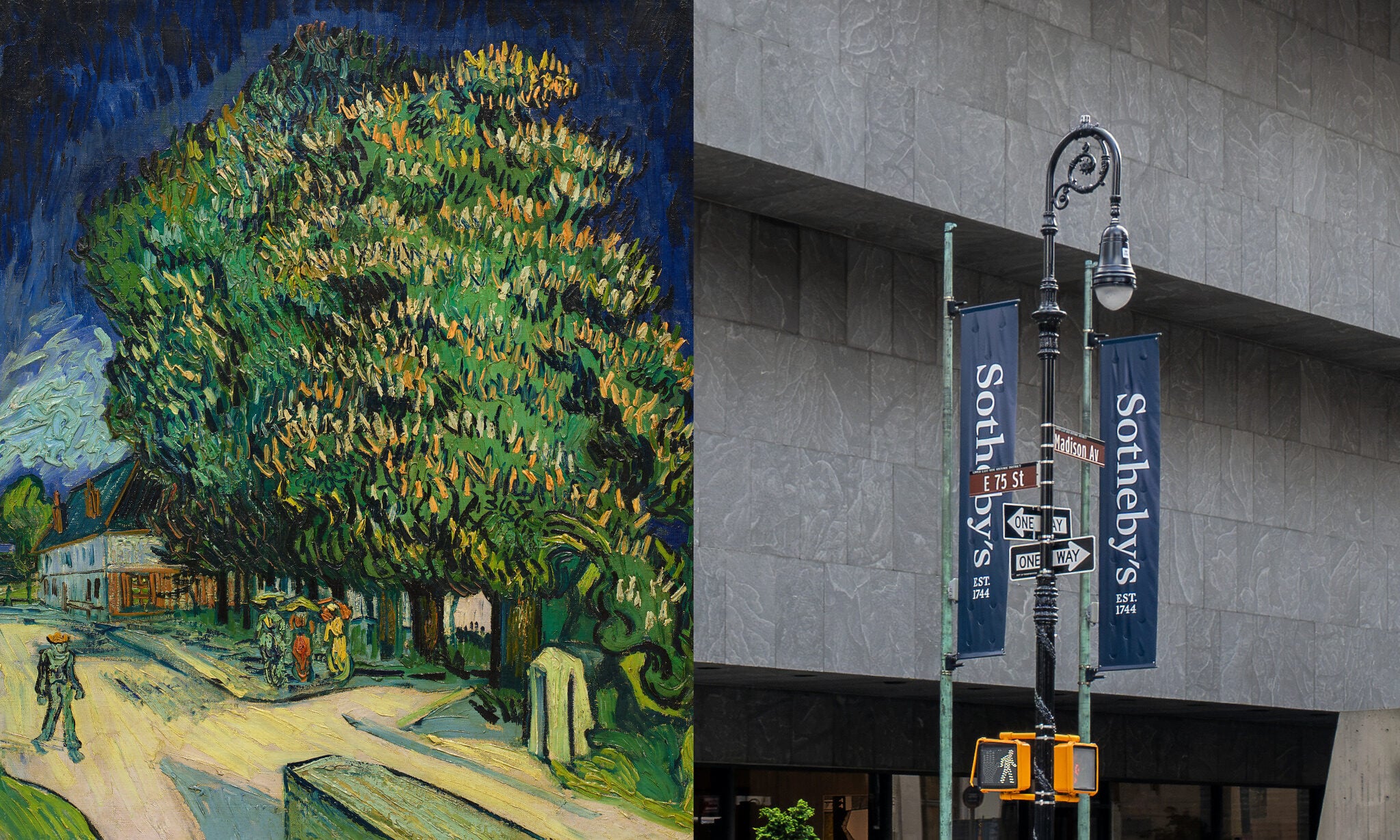
That is the case of Blossoming Chestnut Trees, the painting by Vincent van Gogh that sold in New York on November 18 for $190.4 million, a record for the artist. It was painted in May 1890 in Auvers-sur-Oise, two months before his death. A mass of chestnut trees in full bloom fills most of the canvas, their pink and white blossoms laid on in thick strokes against a deep blue sky. Beneath them, in the shade, are three women with parasols. At the left, a white house sits beside a pale yellow road, along which a man in a straw hat walks toward us.
It had belonged to Samuel Fischer, the Jewish publisher in Berlin who brought Thomas Mann and Hermann Hesse to German readers. After his death in 1934, as the Nazis banned his authors, his daughter and son-in-law moved the publishing house to Vienna. In June 1936, a few months after they left Berlin, the painting was sold through an Amsterdam gallery. Two years later they fled again, and the Gestapo seized what was left of their collection. Before the auction, the heirs argued that the painting had left the family under Nazi persecution; Sotheby’s said it had found no evidence of duress, and the two sides settled the day before the sale. The claim was not about what the painting shows, but about what happened to it.
The 1936 sale came years before the deportations. But the dispossession of German Jews was where the Holocaust began, and its memory reaches back to what was lost then. That memory does not live mainly in images; it lives in objects. Museums of the Holocaust are full of suitcases with names painted on them, shoes, eyeglasses. None of them is beautiful. Their power lies in the fact that they are the actual things. A photograph of the suitcase is a document. The suitcase itself is a remnant.
Walter Benjamin, the German Jewish critic who fled the Nazis and died in 1940, called what a copy cannot transmit the aura: the original’s unique presence in time and space, including everything it has undergone. The suitcase in the museum has an aura too, but not because of art, and not because of the hand that made it. Its aura comes from its history: from what happened to the people who carried it. Call it an aura of memory. Blossoming Chestnut Trees carries both. Its aura of art lies in what is painted; its aura of memory lies in what happened to the object. It is a masterpiece to the world and a remnant to a family, and neither can stand in for the other.
Gustav Klimt’s Portrait of Adele Bloch-Bauer I is the familiar version of this. Seized by the Nazis in Vienna in 1938, it was recovered in 2006 by Adele’s niece, Maria Altmann, after years of litigation. The world saw a masterpiece. Altmann saw a portrait of her aunt that had hung in the family home.
The Van Gogh is the harder case. There is no aunt in the picture, no face to carry the memory into the image. The women under the chestnut trees are strangers. What makes the painting a remnant lies outside what is painted, in the history of the object itself.
That history does not show itself. It surfaces only at the moments when the object changes hands. That is why the Fischer claim appeared on the eve of the auction, at the very moment the painting was more visible than it had been in half a century. The most commercial moment in the painting’s life was also the moment the family’s story returned to it. And that story is fragile in a way the suitcase’s is not. In a Holocaust museum, the place itself tells the suitcase’s story. The Van Gogh hangs in auction rooms and galleries, where everything around it says masterpiece.
The market is not blind to any of this. It prices provenance, and the settlement with the heirs was part of what cleared the way for the sale. But the market cannot put a figure on what that history means to the people the object belonged to. That is the part of the painting no one can buy. It travelled with the canvas to its new owner all the same, just as it travels with Adele’s portrait, wherever it hangs.
We are used to thinking that remnants are found: a suitcase in a camp, a pair of shoes. But nothing looks like a remnant on its own. An object becomes one when memory insists on its history, as the Fischer heirs did before the auction, and as the settlement did when it acknowledged their family’s suffering. Nothing in Blossoming Chestnut Trees points to Berlin, to Vienna or to 1936. Unless someone says what it is, every viewer will see only a masterpiece.