Bridging faith. Defending truth. Confronting hate
When a Debate at Oxford About Islam Requires a Security Detail
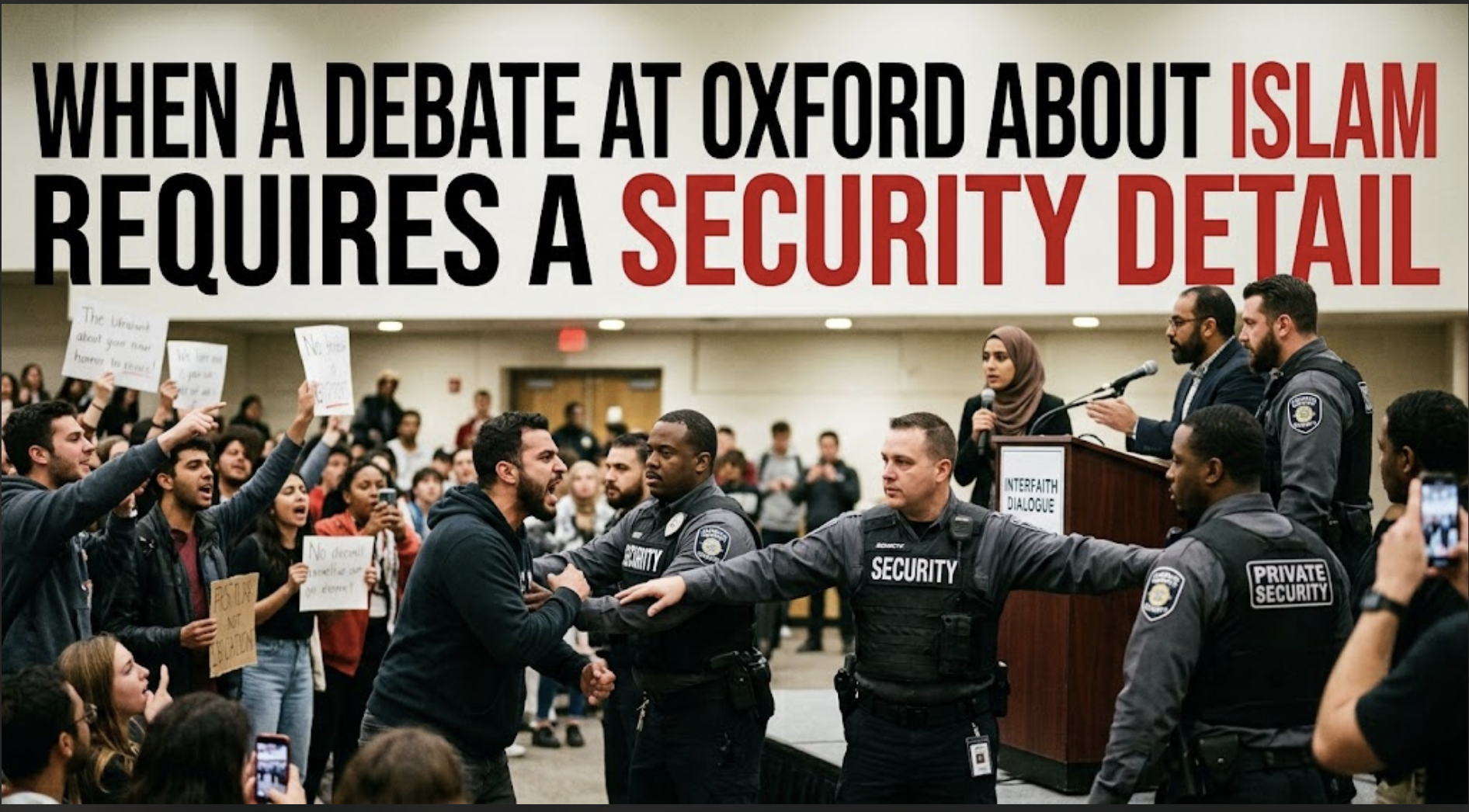
Image created from Google Gemini by Tim Orr
Perhaps the greatest irony of the Oxford Union debate about the motion “This House Believes the West Is Right to Be Suspicious of Islam” was too big to miss. The debate over whether Islam poses legitimate concerns for Western societies reportedly required an unprecedented security effort to occur. Police cordons and teams of private security were needed to separate the debaters and attendees of the event from protesters outside the building.
Of course, this doesn’t prove the motion. And the protest behavior outside should not be considered reflective of Islam’s nearly two billion adherents worldwide. But the security context surrounding this debate is not irrelevant, either. When hundreds of police officers are needed to provide intellectual security, the security presence itself becomes part of the problem to be analyzed. It’s not evidence for what all or most Muslims believe; it is evidence of the conditions under which Islam can currently be discussed in Western liberal democracies, including the opposition to such discussions by Muslims themselves.
On June 17, 2026, officers formed police cordons and hired private security officers to ensure the safety of debate participants. The situation dissolved into such a level of conflict that it became difficult for people to enter or leave the Oxford Union without facing confrontation. The cost of police operations reportedly reached £100,000 ($155,000).
The troublesome part of the need for such security for an event like this is that there was a strong move by some Muslims to ensure that this topic should not be debated. This can become a piece of evidence for some that proves the motion. But a liberal society ensures that a debate like this should take place because the free expression of ideas should be discussed in the marketplace. The question then is whether those demonstrating outside reveal something about Islam.
The larger issue may not be suspicion toward Muslims, but whether Western institutions have the confidence to study Islam with the same openness they would apply to Christianity, Judaism, patriarchy, liberalism, socialism or any other belief system that structures human lives. Asking questions about Islam is important precisely because Islam is not monolithic. It has inspired holy texts, a history of theological debates, a division of denominations such as Sunnis and Shia, composed of reformists and conservatives, different schools of Islamic law, and political Islamist movements that want to dominate the state. Serious examination of those traditions also demands serious distinctions.
Not every conservative Muslim has the same political outlook as al-Qaida. Muslims can be the targets of Islamist terrorism too. But intellectual honesty in the other direction is required as well: just because Muslims should not be collectively blamed for terrorism does not mean we can never question how certain Islamic teachings have been used to justify violence.
If police cordons become necessary to allow people to enter a building to hear debates about religion, the debate is no longer purely about theology. It is about the future of liberalism. Freedom of speech exists only in the most formal sense if individuals know discussing certain topics will predictably require extraordinary security. Free speech protects a right to say whatever you want, but it is a radically different right when what you want to say means you also need police protection.
Adding to the controversy, Oxford Union trustee Jonathan Sacerdoti said on Twitter that when the event concluded, the Union told him footage would be released “sometime within the next 2 weeks.” It took over six weeks for full speech transcripts to be released. In that time, the Union allegedly uploaded footage to a third-party site where it appeared in a brief edited video Sacerdoti says misrepresented the event. Sacerdoti released his own audio recording of the event, after which the Union promptly released transcripts of the speeches hours later, according to Sacerdoti. He also alleged that the Oxford Union refused to publish remarks by one Muslim student who argued in favor of the motion and discussed personal experiences with violence at certain mosques in Britain. Sacerdoti posted a recording of that student’s full speech as well.
Some of the most courageous critics of Islamist thought have been Muslim commentators, including reformers, dissidents, journalists, women’s-rights activists, converts from Islamism, and ordinary Muslims criticizing extremist readings of their religion. When people portray criticism of Islamic beliefs as intrinsically hostile to Muslims, they risk chilling criticism from the very Muslims whose voices ought to be heard the loudest. The line that matters, in other words, is not between people who criticize Islam and people who respect Muslims. Respect should never be mistaken for immunity from criticism. A pluralist society shouldn’t need to mute its own citizens in order to show respect for Muslims either.
However, we shouldn’t romanticize the category of “Muslim dissident” itself. Muslim opponents of Islamism have views towards Gaza/Israel/Zionism/Palestinian resistance that align significantly with themes found in Muslim Brotherhood political rhetoric for decades—even as they distance themselves from the Brotherhood or other forms of political Islam. That’s why we can’t categorically separate Muslim thinkers into “moderates” vs. “Islamists.” One can be critical of clerics/jihadist violence/women’s rights and wholeheartedly accept the political storyline being pushed about Israel that’s based on the same ideological assumptions that Islamists operate under. This isn’t to single out Muslim reformers and say they’re bad—simply to hold them to the same standard this article is trying to establish: don’t give anyone a free pass just because they’re considered a dissenter.
Which leads me to the still-more-profound irony behind what occurred at Oxford. One argument Aisha Khan Aziz reportedly made during the debate was that Tommy Robinson was being owed special protection against the hostile crowd outside by virtue of his inclusion in an event hosted by a Muslim Palestinian president and a mostly South Asian executive committee. Aziz reportedly said that without those people watching his back, Robinson “would literally be cooked.” Sacerdoti read this as tantamount to yelling “fire” in a crowded theater. He interpreted it as tacit blackmail: you owe Robinson an apology for criticizing Islam only because the Muslims inside are restraining other Muslims outside who might hurt him if given the opportunity. Whether or not Aziz intended this inference, the logic underlying her remark deserves commentary of its own. The deeper liberal conviction is that no one should need bodyguards just for speaking at a debate.
So the solution to Oxford is not suspicion of Muslims. It’s remembering that one of liberalism’s oldest principles seems to have been forgotten: people deserve protection; ideas deserve criticism. We should never require all Muslims to police the thoughts of extremists who claim to speak on their behalf. But we can and should insist that Islamic scriptures, doctrines, institutions, political movements, and interpretations remain fair game for critique. Likewise, protestors have every right to loudly denounce speakers they find bigoted. But they don’t have the rest to use their rights to promote fear of debate, nor incite violence. Neither fear nor respect should put citizens in that position.
Sources
Cook, David. Understanding Jihad. Berkeley: University of California Press, 2005.
Oxford City Council. “Statement on the Oxford Union Invitation to Tommy Robinson.” 2026. https://www.oxford.gov.uk/news/article/1857/statement-on-the-oxford-union-invitation-to-tommy-robinson.
OxfordUnion. “THB the West Is Right to Be Suspicious of Islam—Full Debate.” YouTube video. 2026.
Pew Research Center. “The World’s Muslims: Unity and Diversity.” August 9, 2012. https://www.pewresearch.org/religion/2012/08/09/the-worlds-muslims-unity-and-diversity-executive-summary/.
Sacerdoti, Jonathan. “Public Posts and Commentary Concerning the Oxford Union Debate.” 2026. YouTube. https://www.youtube.com/user/MrJonsac.
“Tommy Robinson’s Invitation to Oxford Union Met with Protest: Live Updates.” Cherwell, June 17, 2026. https://www.cherwell.org/2026/06/17/union-west-is-right-to-be-suspicious-of-islam-debate/.
“Tommy Robinson Apologises to Muslim Student over Oxford Union Islam Debate.” The Independent, 2026. https://www.the-independent.com/news/uk/home-news/tommy-robinson-apology-muslim-student-oxford-union-islam-debate-b3028577.html.
Related Topics