
When Academic Boycotts Target Jewish Culture
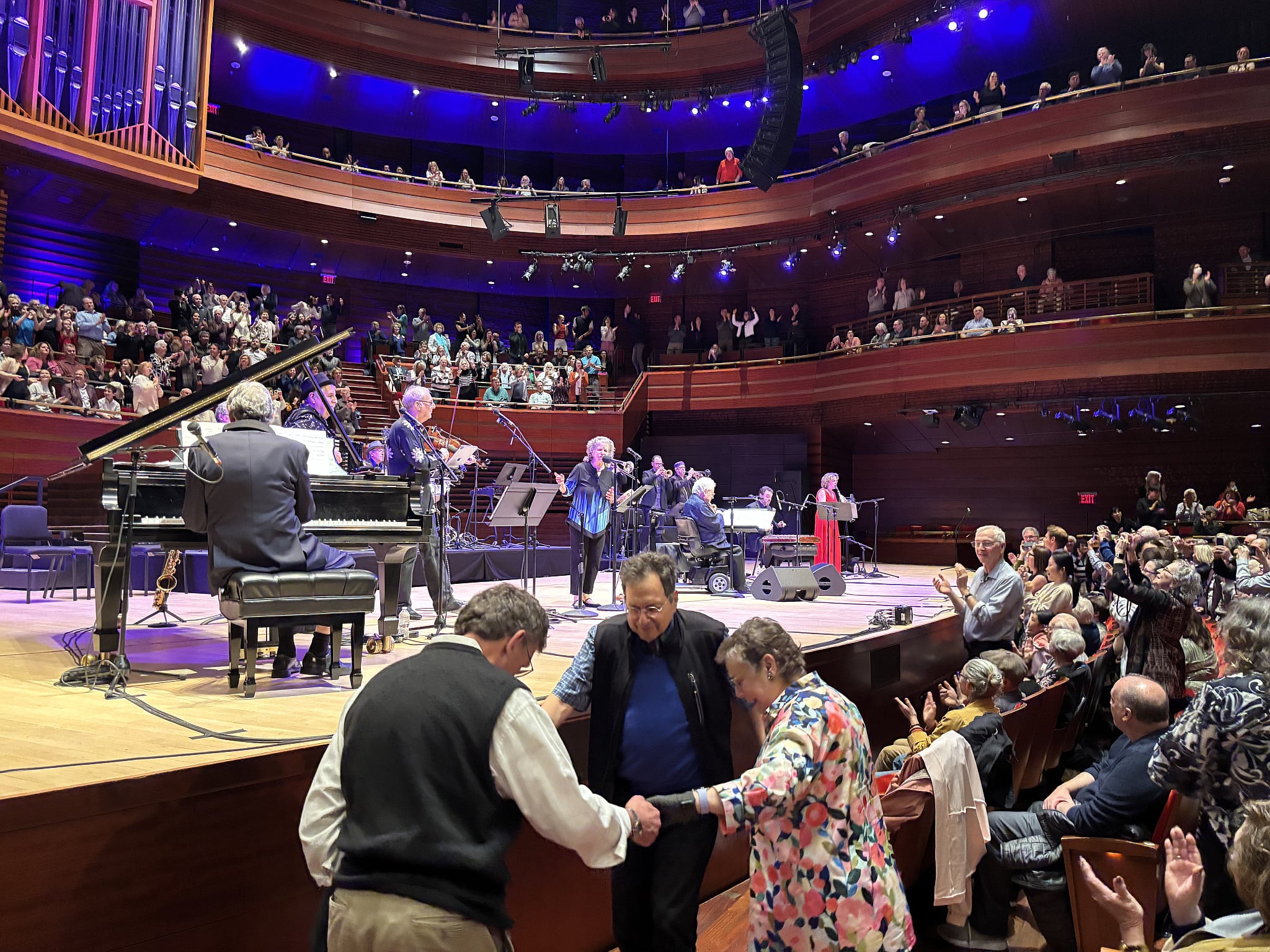
When I was 8 years old, I asked for tickets to see Itzhak Perlman perform with the Philadelphia Orchestra. My parents, who were never fans of classical music, took me to see the Israeli-American violin virtuoso and politely tolerated the concert while their young daughter was spellbound, swept away by the music. Several years later, I learned of another Perlman concert in Philadelphia. Unable to convince my parents to allow me to miss school to attend, I lay under my duvet, listening on my clock radio as a performance from his In the Fiddler’s House tour was broadcast. I remember the commentator describing people dancing in the aisles and the feeling of breathtaking awe I experienced at the music filling my childhood bedroom.
By the mid-1990s, Perlman’s In the Fiddler’s House, brought together a collaboration of leading musicians to bring klezmer, Eastern European Jewish heritage music, to wider audiences. Though not trained as a klezmer violinist, his involvement helped amplify a revival already underway since the 1970s, driven by community-based performers and scholars. The project—documented in a 1995 PBS special and album—was distinct from his classical work: ensemble-driven, participatory, and rooted in Jewish tradition. Touring with groups such as Brave Old World, The Klezmatics, and The Klezmer Conservatory Band, Perlman helped introduce klezmer to audiences who might not otherwise have encountered it.
For his 80th birthday in 2026, Perlman revived this landmark project in a tour which brought In the Fiddler’s House back to the stage. I drove from southern Virginia to Philadelphia to attend. No longer an introduction, the performance was a celebration of the klezmer revival, of Jewish musical life, and of a tradition that had not only endured but flourished.
Despite orchestral playing into adulthood, I never made a true career of music. The little girl who once sat spellbound in that concert hall, instead, grew up to become a Jewish folklorist. Folklore is the study of tradition—stories, music, rituals, customs, and everyday practices—and how communities create, sustain, and transmit meaning across generations. In addition to my own scholarship and teaching on Jewish folklore, I also proudly serve as the co-chair of the American Folklore Society’s Jewish Folklore and Ethnology Section and as an associate editor of the academic journal Jewish Folklore and Ethnology. My work, like that of my colleagues, depends on engagement with communities, with archives, and with scholars across borders.
It is precisely that kind of engagement that is now under threat.
Within folkloristics, ethnomusicology examines music as a form of cultural knowledge and expression, a way of understanding identity, history, and society. Recently, the group Music Scholars for Palestine has pushed for the Society of Ethnomusicology (SEM) to adopt a resolution aligned with the Palestinian Campaign for the Academic and Cultural Boycott of Israel (BDS). They call for a boycott of Israeli academic institutions, alongside divestment measures, political alignment, and educational commitments, arguing that such actions are necessary ethical responses to state structures. In response, the Jewish Music Special Interest Group (SIG) of SEM has raised concerns that the proposal effectively silences and excludes Israeli scholars, harms ethnomusicology as a field, and undermines cross-cultural collaboration, academic freedom, and the open exchange of ideas.
This debate is not new. Academic associations across disciplines have wrestled with similar measures. The American Studies Association adopted a boycott in 2013; the National Women’s Studies Association voted to divest in 2015; the American Anthropological Association followed in 2023; others, like the Modern Language Association and the American Sociological Association, have stalled such efforts. Across these cases, one pattern is clear: these votes are not simply about policy, but about the nature and contributions of academic societies.
The targeted boycotts of Israeli institutions, scholars, and research blur the line between critique and exclusion. Rather than protecting free inquiry, they reflect double standards and pre-determine political conclusions that shape research. They exclude Israeli, and often Jewish, scholars from participation, deepen polarization, and inhibit the exchange of ideas. At their core, they force a fundamental question: should academic communities function as sites of political enforcement, or as spaces of open, pluralistic engagement that allow for thoughtful disagreement?
Framed as anti-Zionism, these measures nonetheless reproduce a familiar antisemitic pattern: the isolation of Jews and Jewish culture as categories within intellectual life. As cultural historian Sander Gilman has shown, antisemitic discourse has long defined Jews as lacking authentic cultural or artistic capacity, a tradition in which “the stereotypical Jew is denied any special relationship to…music,” forcing Jews to prove participation in “high culture” in order to be considered fully civilized. Today’s exclusions invert that logic but reproduce its structure: Jewish and Israeli cultural production is no longer dismissed as absent, but treated as suspect, illegitimate, or uniquely subject to removal. When only one national or cultural group is subjected to collective exclusion, the result is not simply political critique; rather, it is the reemergence of institutionalized antisemitism.
Increasingly, this exclusion also operates through what has come to be called shadow boycotts. Israeli affiliations are quietly removed from conference programs, scholars are disinvited without explanations, collaborations are avoided without formal policy. These practices are not incidental—they are strategic. By avoiding formal declarations, they evade scrutiny while producing the same result: the quiet removal of Israeli, and often non-Israeli Jewish, presence from academic and cultural life. Such tactics have clear historical precedents. They recall earlier covenants of exclusion, mechanisms designed not to debate Jewish participation but to render it invisible.
The effects do not stop at Israeli institutions. American scholars, Jewish and non-Jewish alike, whose work depends on Israeli archives, collaborations, and intellectual networks are inevitably implicated and politically circumscribed. For Jewish academics, the impact is often more personal: identity, heritage, or research focus becomes grounds for suspicion or exclusion, regardless of one’s own views. What is framed as a targeted institutional boycott functions more diffusely, shaping who feels welcome to participate; whose work is considered legitimate; who is offered career advancement, speaking, and publication opportunities; and which voices shape the field.
These dynamics are not confined to academia. At the Eurovision Song Contest, Israel’s participation has triggered repeated boycott campaigns, public protests, and calls for exclusion rather than engagement. At the same time, more localized incidents reveal how such logics operate interpersonally. For example, in 2026, a benefit concert in Sydney, Australia was canceled after members of a non-Jewish choir refused to perform alongside a Jewish choral group in a Hope and Unity collaborative benefit concert to support the victims of the Bondi Beach massacre. Though these are not identical cases, they share a similar structure: the transformation of Jewish or Israeli participation into a condition of controversy and, ultimately, exclusion. What is framed as protest functions instead as gatekeeping.
Even figures like Perlman, who has not himself been systematically boycotted, have spoken about how anti-Israel sentiment shapes the reception of artists and the contexts in which they are permitted to perform. He underscores the significance of the Israel Philharmonic Orchestra appearing in countries with histories of Jewish persecution, framing such performances as acts of cultural presence and historical reckoning. Yet the orchestra itself has faced cancellations, protests, disruptions, and refusals to host or collaborate—evidence that these pressures are not abstract but operational. What emerges is not simply critique but a double standard: Jewish and Israeli cultural expression is uniquely politicized, uniquely scrutinized, and uniquely subject to exclusion. And when that exclusion occurs, it is rarely named as such, deflected instead into procedural justifications or overshadowed by unrelated controversies, allowing the marginalization of Jewish cultural presence to proceed without accountability.
Folklore and ethnomusicology as fields depend on connection, crossing figurative and literal borders, and building relationships. The consequences are not abstract. Restricting collaboration and engagement with living traditions and their practitioners undermines the central methodological framework and commitments of our field. They determine what research is possible, what traditions are documented, and how knowledge circulates.
At the In the Fiddler’s House concert in May 2026, Hankus Netzsky, a leading American klezmer musician, composer, and scholar, stood beside Perlman and reminded the audience that Eastern European Jewish music “belongs to the entire world.” He invited us to dance, noting that even in a fractured world, we could still come together in shared celebration. As I danced and clapped, tears came to my eyes as I thought about the SEM vote—and what it would mean for the study of Jewish heritage music and the future of my field.
SEM is not the first organization to face such a divestment vote, nor is it the largest academic body to do so. Still, this vote is critically important, as it reflects a broader trend that threatens academic freedom and open scholarship while contributing to the systematic marginalization and silencing of Jewish culture, extending beyond Israeli institutions to Jewish cultural life more broadly.
We cannot claim to study culture while endorsing its fragmentation. We cannot claim to value community while institutionalizing Jewish and Israeli exclusion. And we cannot claim to pursue knowledge while closing ourselves off from those with whom we perceive disagreement.
The choice before us is clear: to build a scholarly world defined by openness, complexity, and shared humanity—or to accept one narrowed by division. If Jewish and Israeli exclusion can be reframed and justified within our learned societies, then we must name it for what it is: antisemitism. And if we fail to do so, we do not simply lose a debate; we compromise the integrity of our field itself.