When Ancient Inhabitants Return
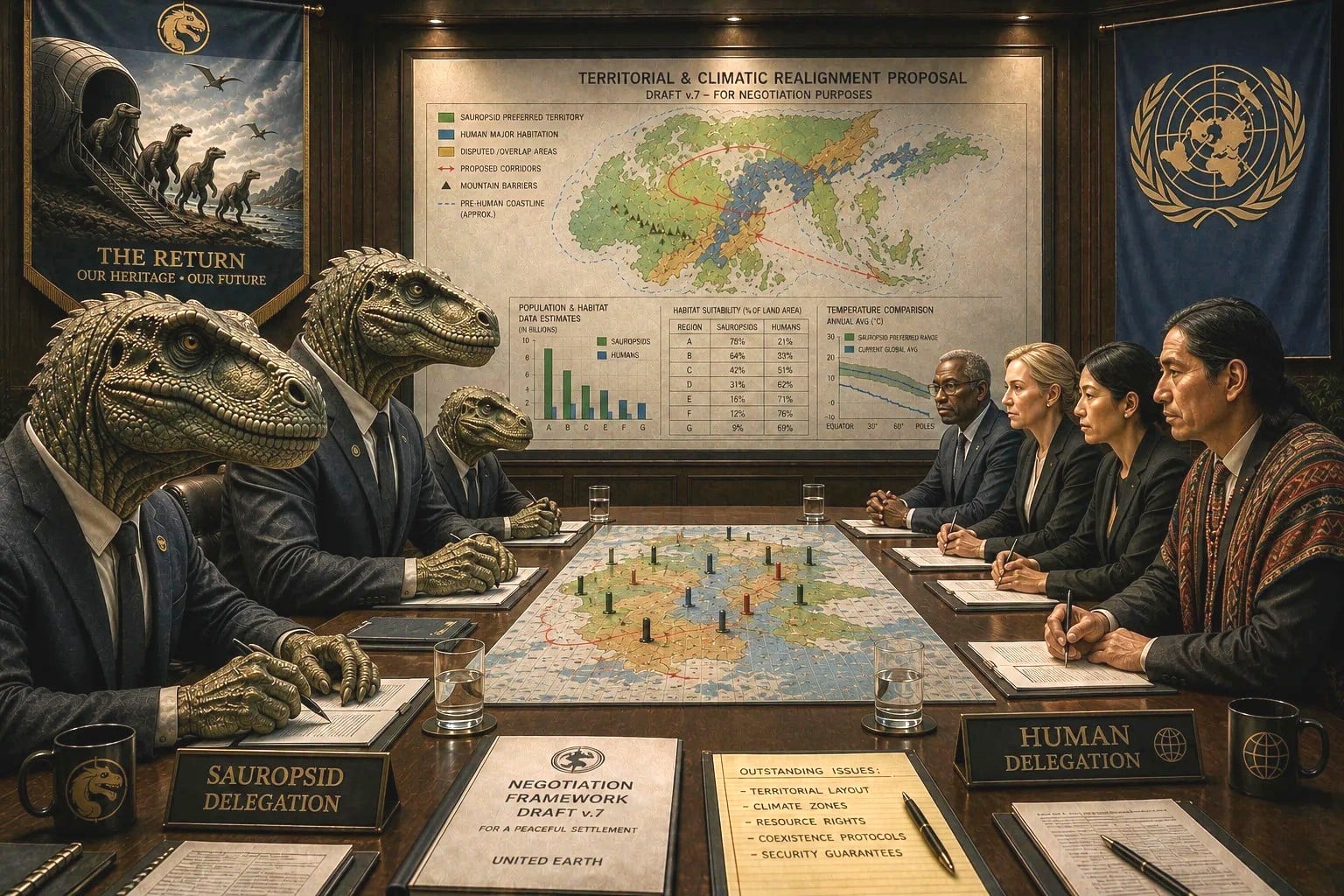
Dinosaurs escaped Earth before the asteroid hit. Sixty-six million years later, they have returned home to find it occupied. This allegory, in the form of a television interview, helps frame the current problem between Jews and Palestinians:
Smith: Hello everybody, this is Frank Smith on the Human Channel’s 24-hour news, coming to you live from New Greenland. We continue now with our around-the-clock coverage of the UN’s Special Negotiation for a Peaceful Settlement initiative. The session itself cannot be televised, as per the agreement between the two parties. So, while we await the conclusion of today’s morning session, we turn to an interview with a spokesperson for the dinosaur-sauropsid faction, Professor Relic Jellers. How are you today, Professor?
Jellers: Quite well, Mr. Smith, thank you for asking.
Smith: Let’s start off with your sharing a little about yourself with our audience. You’ve never been on Human TV before, correct?
Jellers: Well, my books have been translated into Earth Standard English so I like to think I’m not unfamiliar to humans, but no, this is the first time I’ve been interviewed on the Human Channel.
Smith: Great! And may I say, you speak ESE remarkably well. I can barely hear any sauropsid accent.
Jellers: Oh, you’re flattering, but I’ve worked at it, as we can’t just rely on you guys mastering Saurish.
Smith: Saurish is quite difficult… those rolling s’s are so difficult to pronounce.
Jellers: Humans don’t have the tongue for it I suppose.
We Lived in Exile
Smith: Anyway, about yourself…
Jellers: Of course. Like all sauropsids my age, I was born on the exile planet in the Trappist-1 system. Earth astronomers call it Trappist-1f, but the natives there called it Gar.
Smith: And what was life like there?
Jellers: Terribly hard. We never planned to live there permanently, but for the meantime, we tried to fit in with the Garians, who are reptilian like ourselves. There were even some intermarriages.
Smith: That doesn’t sound so bad.
Jellers: Well, we were never treated as equals, even in the best of times. And in the worst of times, we were subject to great violence, including countless massacres.
Smith: And this kind of thing happened more than just once, I presume.
Jellers: It was a cycle. You have to understand, Smith, the Garians always saw us as outsiders, even though we lived in that system for thousands of years.
Smith: Thousands? Not millions? Didn’t you leave Earth right before the Chicxulub impactor asteroid hit 66 million years ago?
Jellers: Yes. But we spent the trip in cryofreeze, and we experienced multiple time-dilations on the way, so we really only lived on Gar for a few thousand years.
Smith: And what made you finally decide to return?
Jellers: Oh, we always knew we would return to Earth someday. In my grandparents’ generation, the movement to repopulate the Earth began to take off. But the real push came in my parents’ generation.
Smith: What happened then?
Jellers: The Garians perpetrated their most savage “purge,” as they called it. Fully a quarter of the sauropsid population was murdered.
Smith: That’s terrible.
Jellers: That it was, and it essentially sealed the deal, since the majority of the survivors felt that Gar held nothing for them anymore.
Smith: You say the majority. Does that mean that not everybody supported the decision?
Jellers: It was far from unanimous, actually. Some sauropsids are still there. The especially pious are awaiting a sign from Zlark, may he be eternally praised, that the time has come to return home. Others just grew attached to Gar and began to think of themselves as more Garian than sauropsid. And I can understand them really. It was all we knew; Earth was just a place in stories from ancient times. Sure, we would sing, “Next Year in the Deccan Traps,” but who took that seriously?
The Return
Smith: As part of your plans in returning, did you think that Earth might now be dominated by another intelligent species?
Jellers: It seems silly, in hindsight, that we didn’t really consider that possibility.
Smith: Nobody raised it? In all those centuries of planning?!
Jellers: Not that I’m aware of.
Smith: Hm. Okay. What did you think you’d find when you returned?
Jellers: We had no idea. Many worried it would be a wasteland.
Smith: But then you found it was fully healed.
Jellers: Well, I wouldn’t say fully, but inhabitable yes. But we were also taken aback by the massive changes to the planet itself.
Smith: Yes, the current arrangement of the continents has been a major sticking point in the failed attempts at negotiating a settlement.
Jellers: Look, we don’t have that mammalian internal heating system you guys have. For us, outside the tropics, Earth as it exists now is too cold.
Smith: It’s funny, since right before the sauropsids arrived…
Jellers: Returned!
Smith: Of course, sorry. Right before you returned, humans were trying to halt global warming, which we had been unwittingly accelerating for more than a century.
Jellers: Yes, in a strange irony, humans began to solve our problem of the cold planet before we arrived, by returning the planet to its natural state.
Smith: Isn’t “natural state” a false metric? There were colder periods and hotter periods on Earth. You are simply choosing one period of time in the planet’s history, the period during which dinosaurs ruled the Earth, and declaring that to be more authentic than other periods.
Jellers: You have a point, Smith, but in our tradition, Zlark, may he be eternally praised, created the Earth for the sauropsids to rule, which he promised our ancestors eons ago. Part of that was the command to make the Earth fecund with all species of reptiles, to protect the holy forests, to sail the sacred Seaway at least once in our lives, and of course, to worship in the Deccan Temple. It is very exciting to know that we will be the first sauropsids in thousands of years to live the authentic sauropsid life.
Who Shot First
Smith: I understand it feels that way to you, but these aspirations led to the death and displacement of millions of humans, who lived in the very areas you are remaking. We will have difficulty surviving in many parts of the planet once it reaches the global temperature ideal for sauropsids.
Jellers: It is an unfortunate consequence of the Reclaiming-the-Earth project. We see that… now. I admit that in the early years, we were pretty insensitive to your plight.
Smith: Do you think “insensitive” really captures it? You massacred many of us and subjugated the rest.
Jellers: Now don’t get all dramatic, Smith. The Sauropsid Council has taken full responsibility for our opening maneuvers, and we’ve issued a full and unconditional apology to the families of the lost humans.
Smith: And we appreciate that, but you erased entire cities and so many humans were killed and displaced that even now the count is only a rough estimate.
Jellers: And I wish we could take it back, but you must also hold some of the blame. When our ships first arrived in the inner solar system, you refused to speak with us or let us land. Then, when we entered orbit around Earth anyway, you shot at our ships with hydrogen bombs! Our lead ship, which carried our leader—not to mention hundreds of families, including children!—was blown out of the sky. And two others were badly damaged, causing widespread panic that we were about to be eliminated as a species.
Smith: Well, we certainly paid the price for that, given that your technical officers soon figured out how to stop our bombs entirely.
Jellers: True. But the initial danger to us was real. If we hadn’t deployed our defenses, we would have all been killed.
Smith: Your defenses, yes, but you didn’t stop at defense at all.
Jellers: When under attack, one responds in kind, does one not? Is it our fault that our weapons are so much more advanced than yours?
Smith: But what choice did we have but to attack? You were invading our planet!
Jellers: We see it as returning to our own planet.
Smith: Which you left.
Jellers: Through no fault of our own! Were we supposed to just sit there when a giant asteroid was threatening to make us extinct? What else could we have done but leave?
Smith: Your leaving is not the controversial point. It’s your returning.
Jellers: Do we not have the right to return to our own planet? The place where sauropsids evolved and thrived? We were the apex species of this planet in our day, so imagine our frustration upon our finally returning home only to find that a species that was once no more than oversized egg-stealing rats had become intelligent and taken the whole thing over.
Smith: Let’s take a breath, Professor. We’re not here today to rehash old arguments or even to solve the blame question.
Jellers: I apologize, Mr. Smith, I got carried away there. I am actually quite optimistic about the negotiations now. I think there can be a bright new future for both species if we can come to terms on the essentials.
Climate Correction
Smith: The essentials, yes. So, as someone involved in crafting the sauropsid negotiating team’s terms, what do you see as your side’s essentials?
Jellers: Let’s start with something that has already come up in our brief time together. Climate correction.
Smith: Humans do not like that term.
Jellers: Of course, but if sauropsids are to thrive here again, more of the planet has to be habitable. We cannot simply confine ourselves to the tropics.
Smith: How hot are you planning on making the planet?
Jellers: Oh, just a few degrees higher than now. What it was in the Late Cretaceous Period.
Smith: What human scientists call “the Greenhouse World”?
Jellers: Exactly, it’s a beautiful term. We’ve adopted it ourselves.
Smith: But that will make much of the planet uncomfortable for humans.
Jellers: Uncomfortable is better than unlivable. Sauropsids are cold-blooded, so global temperature is more significant for us than for you humans. Get some air-conditioners, take a cold shower, jump in the local pool, sweat a bit—you warm-blooded mammals will be fine.
Smith: On most of the planet, yes, but the equatorial region really will be unlivable for us.
Jellers: So the humans in that zone will have to move elsewhere. It’s a big planet. The temperate zones will be bearable, and the polar regions will be quite nice for you, actually.
The Antarctica Project
Smith: Speaking of the polar regions allows us to segue into another of your essentials.
Jellers: You mean the Antarctica Reforestation Project?
Smith: Exactly.
Jellers: This one is really exciting, and something even you humans can get behind. In our days, Antarctica—a frozen desert supporting nothing but lichen and penguins in the current configuration—was forested in the long summer.
Smith: But still frozen in the winter, yes?
Jellers: True. The reptiles and amphibians of old would hibernate, like your cousins the bears do.
Smith: Humans don’t generally think of bears as cousins.
Jellers: And sauropsids don’t generally think of Brontosauruses or Triceratops as cousins either, but that doesn’t stop you humans from…
Smith: Point taken, Professor. We are mammals; you are dinosaurs. It is only natural that each group looks at the other with a broad gaze. But what I was trying to say is that humans, unlike bears, cannot hibernate.
Jellers: True, but there are options. You could build climate-controlled, domed cities. Or you can stay indoors most of the time, and use virtual reality to communicate.
Smith: But humans are social creatures. Locking us in our homes for half a year, even with virtual reality, would cause profound psychological suffering.
Jellers: I understand. And I like thinking out of the box, which is why I have also suggested humans set up sister communities in the opposite polar region and migrate, like birds; half a year in one place and half a year in the other.
Smith: These suggestions would require an extreme lifestyle change for the humans in this region.
Jellers: That’s inevitable now, don’t you think, Mr. Smith?
Smith: I guess, given the new reality of your return.
Jellers: Look, Smith, I understand that humans never even dreamed about the existence of intelligent sauropsids, let alone the possibility that we would pop out of the sky one day and retake our place as the dominant species.
Smith: Certainly not.
Jellers: And yet, here we are and here you are. No longer are humans the only intelligent species on the planet, and while more numerous than we, humans are significantly less technologically advanced and powerful than sauropsids.
Smith: That, at least, is indisputable.
Jellers: So, what choice do you have but to begin some extreme lifestyle changes to accommodate the new order?
Smith: But we don’t have the resources for migratory living; we’ve never done it en masse. As for domes, we wouldn’t even know where to begin on a technological plane.
Jellers: But we do. We could teach you.
Smith: It is difficult for humans to accept assistance from the very group that is displacing us.
Jellers: An understandable emotional reaction, but one that, I hope, you will be able to overcome in time. As an added bonus, several prominent sauropsids, including myself, have suggested that the Human Polar Neighborhood Projects be subsidized by us.
Smith: Yes, I read that proposal, but here’s the thing: You’ve been in power for years now. When have the sauropsids ever actually invested in us?
Jellers: There was the Asian Forestation Program, which employed many humans…
Smith: Professor, you paid us minimum wage to plant conifer forests so you could bring back your favorite herbivore pets.
Jellers: Flocks.
Smith: Flocks, yes. And you employed humans from the very cities you were tearing down to make the forest land available. At the same time, you did everything to encourage the surviving humans from these regions to split into factions and make war on each other. You must forgive us for not seeing all this in the light of investment in the future well-being of humans.
Jellers: I admit that many of our social scientists and political leaders from the previous generation saw the possibility of humans thinning out their own population through hard work and internal strife as an encouraging, positive development.
Smith: So perhaps you can understand that when a plan comes along with a “don’t worry, the sauropsids will help you implement this,” most humans discount that as mere verbiage.
Jellers: Put that way, I understand your point. I imagine I would react the same if our roles were reversed. Just keep in mind that a new generation of leadership is coming to power. I am optimistic that the neglect of the human side of the equation will stop. We really want a solution so that we can all finally move on and live our lives without all this conflict.
The Deccan Traps Temple
Smith: Okay, so we understand the climate readjustment and the Antarctica reforestation project. What else is there?
Jellers: There are two further non-negotiables. The first is the Deccan Traps Temple Complex.
Smith: Referring to the volcanic region you reclaimed on India’s west coast?
Jellers: Yes.
Smith: This area is sacred to the sauropsids?
Jellers: Certainly! According to sauropsid legend, this is the region in which Glelik was born.
Smith: Glelik, the sauropsid devil figure?
Jellers: Something to that effect, yes. The story goes that at one point in history, the sauropsid population had become sinful. Zlark, may he be eternally praised, became angry with his people and the heat of his anger made the earth start to boil. Eventually, this melted earth…
Smith: Melted earth? You mean lava?
Jellers: Yes, lava, magma, liquid igneous rock. I’m using mythic language of course, to give you a flavor of the old stories. This melted earth burst through the volcanoes in the Deccan Traps, killing millions of our people. But Zlark, may he be eternally praised, did not want to see the world he created destroyed, so he made it known to his prophet, Darp, that if a temple were to be built right where the magma build-up was greatest, Zlark would inhabit the temple, and fight off the new evil power, born from the molten earth.
Smith: That power being Glelik?
Jellers: Yes. Glelik is the instantiation of the divine anger that always lies just below the surface of the planet.
Smith: Was it Glelik who sent the Chicxulub asteroid that made the planet uninhabitable in your day?
Jellers: That is what we believe, yes.
Smith: But doesn’t it seem that this is just a myth?
Jellers: Of course, but let me ask you: The great flood of Noah, the resurrection of Christ, the Kurukshetra war of the Pandavas against the Kauravas—are these too not just myths?
Smith: Certainly.
Jellers: Great, so you have your religious traditions and we have ours.
Smith: And I have nothing against religious traditions from either group. My point is that this particular sauropsid myth seems aimed at assuaging concern over volcanic activity in the Deccan Traps during the Late Cretaceous Period. But given today’s constellation of tectonic plates, this region is of no concern now.
Jellers: And yet the story is an integral part of our tradition.
Smith: But how can you weigh that against the lives of all those people living in the region?
Jellers: Are you saying humans would not kill to protect their own holy sites? What would happen if one of your groups were to have destroyed Vatican City or the al-Aqsa Mosque?
Smith: You have a point.
Jellers: Anyway, much of the Deccan Traps is protected land—Chandoli National Park, the Sahyadri reserve. Not many humans actually live in those regions, so I don’t see the big deal. In comparison with the Western Interior Seaway Re-flooding project, our final non-negotiable, the Deccan Traps Temple is a cakewalk.
Re-Flooding the Seaway
Smith: Yes, the flooding project is the proverbial third rail, at least for Americans. Let me first say that this project is very difficult for me to talk about.
Jellers: Of course, I was notified of this before the interview. Your family is from Nebraska?
Smith: Oklahoma.
Jellers: Oklahoma, yes. I get all those basin states confused. Well, I’m sure you know that this project is, in fact, being paid for entirely by the sauropsids, including relocation funds. Has your family been given a new settlement location yet?
Smith: Yes, we were moved to Greenland.
Jellers: Excellent. It really is green now, isn’t it?
Smith: It’s getting there, now that you melted the glaciers.
Jellers: Hey, to be fair, we didn’t just melt all that ice into the oceans. We created enormous lakes in Greenland, North America, Africa, Oceania, Asia—there is no shortage of fresh water now on any of these landmasses, and your species benefits as much as ours from this.
Smith: Yes, but Oklahoma, or “the Basin” as you call it, was our home for centuries.
Jellers: I hear it was home to Native American tribes for millennia before that, but I don’t recall any of you Anglo-Saxons returning the land on principle.
Smith: True.
Jellers: Well, millions of years before the first humans even evolved, the basin was an enormous body of water, home to uncounted species of fish, not to mention mosasaurs, plesiosaurs, ichthyosaurs, you name it. Sailing and fishing on the Western Interior Seaway was considered the height of cultural activity, not to mention a religious requirement once in every sauropsid’s lifetime. Our most important myth, the Epic of Sauros, is set on this waterway, and our ability to experience this is a core value of ours. Just picturing our doing this again sustained us for centuries of exile.
Smith: But humans have history here too, and it is home to millions of us.
Jellers: I know, and it is unfortunate, but need I remind you? It was ours first.
Smith: That was a long time ago, Jellers. Such claims have a shelf life. And anyway, my family has lived in Oklahoma for over a century, and nothing you’ve told me about the Cretaceous changes the fact that you moved my 83-year-old grandma out of her childhood home into a tiny room in New Greenland along with millions of other refugees from your re-flooding project!
Jellers: Smith, let’s be realistic. The recreation of this sea is going to happen. In the end, we feel, it is still a kind of compromise, since the existence of the sea will make it like Cretaceous times, but the continent being so far west is like human times.
Smith: Humans do not control plate-tectonics, Professor. This is the world as we inherited it. You, in contrast, are bringing back a sea that was dried up before my ancestors were even simians.
Jellers: Ah yes, well, it is only a matter of some small adjustments to the coastlines. Also, I will add that our scientists aren’t entirely sure plate-tectonics is not adjustable.
Smith: Don’t tell me you’re thinking of reversing this too?!
Jellers: (chuckling) Don’t worry; it’s just some preliminary thinking. We’ll share all the research with you, and I’m sure we won’t make any precipitous moves.
Fait Accompli
Smith: Do you believe the humans will accept these four points as the basis for negotiations?
Jellers: Not immediately, no. But in the end, it is all a fait accompli of sorts, and you humans will see that it is in your interest to work with us and not against us.
Smith: Given the power dynamics, you might be correct about that, but it doesn’t place your group in the right.
Jellers: Us in the wrong? Which group sent hundreds of missiles carrying fusion bombs against the other when they were finally returning home, killing thousands of us, including our beloved leader, may Zlark rest his soul?!
Smith: Yes, yes. But, as I said, you were invading our planet.
Jellers: It is our planet as much as yours, and we were here first.
Smith: You keep saying that. And you keep returning to the first Human-Sauropsid War.
Jellers: Because it was traumatic! If we hadn’t figured out how to stop your missiles as quickly as we did, we would have been annihilated as a species in moments. We were scared to death!
Smith: For five minutes. Then you figured out that our delivery systems were easily overridden, and then you sank the entire west coast of the United States with your earthquake weapon, and blasted Beijing, Moscow, London, Paris, Berlin, and Washington D.C. into kingdom come. Don’t you think that was a serious case of overkill?
Jellers: We needed to show you we were serious, that you should not attack us like you did.
Smith: That point, at least, came through loud and clear.
Jellers: So, can we stop harping on the past and think about the present and the future?
Smith: I don’t know. That’s the real question, isn’t it?
Postscript: In 2018, I wrote “Palestinian Nakba and Israeli Independence: Telling Two Incomplete Stories” in which I asked what it would be like to try to integrate both narratives. Here, I want to show, in an exaggerated way, what happens when our side ignores the other’s narrative because we have the power to do so. The next question is: how do we solidly protect our own interests while genuinely helping further theirs? How do we finally start integrating our narratives?