When animals save people
Noah wasn’t the first person to save an animal. He may have been the first to realize the animal would save him back.
This week, Jewish communities around the world are reading Parshat Noah, the portion of the Torah that tells this story. Most people who know this biblical story can recite the following, simplistic version of it: an ark is built, animals enter two by two, a flood erases the world, and Noah, in his righteousness, becomes a shelter for creatures who have no voice of their own. That’s the image from kindergarten, and it sticks.
But when I read the story now, I see something else. The portion read in synagogues does not end with the rescue. It ends with a covenant, and not one made with Noah alone. It is a covenant with “every living creature of all flesh.” A covenant isn’t charity. It’s an agreement between equals.
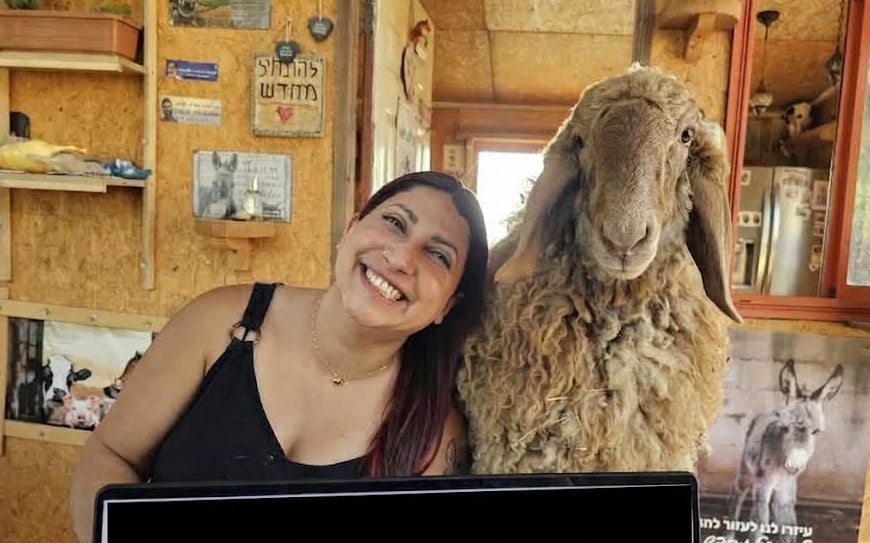
In Herut, a small village in central Israel, the Starting Over Sanctuary has been living out that covenant for years. Donkeys, horses, cats and goats, thousands of them over time, have passed through its gates on the way to better lives. Many arrived there after cruelty at human hands: starvation, neglect. Conditions no living creature should have to endure. This work has nothing to do with any war. It predates it by years, and it will continue long after the headlines move on.
But recently, a new chapter opened at the sanctuary, one that speaks to a wound many people, in Israel and far beyond it, now recognize. Since the war that followed October 7, 2023, Israel has counted a large number of reservists and active-duty soldiers who returned from combat carrying injuries no scan can find. The sanctuary now runs sessions built specifically for them.
Some of these sessions are preventive: structured time with animals for combat teams freshly home from the field, meant to help process fear and grief before it hardens into lasting trauma. Others are for people already diagnosed with post-traumatic stress disorder, where the animal becomes a tool in the hands of a licensed therapist, not a replacement for one. These programs run in partnership with a range of professional bodies, including specialists from Israel’s Ministry of Defense.
There’s no magic in it. When standing beside a donkey, our body learns to let go in ways it might not do so with people. The situation demands one honest breath, real attention, and the surrender of control, exactly what trauma steals from a person, and exactly what an animal, without a single word, can teach a person to reclaim.
Something flips in that exchange. We are used to thinking of ourselves as the great rescuers of the animal kingdom: the species with the moral weight – and the opposable thumbs – that enable us to do something about suffering we didn’t cause. But someone sitting on the floor of a barn, a hand resting on a horse’s neck, breathing calmly for the first time since coming home from war, understands something the rest of us don’t. In that moment, they know exactly who is doing the saving. And it isn’t only them.
This isn’t sentimentality. It’s demanding work, carried out by trained professionals, with animals who carry their own scars from their own histories of harm. That combination, expertise plus vulnerability on both sides of the fence, is precisely what makes the work credible. It also points to something larger than one small farm in Israel.
Three thousand years after the ark first closed its doors, the covenant described at the end of that story is still open, waiting for anyone willing to take part. All around us are scars, visible and hidden, carried by people and by animals alike, and it isn’t always easy to tell them apart from the outside. Helping an injured animal recover and helping a soldier who came home broken are two distinct acts of compassion. Nobody should collapse the two into one, or weigh a person’s suffering against an animal’s. But both, in the end, spring from the same choice: choosing humanity, in whatever form it happens to need from us that day.
That choice does not actually require a farm in Israel, or a war, or even a religious text to justify it. It only requires noticing when someone, or something, in front of you needs a moment of quiet decency, and being willing to give it. Somewhere in a small village you may never visit, people and animals are teaching each other that lesson, one session at a time. It’s worth asking how, in our own lives, wherever we live and whatever we do, we might be able to do the same.