
When being Jewish starts to feel like being permanently “on call”?
There is a lot to have an opinion about right now.
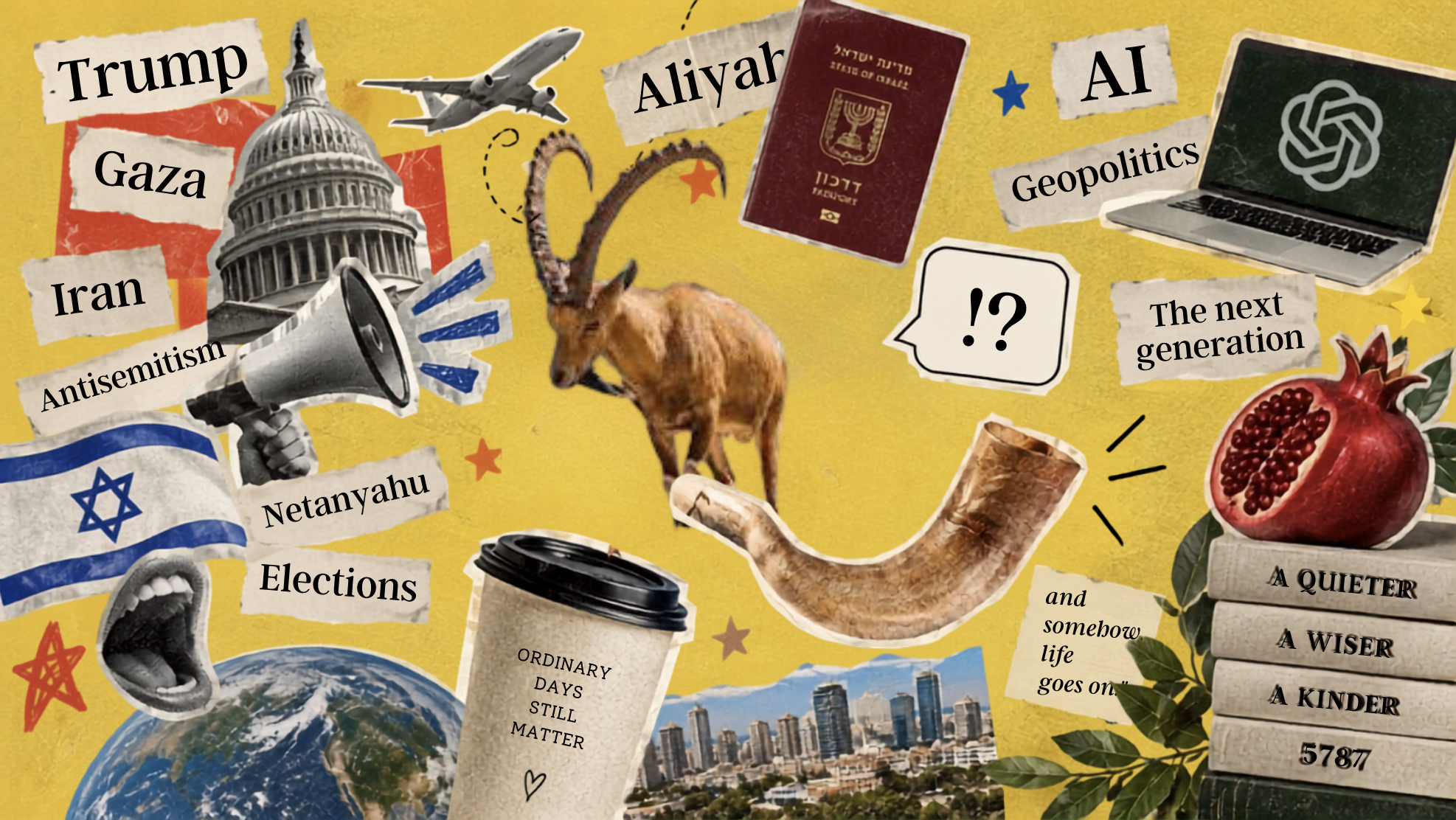
Trump. Gaza. Iran. Antisemitism. Netanyahu. The next Israeli election. The next American one. Whether everyone is making aliyah or threatening to leave Israel. Whether artificial intelligence is going to eliminate our jobs, save our jobs, destroy democracy or finally figure out how many r’s are in “strawberry.” There are wars happening, wars threatening to happen and wars being fought exclusively in comment sections by people who appear to have unlimited free time.
Then there are the High Holidays.
5786 was, to use the technical term, a brick to the face. I would like to tell you that I expect 5787 to be gentler. I do not.
What we can expect is that life will continue to happen underneath all of it.
The harder question is what kind of life.
There has always been more suffering in the world than any individual could absorb. What has changed is our proximity to it. For most of human history, the fact that something terrible was happening somewhere did not mean that footage of it could appear between a text from your mother and an advertisement for moisturizer. Today, distance no longer determines what enters our field of vision. A missile launched thousands of miles away can reach a phone before the sound of the explosion has finished traveling across the city where it landed.
That collapse of distance has produced an odd moral consequence. Once we can know about nearly everything, it becomes harder to explain why we do not know about something. Once we can respond to nearly everything, not responding begins to look like a response of its own.
This is how attention quietly becomes obligation.
For Jews, that transformation carries particular weight. Vigilance is not some neurosis invented by social media. Jewish history contains enough examples of threats being dismissed until they could no longer be dismissed to make “pay attention” feel less like anxiety than inherited common sense. October 7 did little to weaken the case. Neither has the resurgence of antisemitism in places where many Jews had been assured that antisemitism belonged safely to history.
The instinct to watch, then, is not irrational. The problem is what happens when an old instinct meets a machine with no concept of enough.
The modern information system does not merely allow vigilance; it rewards its continuous performance. It asks us not only to know what happened but to demonstrate that we know. A tragedy occurs and almost immediately a secondary drama begins around who acknowledged it, who used the correct language, who posted too soon, who posted too late and who did not post at all. Silence, once simply the absence of speech, has acquired an astonishing number of possible meanings.
The result is that moral seriousness increasingly has an aesthetic. It looks like being visibly informed.
This is not only a Jewish problem. It is a generational one. Gen Z has come of age during a period in which forming an identity and broadcasting one have become unusually difficult to separate. Previous generations had to figure out what they believed. This generation has been asked to figure it out while a blinking cursor waits beneath the words “What’s happening?”
There is something developmentally strange about that arrangement. Growing up requires contradiction. People inherit beliefs, test them, discard some, recover others and occasionally discover with horror that their parents were right about something. A worldview is supposed to contain revisions. Yet the internet keeps receipts from every draft.
So the process of becoming a person increasingly takes place before an audience.
That changes how opinions work. A belief can become part of an identity before it has had time to become a conviction. Positions harden because changing one’s mind no longer means privately reconsidering an idea; it can mean publicly defecting from a version of oneself that other people have already learned to recognize.
For young Jews, the years since October 7 have accelerated this process. Questions that might once have developed slowly—what Israel means to me, how Jewish I am, what I owe other Jews, what I believe about Zionism, what I believe about Palestinians, where I feel safe, where I belong—have often been presented as questions requiring immediate answers.
That is an enormous amount of certainty to demand from people who are still becoming themselves.
It may also explain why being Jewish can increasingly feel like being permanently on call. The sensation is not simply that something bad might happen. It is that, when something happens, there will be a test afterward.
Did you know? Did you speak? Did you speak correctly? Did you care enough? Can you prove it?
The problem with living permanently on call is not merely exhaustion. Exhaustion would be comparatively simple. The deeper risk is that constant reaction begins to substitute for reflection.
When every event demands an immediate moral response, there is little time to ask the slower questions from which morality is actually built. What do I believe when nobody is asking? Which obligations are mine rather than merely available to me? What deserves my attention? What deserves my action? What can I admit I do not understand? What am I doing because it is right, and what am I doing because I want to be seen doing the right thing?
This is where the timing of the High Holidays becomes interesting.
There is an old Jewish saying that what matters is not what we do between Rosh Hashanah and Yom Kippur, but what we do between Yom Kippur and Rosh Hashanah.
It is usually offered as a reminder that ten days of unusual piety cannot compensate for a year of behaving badly. But there is something almost subversively contemporary about the distinction. The saying asks us to distrust moral intensity precisely when it is most visible.
Anyone can become temporarily serious when seriousness is in season. The harder question is what remains when nobody is watching.
Our public culture increasingly asks the reverse. It is extraordinarily interested in what people say at moments of maximum attention and considerably less equipped to measure what they do during the long stretches between them. We judge character through declarations because declarations are visible. The quieter architecture of character—habits, loyalties, generosity, restraint, curiosity, the ability to admit error—is much harder to post.
Perhaps that is why the distinction between those ten days and the other 355 feels newly useful.
The question is not whether we care about Gaza, Israel, antisemitism, Iran, democracy, artificial intelligence or whatever crisis arrives next. We should care about consequential things. Nor is the answer to retreat into private life and declare the world somebody else’s problem.
The question is whether constant awareness of consequential things necessarily makes us more consequential people.
There is reason to doubt it.
Knowing more about suffering does not automatically make us kinder. Having more opinions does not necessarily make us wiser. Being able to identify the moral failure in somebody else’s argument does not make us less capable of failing the people sitting across from us. It is entirely possible to maintain impeccable positions on humanity while being fairly terrible to actual humans.
That contradiction may be one of the defining temptations of life online: the scale at which we are invited to care has become enormous, while the scale at which most of us can meaningfully practice care remains stubbornly small.
History happens at the scale of nations. Life happens mostly at the scale of people.
Both matter. The mistake is assuming that attention to the first can replace responsibility to the second.
This is why the ordinary life continuing underneath the headlines is not a distraction from the important stuff. It is where much of the important stuff actually happens. People still have parents to call, children to raise, strangers to treat decently, friendships to repair, apologies to make, work to do and beliefs to reconsider. None of these acts will stop a war. Most will never become public evidence of anyone’s goodness.
They are nevertheless the substance from which a life is made.
There will be plenty to watch in 5787. There will almost certainly be plenty to fear, argue about and mourn. There will be moments when vigilance is necessary and moments when silence would be cowardice. The challenge is not learning to look away from the world.
It is remembering that watching the world is not the same as living responsibly within it.
The old saying does not ask what we posted between Rosh Hashanah and Yom Kippur, or whether we found the correct words quickly enough when everybody was looking. It asks about the much longer, quieter stretch afterward.
That is where most of 5787 will happen.
It is also where most of us will become whoever we are becoming.