
When Business and Foreign Policy Share a Room
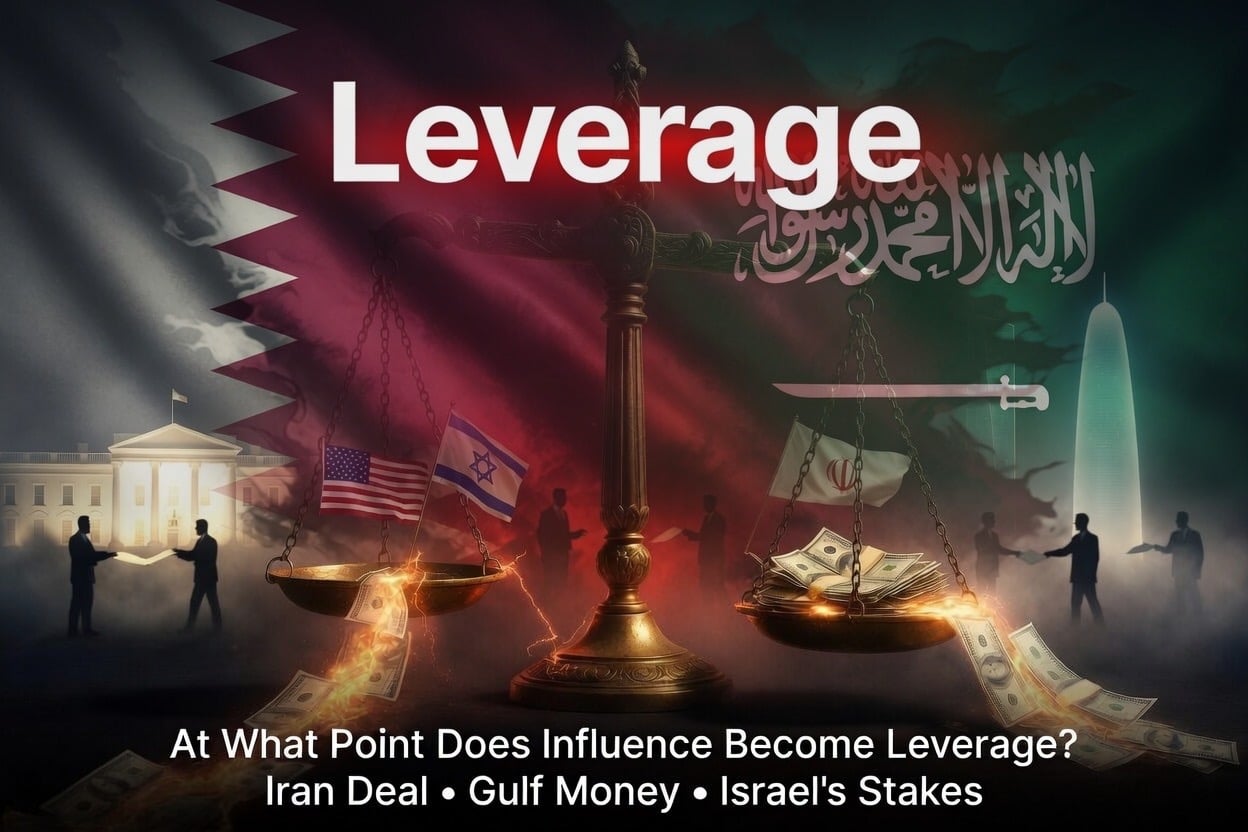
As reports emerge regarding the proposed U.S.-Iran agreement, reportedly known as the Islamabad Memorandum, senior Israeli officials are raising alarms that many of Israel’s core concerns appear absent from the emerging framework.
According to those reports, the Iranian regime remains intact. Uranium removal has reportedly become uranium dilution. Iran’s ballistic missile program is not addressed. Support for proxy organizations such as Hezbollah appears largely unaddressed.
One senior Israeli official summarized the situation bluntly:
“The Iranians are not agreeing to this for nothing.”
If these reports are accurate, they raise an obvious question. After a military campaign presented as an effort to fundamentally alter Iran’s strategic position, what exactly did Tehran surrender in exchange for the concessions now under discussion?
This is not an accusation of wrongdoing. It is a question about influence, proximity, and whether the public can realistically distinguish between diplomacy, access, and leverage when all three exist in the same ecosystem.
Proximity Matters
Jared Kushner’s Affinity Partners raised billions primarily from Gulf sovereign wealth funds after his first stint in government:
• Saudi Arabia’s Public Investment Fund committed $2 billion.
• Additional funding flowed from Qatar’s sovereign wealth fund and Abu Dhabi-based Lunate.
• By the end of 2024, assets under management had reportedly reached approximately $4.8 billion.
Steve Witkoff, a longtime Trump ally involved in Iran-related files, has likewise drawn scrutiny over the intersection of diplomacy, business interests, and Gulf relationships.
None of this proves wrongdoing. Influence is normal in international affairs. However, when such financial relationships exist in close proximity to individuals helping shape U.S. Middle East policy, especially on Iran, they deserve heightened scrutiny. Israeli security, after decades of Iranian hostility and proxy warfare, hangs in the balance.
Qatar’s Dual Role
Qatar occupies a particularly complex position. For years, it has been described by critics as a principal patron of Muslim Brotherhood-aligned movements. Hamas itself emerged from the Palestinian branch of the Muslim Brotherhood, and Qatar has hosted Hamas leadership while simultaneously acting as an intermediary between Hamas, Tehran, Washington, and Jerusalem.
In September 2025, the Trump administration issued a formal executive order assuring the security of Qatar. The order declares that any armed attack on Qatar’s territory, sovereignty, or critical infrastructure would be regarded as “a threat to the peace and security of the United States” and pledges “all lawful and appropriate measures — including diplomatic, economic, and, if necessary, military” in response.
Israeli strategic analyst Yoram Ettinger has repeatedly warned that Qatar’s relationships with Iran and Muslim Brotherhood-linked actors often run counter to long-term American and Israeli interests, while simultaneously making Doha an indispensable diplomatic player.
The same state that hosts Hamas leaders, maintains channels to Tehran, and now enjoys this significant U.S. defense guarantee is treated as a critical mediator by the United States. At the same time, Qatari capital has flowed into ventures connected to the president’s inner circle, including Kushner’s Affinity Partners and prior Kushner family transactions.
This creates an extraordinary convergence: diplomatic mediation leverage, financial relationships, privileged access, and a major U.S. security commitment all held by one actor. The line between legitimate diplomacy and structural leverage becomes even harder to discern.
This creates an extraordinary convergence:
diplomatic mediation leverage, financial relationships, and privileged access all held by one actor. The line between legitimate diplomacy and structural leverage begins to blur.
The Policy Picture
The administration pursued a campaign of maximum pressure against Iran, culminating in military strikes and declarations that Tehran would face severe consequences unless it changed course. Yet, if the reported terms of the Islamabad Memorandum hold, Iran retains its regime, its Supreme Leader, an intact Hezbollah proxy network, and a nuclear program headed back toward negotiations rather than dismantlement.
Urban warfare expert John Spencer, who has strongly supported Israel’s right to decisive victory against Iran’s axis, has argued that acceptable terms must include “no nuclear program, no long-range ballistic missile program, give up nuclear enriched material, complete freedom of navigation in the Strait of Hormuz, [and] give up [the] robust proxy program.”
Reasonable people can debate whether this outcome represents prudent diplomacy or strategic restraint.
Author’s Note:
This article raises questions about influence, proximity, and appearance. It does not allege criminal conduct, corruption, or a quid pro quo. Readers are encouraged to review the cited sources and draw their own conclusions.
Sources
¹ Reuters, March 28, 2025 – Affinity Partners assets under management and Gulf sovereign wealth fund investments.
² Reuters, March 30, 2023 – Qatar and UAE participation in Affinity Partners and related reporting regarding Gulf investment relationships.
³ John Spencer (@SpencerGuard), public comments regarding the proposed Islamabad Memorandum and conditions for an acceptable agreement with Iran, June 12, 2026.
⁴ Reports citing senior Israeli officials regarding the proposed U.S.-Iran agreement (Islamabad Memorandum), including statements that uranium removal had reportedly become uranium dilution, ballistic missile restrictions were absent, and Hezbollah-related concerns remained unresolved, June 2026.