
When Commencement Becomes Division: A Serious Test of Responsibility
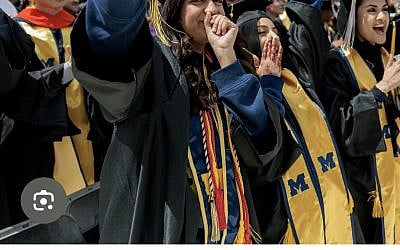
I returned to the University of Michigan, my alma mater, to attend a family member’s graduation and to spend several meaningful days in Ann Arbor. Three generations of our family gathered there, united by a shared history with the university across undergraduate and graduate programs, including business, engineering, law and medicine.
What should have been a unifying celebration instead left us deeply unsettled.
The commencement address delivered by Professor Derek R. Peterson, a tenured historian at the University of Michigan, did not, in our view, reflect the spirit or responsibility of the occasion. Rather than focusing on graduates and their families, the remarks were widely experienced by attendees—including ourselves—as overtly political and, for many, deeply alienating and inappropriate for an official university ceremony. Peterson hijacked the commencement ceremony praising anti-Israel protesters.
Commencement ceremonies are among the most visible institutional moments of endorsement and unity. When a faculty member uses that platform in a way that appears to single out or marginalize a group in front of a stadium-sized audience, it raises serious concerns about professional judgment, institutional stewardship, and abuse of privilege.
This is not about disagreement over political viewpoints. Universities must protect academic freedom and robust debate. The issue is the use of a university-sanctioned ceremonial platform—one intended to honor all graduates equally—in a manner that many reasonably experienced as exclusionary during a moment meant for shared celebration.
The reaction in the stadium underscored how deeply that moment fractured the intended unity of the event. What should have been a collective celebration was, at points, experienced as polarized and divisive, compounding the concern that the platform was misused.
At a minimum, this incident warrants a serious and transparent internal review by the University of Michigan regarding speaker selection, oversight, and accountability standards for commencement addresses.
But accountability cannot stop at process review alone.
When a tenured professor, acting in an official institutional capacity at a university-sponsored event, uses a platform of this magnitude in a way that is widely perceived as discriminatory toward a protected group, it raises not only institutional concerns but also civil rights implications. The University of Michigan receives approximately $1.24 billion in federal funding annually, and is therefore bound by Title VI of the Civil Rights Act of 1964, which prohibits discrimination in federally funded programs and activities.
Those obligations require universities not only to avoid discrimination, but to ensure that official institutional events do not create or endorse environments that reasonably appear hostile or exclusionary to members of protected groups.
In light of the role, platform, and institutional authority involved, this matter warrants serious review not only internally but also, where appropriate, external scrutiny by relevant federal oversight bodies, including the Department of Education’s Office for Civil Rights.
Accountability must also include consequences proportionate to the misuse of an official university platform. When a faculty member’s conduct at an institutional ceremony undermines the university’s stated commitment to inclusion and equal respect for all students and families, disciplinary action—including termination where warranted under university policy and governing standards—must remain on the table. Anything less risks signaling that such conduct is acceptable when delivered from a position of tenure or authority.
To the leadership of the University of Michigan—including President Domenico Grasso—the responsibility is clear: address this matter with seriousness, transparency, and a level of accountability consistent with the university’s obligations to its students, alumni, and broader community.
This is not about restricting academic freedom. It is about ensuring that official university ceremonies remain what they are intended to be: moments of shared recognition, not platforms for division.
At a time of heightened concern about antisemitism on campuses across the United States, institutions must be unequivocal in safeguarding inclusion. Academic freedom and institutional responsibility are not in conflict—but they do require boundaries when a university speaks with its own voice.
Commencement should mark a beginning defined by unity and hope. This moment raises urgent questions about how faithfully that standard is upheld.