
Digital Dreamer
When Did Everything Become Iraq?
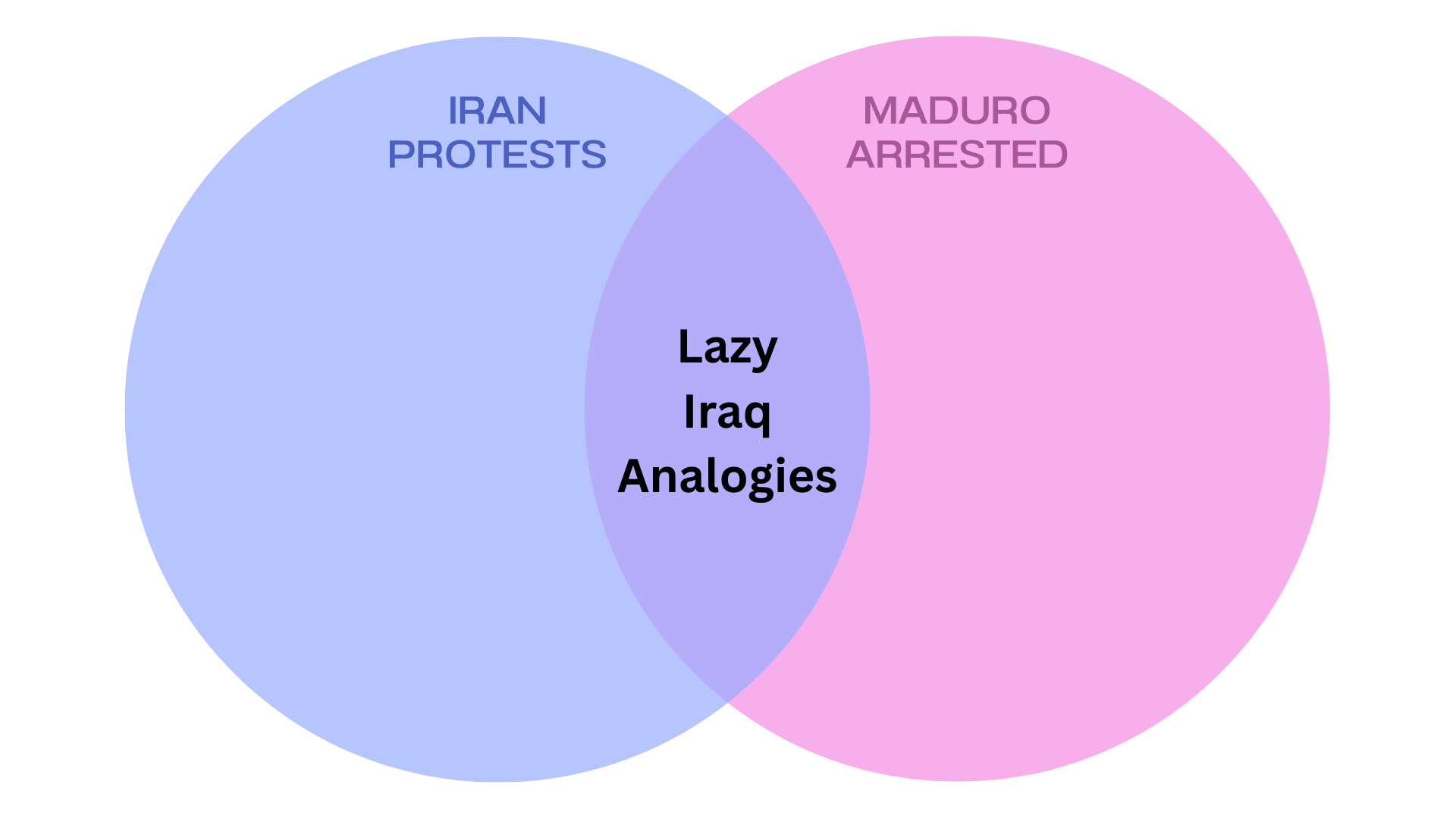
In contemporary discourse, misidentifying people is rightly criticized because it erases identity and specificity. Confusing Korean with Chinese people, or Urdu and Hindi, is understood as harmful regardless of intent. Proximity and superficial similarity are not accepted as excuses.
When it comes to non-Western states, insistence on precision vanishes. Iraq, Iran, Venezuela, even Vietnam are casually folded into a single moral shorthand: same sin, same story. This abstraction is summarized as ‘Brown states the West harms.’ This is racial essentialism with either progressive or “America First” branding, sometimes both despite the inherent contradictions.
Those who once defended anti-racism nuance pivoted to slogans that reward outrage. It is as though geography, history, political structure, and stated intent no longer matter. This political disorientation is making the world dumber.
The latest example is the growing insistence that arresting Madoro is simply “another Iraq War.” Comparing Venezuela or Iran to the Iraq War is not an act of moral clarity. It is an act of intellectual laziness. It relies on racial flattening while claiming the moral authority of anti-racism.
Start with the most basic distinction: Iran and Iraq had an eight-year war.
Iraq under Saddam Hussein was a brutal but largely secular dictatorship, weakened by years of war and internal fragmentation. Its military power was conventional, its ambitions regional, and its regime stability brittle. Iran, a different state, is a theocratic system built around ideological expansion, proxy warfare, and long-term strategic patience. Its leadership has openly articulated a regional vision that includes arming non-state actors, destabilizing neighbors, and pursuing nuclear capability as leverage.
These differences were never obscure. Israeli leaders across the political spectrum (including Netanyahu, who was not PM at the start of the Iraq War; Sharon was) consistently warned that Iran represented a categorically different threat from Iraq, and that invading Iraq would likely strengthen Iran by removing its primary regional rival. That assessment was not rhetorical. It was grounded in intelligence, regime structure, and an understanding of how power actually functions in the Middle East.
The Iraq–Venezuela comparison is even thinner.
Iraq was a state shaped by sectarian divisions, decades of militarization, and repeated external wars. Venezuela was a wealthy petrostate whose collapse unfolded through internal authoritarian consolidation, economic mismanagement, and the systematic erosion of democratic institutions. These states’ context and politics are not similar. Treating Venezuela as “another Iraq” requires erasing political structure, economic history, geography, and motivation.
The only thing going for Venezuela and Iraq comparisons is oil… Sort of. Even that comparison requires ignorance about the history of Venezuelan and Iraqi oil refineries as well as the aftermath of the Iraq War. There is space for a conversation about a domestic asset nationalized and hollowed out long before international pressure escalated. Do it without the false, often repeated anyways, insistence that the US seized Iraqi oil. U.S. companies benefited, but seizure never took place. Chinese firms ultimately secured a larger share of Iraqi oil contracts than U.S. firms.
The far left and far right increasingly converge on a worldview in which non-Western societies are interchangeable victims and a few Western states are interchangeable villains. In that framework, Israel becomes less a relevant actor than a symbolic one, invoked reflexively even when it has no material connection to the event at hand. It’s no surprise Venezuela’s Vice President blamed “Zionists” for actions the US took full credit for. Flattening the world into racialized categories makes this scapegoating feel coherent rather than conspiratorial.
The result is a politics of noise rather than knowledge. Certainty replaces curiosity. The loudest voices are often those least connected to the people they claim to defend. As Venezuelans and Iranians seek freedom from their tyrannical overlords, the collective voice of racists on the far left and far right scream over them.
The world is not improved by pretending that every conflict is the same. Iran is not Iraq. Venezuela is not Iraq. Iraq is not Vietnam. Treating major events as interchangeable generates applause online, but it actively degrades our ability to understand reality.
If we are serious about rejecting prejudice, then precision cannot be optional. Discussions about Israel and Palestine should center Israelis and Palestinians. Discussions about Venezuela should center Venezuelans. Discussions about Iran should center Iranians. And the microphone should not automatically go to those whose only involvement is directed and manipulated outrage, often for profit, amplified by the false comfort of easy answers chanted to our complex world.
Related Topics
Related Posts