When Did the Holocaust Actually Begin?
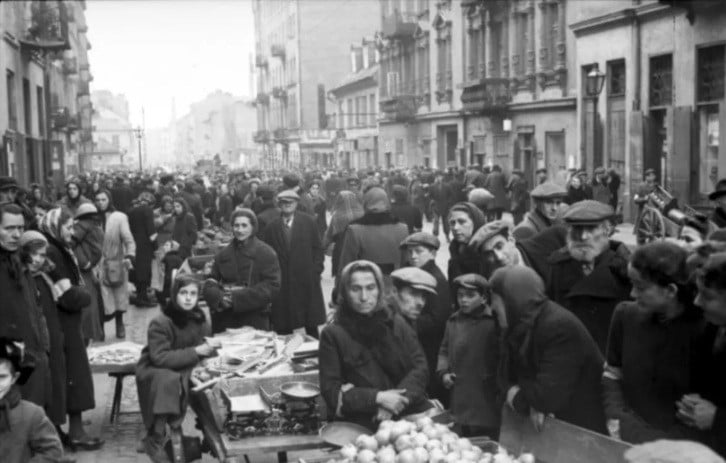
The mass shootings began in 1941. But in the Warsaw Ghetto, death by wall, ration card, disease, and cold had already begun.
Open most accounts of the Holocaust and you will find a hinge fixed on a single date: June 22, 1941, the morning Germany invaded the Soviet Union. Behind the advancing army came the killing squads, and the systematic murder of Europe’s Jews began in earnest. Serious historians use this date. It is not wrong, exactly. The genocidal phase, the mass shooting of Jews simply for being Jews, does open here.
But to call it the start of the Holocaust is to make a quiet, profound mistake. It assumes that murder begins at the moment it becomes visible. It does not.
By June 22, 1941, the deliberate killing of Jews as a matter of German policy was already a year old. It simply hadn’t looked like killing. It had looked like a wall, a ration card, a fever. To understand what really happened, you have to hold two machineries of death side by side: the one that announced itself, and the one that didn’t.
The killing did not begin when it became visible. It began when policy made survival impossible.
A wall, a year before
To see this, go to Warsaw, and meet a seven-year-old girl.
My mother-in-law, Edna, was a child behind the wall that the Germans sealed around the center of Warsaw in November 1940. More than four hundred thousand Jews were shut inside a few square miles, eight months before Barbarossa, before the Einsatzgruppen became the emblem of Nazi mass murder in the East. There was no invasion here, no advancing army, no morning you could circle on a calendar. There was only the wall, and behind it a number set on a piece of paper.
And consider that wall for a moment, because it tells you everything about the method. The Germans did not build it. They forced the Jews of Warsaw to build it themselves, brick by brick, ten feet high and topped with barbed wire and glass shards, and then made the Jewish community pay for the construction. The people inside were compelled to raise the very barrier that would seal them in to die. This was the signature of the quiet killing: it made its victims into its instruments, and it left the perpetrators’ hands clean enough to call the result natural.
A wall can be a weapon. So can a ration card.
The official ration for a Jew in the ghetto was a few hundred calories a day, a figure chosen by men who knew exactly what a body does on so little. Starvation was not a side effect of war. Starvation was the method. And it had partners. With almost no clean water and no working sanitation, the overcrowded ghetto became a breeding ground for disease, and typhus moved easily through streets where too many people were packed into too little space with too little food and no medicine. Winter brought another killer still: with little fuel and less shelter, the cold took the weak where hunger and fever had not yet finished. This was mass killing. It simply wore a disguise: it arrived as hunger, as fever, as a body found frozen in a doorway, as a death certificate that read natural causes over a person the state had condemned on purpose.
By the spring and summer of 1941, the very season historians mark as the beginning, Edna was already living inside a slaughter. She was seven years old and slipping through a gap in the wall near Smocza Street to find food, because the ration had been set at a level designed to kill her family slowly, and smuggling was the only thing standing between them and the number on the card. Children caught at it were shot. She went anyway. Around her, the dead lay on the pavement under sheets of newspaper, a few hundred each morning, and the carts came to take them away. No ravine. No photograph of the act. Only a slow, deliberate subtraction that had been underway for the better part of a year before the world’s idea of the Holocaust had even begun.
By June 1941, Edna was not waiting for the Holocaust to begin. She was already living inside it.
Tens of thousands behind that wall were dead before June 22, 1941. The silent killing did not follow the loud one. It came first. We just didn’t count it, because it came without a gunshot.
Then the killing got loud
On June 22, 1941, Germany launched Operation Barbarossa, the invasion of the Soviet Union, three million men crossing east on the largest front in the history of war. Behind the army came four mobile killing units, the Einsatzgruppen, whose work was not combat but murder. Town by town, they rounded up the Jewish population, marched them to the edge of the settlement, and shot them into pits.
This is the killing history finds easy to point at, because it has the terrible clarity of all loud violence. We can name its emblem: Babi Yar, the ravine outside Kiev where, over two days in late September 1941, more than thirty-three thousand Jews were shot. We can put a number to the campaign: somewhere between one and a half and two million people, killed by bullet across the occupied East. There are dates. There are places. There are even photographs, taken by the killers themselves, who seemed to want a record.
That same year, the men of Edna’s family were taken east to “labor” and never returned. They vanished into this faster machinery, the one with the trains and the pits, while the women and children behind the wall went on dying the slow way. One family, two methods. The Nazis were running both at once.
Why the quiet killing matters
It is tempting to measure atrocity by its drama, to reserve our horror for the ravine and the gas chamber, the killings that announce themselves. The Einsatzgruppen earn their place in memory because they are unmistakable. You cannot look at Babi Yar and tell yourself a comforting story.
But the wall asks something harder of us. It asks us to recognize murder that wears no uniform of violence: murder committed by a clerk with a ledger, by a number on a ration card, by the patient arithmetic of starvation, disease, and cold. Tens of thousands died this way in Warsaw alone, and many more across occupied Poland, before and alongside the shooting. They died so quietly that we strain to see them at all: a grandmother who simply grew weaker, a neighbor who stopped coming to the window, a child who was there in spring and gone by autumn, with no massacre to mark the loss.
Edna survived. Most of her family did not. What she carried out of that ghetto was the memory of this quieter death, the kind that never makes the history books the way Babi Yar does, and the kind that was killing her family a full year before the date we are taught to call the beginning.
Barbarossa shows us what the Nazis did when they wanted to kill quickly. The ghetto shows us what they did when they were willing to wait. Both were murder. One announced itself. One knew how to hide.
So when someone tells you the Holocaust began on June 22, 1941, you can grant them the date and still correct the claim. That was the day the killing got loud. It was not the day it began. The beginning was quieter, and earlier, and harder to look at: four hundred thousand behind a wall, a seven-year-old at the gap in it, and the slow, deliberate, almost invisible way a people can be made to disappear without a single shot being fired.