The perpetual cyberabbi!
When Does the Rabbi Get to Pray?
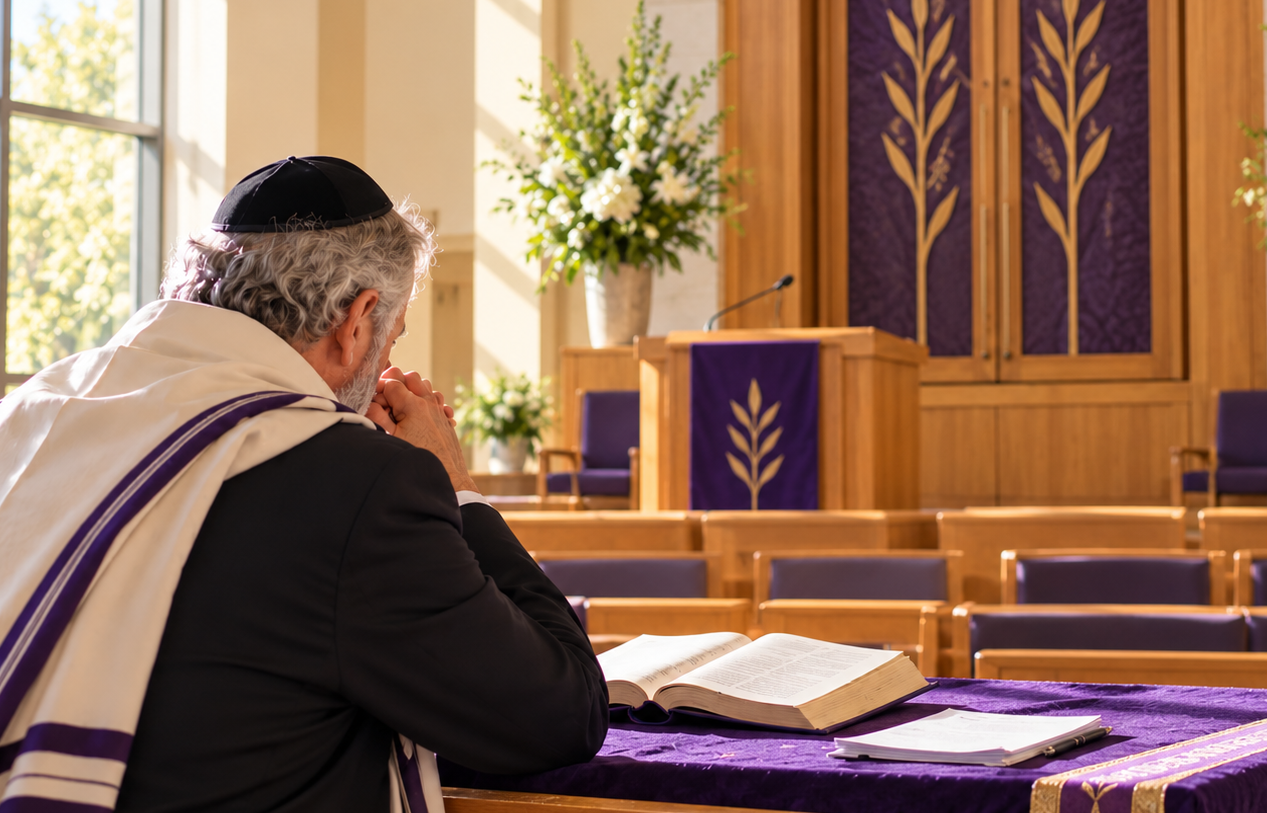
The spiritual paradox of producing other people’s religious experience.
This year, at the conclusion of Simchat Torah, I expected to feel something. We had reached the end of a long season that began with preparation for Rosh Hashanah, moved through Yom Kippur and Sukkot, paused for Yizkor, and finally arrived at the moment when we completed the Torah and immediately began again.
I imagined that transition might carry its own spiritual weight. We would finish Vezot HaBerakhah, return to Bereshit, and somehow experience what the ritual itself seems to promise: ending giving way to beginning, memory yielding to renewal. Instead, my internal response was remarkably prosaic. We finished. We began again. Now let’s move on. I confess that with some discomfort, because I was the rabbi leading the service.
My son Daniel, who is also a rabbi, has asked me more than once, “When do you have time for your own spiritual experience when you are busy producing and directing everyone else’s?” My standard answer has usually been, “That is what I do.” And I have meant it.
Preparing the service, teaching Torah, delivering the sermon, guiding the congregation, making sure every honor is handled properly, watching the emotional temperature of the room, and helping others encounter something sacred have always been part of my own avodah. I have never drawn a neat line between serving the congregation and serving God. But Daniel’s question stayed with me this year because Simchat Torah exposed something I had not wanted to examine too closely.
While members of the congregation may be praying, remembering, singing, or reflecting, I am trying to do all of those things while simultaneously asking another set of questions. Is the next Torah ready? Who has the next aliyah? Are we running too long? Did everyone who needed an honor receive one? Is the sound system working? What comes next? Someone has to carry the service while everyone else is allowed to inhabit it. And sometimes the person carrying it cannot inhabit it in quite the same way.
Afterward someone approaches and says, “Rabbi, that was a beautiful service. Your sermon really touched me.” I am grateful. But I also realize that what may have felt mechanical from my side may have been spiritually meaningful from theirs. I suppose that is part of religious leadership.
Still, another question has been troubling me. Several months ago, I learned that a congregant had described our services as “tedious.” My first instinct was to resist the characterization. But the word stayed with me. This Simchat Torah, when I found myself experiencing part of the service in much the same way, I heard it differently. If the rabbi, who understands the language, knows the choreography, and has spent a lifetime inhabiting these rituals, can sometimes experience them as tedious, what might they feel like to someone for whom much of the language and structure remains unfamiliar? Tedium is not proof that worship has failed. Repetition, Hebrew, silence, inherited liturgy, and ritual form are not defects to be edited away until prayer becomes entertainment. But neither should tedium simply be dismissed. Tedium is not a verdict. It is a pastoral datum. It asks whether people are inhabiting the service or merely watching it happen.
I serve a relatively small community composed primarily of seniors. In our congregation, Simchat Torah does not unfold amid crowds of children waving flags, young families filling the aisles, teenagers carrying Torah scrolls, and generations dancing together. Surely that changes something. Yet I wonder whether it would change the rabbi’s experience quite as much as I imagine. After nearly forty years of leading services, would Bereshit bara Elohim suddenly feel new simply because more people were dancing? Perhaps. Perhaps not.
When I read reflections from colleagues serving very different congregations, I sometimes hear echoes of the same tension. The details differ, but the question remains: what happens when clergy become increasingly responsible for producing the religious experience that everyone else has come to receive? We worry that technology can turn religious life into content, something watched, sampled, and consumed. But Jewish life can become content even when everyone is physically sitting in the sanctuary. If clergy become producers and the congregation becomes an audience, presence alone does not solve the problem. “Was the music good?” “Was the sermon moving?” “Did the service run too long?” “Did I get something out of it?” Those are understandable questions. But Jewish worship was never meant to be primarily something produced for us.
Jewish prayer has long lived with a tension between keva, fixed practice, and kavanah, inward intention. When keva becomes mere routine, prayer can become mechanical. Yet Judaism’s answer has never been to abolish repetition. We pray again. We return to the same words. We hear the same Torah portions. We arrive at Yom Kippur again. We say Yizkor again. And on Simchat Torah, we finish the Torah and immediately begin again. The problem is not repetition itself. It is what repetition can do to attention.
I believe the tradition knows something about us that we sometimes forget: we cannot manufacture transcendence on schedule. Some years the words penetrate us. Some years they do not. Sometimes kavanah fills the ritual. Sometimes keva carries us until kavanah returns. This year, beginning again did not feel particularly new. But we began anyway. And I hope that after nearly forty years, that too is a kind of faithfulness.
Still, Daniel’s question remains. Is faithfulness simply continuing to carry the Torah for others? Or must the person carrying it occasionally find a way to let the Torah carry him? And is it possible that the congregant who called the service tedious was asking, from the other side of the room, a version of the same question. Was asking: How do I enter this? Daniel was asking: When do you get to enter this?
Maybe the harder question, then, is not only when the rabbi gets to pray. It is when any of us, clergy or congregant, move from attending a service to entering into prayer. I am no longer satisfied with answering, “That is what I do.”
Somewhere inside all the producing, directing, teaching, organizing, listening, singing, and leading, I still need to remember that I, too, came to the sanctuary to pray.
Related Topics