
Notes from home and far away
When Empathy Hurts: Seeing the World Like an Animal
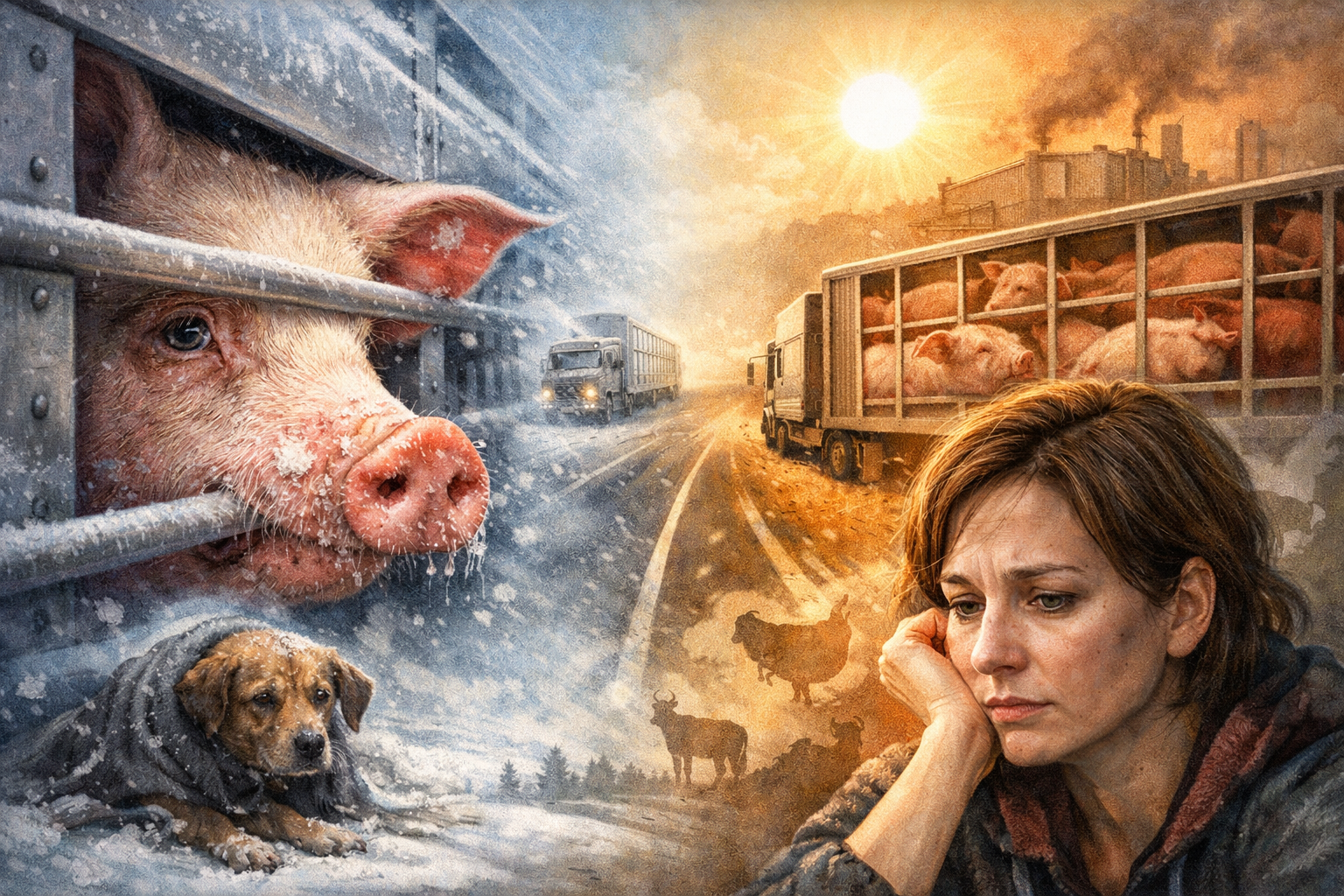
© 2026 Monique Dietvorst. All rights reserved. This image may be reused or shared with clear attribution and a direct link to the original blog post.
Why Animal Cruelty Stays With Me
Animal cruelty bothers me more than I can explain. It isn’t just something I read about and shake my head over. It stays with me. I think about it when I’m driving, when I’m trying to sleep, when I see transport trucks on the highway. It’s like I can’t turn it off.
Temple Grandin once said that she “thinks like an animal.” As an autistic person, she describes experiencing the world in vivid sensory images, which allows her to understand how animals feel in stressful environments. When I read her work, something clicked. I’m autistic too, and I sometimes wonder if this is why animal suffering hits me so hard. I don’t just intellectually understand it. I imagine it. I feel it.
Cruelty to Pigs
One example that has never left me is pigs.
Research has shown that pigs are highly intelligent and emotional animals. They can solve problems, recognize individuals, form bonds, and experience fear and stress. When I think about that, I can’t separate it from what happens in industrial farming. I stopped eating pork years ago because I couldn’t reconcile eating an animal that I believe is too smart, too aware, too emotionally complex to treat as a commodity.
When I picture a pig, I don’t see “livestock.” I see an animal with curiosity, memory, and fear.
The Transport That Haunts Me
What disturbs me deeply in Canada is the long-distance transport of farm animals to slaughterhouses. In winter, animals are transported in open or partially open trucks through freezing winds. In summer, they endure intense heat. These journeys can last many hours.
I think about what that actually feels like.
Imagine shaving a dog down to the skin in January and putting them in the back of an open truck on the highway in subzero windchill. Everyone would immediately recognize that as cruelty. There would be outrage. Charges would be laid.
But when it comes to farm animals, we normalize exposure to extreme weather during transport. We don’t picture them as individuals experiencing cold, heat, fear, and confusion. We use different language. We call it “agriculture.” We call it “standard practice.”
Yet physiologically, the suffering from exposure is real. Cold wind strips away body heat. Heat causes distress and dehydration. Animals can arrive at slaughter already compromised or dead. And I can’t stop thinking about what those hours must feel like from inside the truck.
Why It Stays With Me
I don’t think everyone visualizes suffering the same way. For me, it’s almost impossible not to imagine the perspective of the animal. I picture the wind on skin. The confusion of movement. The inability to escape. The stress of being packed together with other frightened beings.
Sometimes I wish I could think about it less. But I also believe that discomfort is a signal. It tells us something is misaligned.
It wouldn’t take much to improve transport conditions — better shielding from wind, temperature protections, stricter limits during extreme weather. These are practical engineering solutions. We already protect other animals from exposure. The gap is not technical; it’s moral and political.
Feeling Isn’t Weakness
For a long time, I thought being this affected meant I was overly sensitive. Now I’m not so sure. Maybe sensitivity is information. Maybe imagining the experience of another living being is not a flaw but a form of moral perception.
I don’t claim to have all the answers. I just know that when I see a livestock truck on a freezing day in Canada, I don’t see “product.” I see sentient beings in distress.
And I don’t think I will ever stop thinking about that.
Related Topics
Related Posts