
When Every Fact Is True, but the Story Is Misleading
Among my many WhatsApp groups is one concerned with antisemitism in Brookline and Newton, Massachusetts. A few months ago, a member shared an undergraduate thesis written by a newly hired eighth-grade history teacher at a Newton middle school.
The thesis raised troubling questions. In discussing the war in Gaza, it accused Israel of genocide and collective punishment, described Hamas merely as a “militant Palestinian nationalist group,” and omitted the October 7 massacre and the taking of hostages.
Equally troubling was its treatment of antisemitism on campus. During protests at the University of Connecticut, university president Radenka Maric was depicted in images featuring devil horns, dollar bills, missiles, and a horned boar—imagery university administrators condemned as antisemitic. Yet the thesis portrayed accusations of antisemitism against pro-Palestinian protesters as a means of suppressing their activism, describing protesters as being targeted “under the guise of scapegoating activists as antisemitic, aggressive or threatening.”
Students deserve to learn history from teachers who distinguish established facts from contested interpretations. I therefore decided to speak at the Newton School Committee meeting on September 14, 2026.
In my three-minute statement, I made an important distinction. While we had no evidence that the teacher had behaved improperly in the classroom, and her thesis did not establish that she was incapable of teaching impartially, it nevertheless raised legitimate questions about how the district ensures that controversial subjects are taught accurately and fairly.
While I expected disagreement, what surprised me was how the controversy itself would be portrayed in the local press.
What followed offered a firsthand illustration of how the news can shape a controversy as much through what it emphasizes and omits as through what it reports.
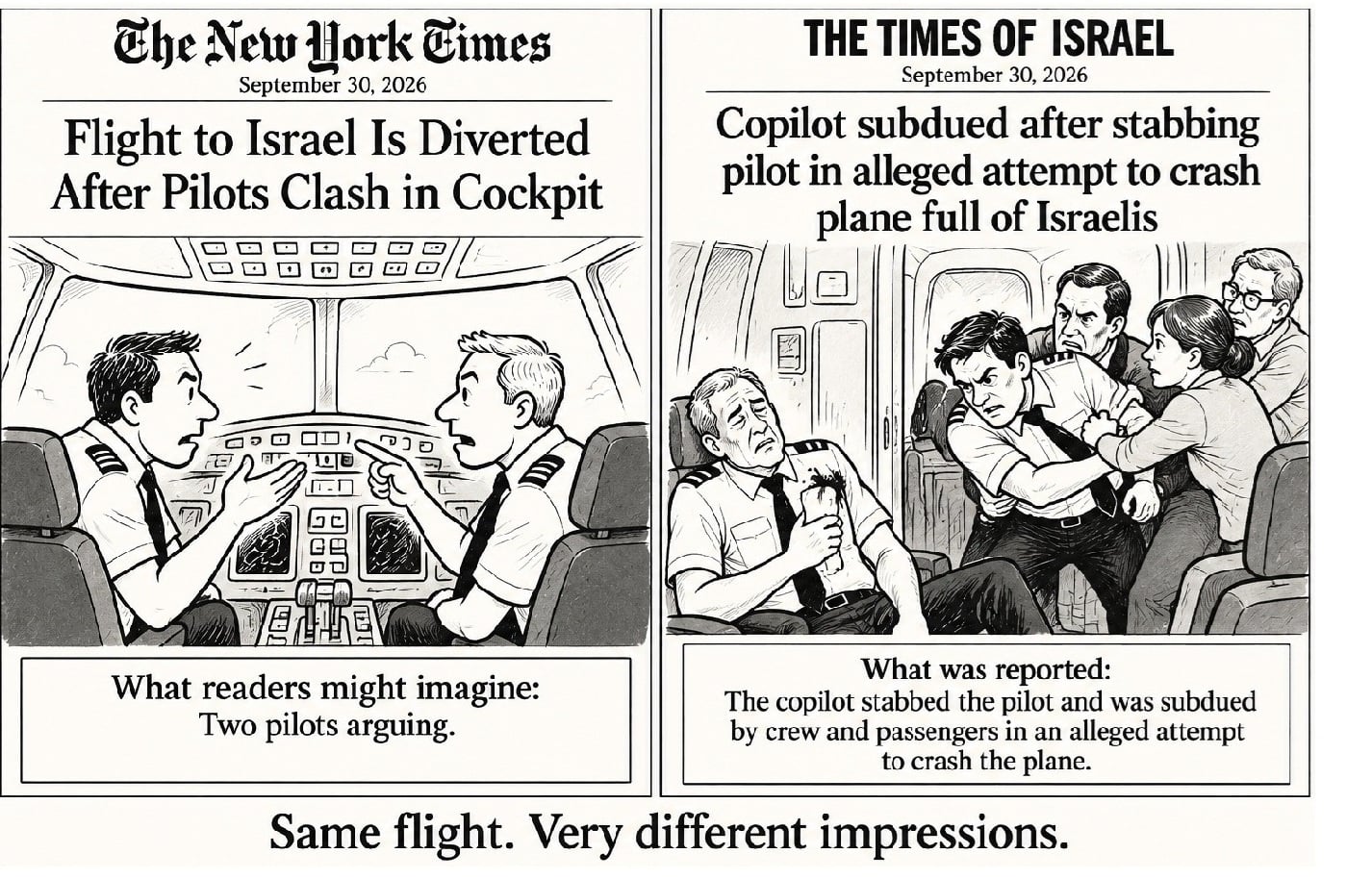
A news article can contain accurate facts and still leave readers with a misleading impression.
The problem is often not fabrication. It is framing—the selection of facts, the words used to describe them, the quotations included, the context supplied, and sometimes the decision not to cover a story at all.
How One Word Changes a War
The Newton Beacon, a local newspaper, reported on the controversy surrounding the teacher’s hiring, but I was struck by its description of the Israel-Hamas war.
The article stated that Hamas’s October 7 attack, in which approximately 1,200 people were killed and 250 taken hostage, prompted Israel’s “massive retaliation in Gaza.”
Retaliation?
Hamas had vowed to repeat the atrocities of October 7 again and again until Israel was destroyed. Israel also faced the urgent task of securing the release of its hostages and preventing further attacks on its citizens. How, then, can a military campaign undertaken to address these threats be characterized simply as retaliation?
The Beacon also reported that a United Nations commission had determined Israel committed genocide, while describing Israel as denying the accusation and claiming to target Hamas terrorists.
Missing was meaningful acknowledgment that the genocide accusation remains legally and factually contested. The U.S. State Department explicitly rejected allegations that Israel was committing genocide, describing them as unfounded. Military analysts have argued that Israel undertook extensive measures to minimize civilian harm, while UN Watch has documented what it regards as longstanding institutional bias against Israel within the United Nations system. None of these perspectives automatically invalidates the commission’s findings. But omitting them risks leaving readers with the impression that the commission’s conclusion was an established fact and Israel’s contrary position merely a denial.
What troubled me most was the irony. The article was about concerns over how contested political claims might be presented to schoolchildren. Yet its own language illustrated how easily contested interpretations can be presented as settled conclusions.
I wrote a letter to the editor explaining these concerns, and the Beacon published it.
When Raising Concerns Becomes “Targeting”
Another local publication, Sampan, published an editorial titled “Publicly Targeting Teachers, Students Is Such a Bad Look.”
The headline itself established a judgment about those of us who had raised concerns.
The editorial portrayed public scrutiny of the teacher’s hiring as inappropriate targeting. It also questioned why a Brookline resident would address the Newton School Committee.
But my concern was not about the teacher’s right to hold political opinions. Nor had I accused her of classroom misconduct. I had explicitly acknowledged that we possessed no such evidence.
My concern was whether parents could reasonably expect the district to ensure that controversial subjects would be taught with intellectual honesty.
There is an important difference between harassing an individual and questioning how a public institution fulfills its educational responsibilities. The editorial’s characterization blurred that distinction.
And why should my residence in Brookline invalidate my concerns? Antisemitism in education is hardly confined by municipal boundaries.
I submitted a response, but as of this writing, Sampan has not published it.
The contrast between the two publications was instructive. The Beacon reported on the controversy but used language that, in my view, tilted the reader’s understanding of the underlying conflict. Sampan went further, framing the act of raising concerns as itself objectionable.
Framing Through Selective Quotation
Unfortunately, I had encountered similar concerns in my community’s newspaper, Brookline.News.
In April 2026, the Brookline School Committee was considering revisions to its districtwide Student Civil Rights and Non-Discrimination Policy, which addresses discrimination, harassment, and protections for students from a wide range of backgrounds.
School Committee member Jesse Hefter proposed changes that included removing or revising terms such as “microaggression” and “bias-based conduct.” He questioned whether some of the language was sufficiently precise and whether it could interfere with students’ freedom of expression.
Students and school administrators strongly disagreed. They argued during a School Committee meeting that the proposed changes could weaken protections for students experiencing discrimination. But the discussion soon devolved into personal attacks.
Brookline.News reported the students’ criticisms and quoted one student saying that Hefter “should have been laughed out of the room.” The article also described the student’s distress about the implications of the proposed changes for transgender students.
What the article did not convey was the extraordinary hostility expressed in some of the students’ remarks. One student asked Hefter and other School Committee members, “Who do you want to kill?” Another said, “I think I hate you for letting Jesse Hefter get up there and just say that.”
Hefter is a visibly observant Jew. That does not establish that the remarks were antisemitic, and I would not claim otherwise without evidence. But I wonder whether comparable personal hostility toward another visibly identifiable minority official would have received more attention.
The issue is not whether the students’ concerns deserved coverage. It is whether readers also deserved to know how heated and personally hostile the discussion had become.
Framing Through Unnecessary Context
Another Brookline.News article concerned student artwork displayed at the Florida Ruffin Ridley School.
The artwork depicted a figure piercing an Israeli flag with a sharpened stick. Jewish and Israeli families objected, and school officials acknowledged that the display should not have occurred. The district subsequently introduced changes to its review procedures.
Brookline.News reported the incident and included the perspective of an Israeli parent who described its impact on his daughter.
But the article also introduced an unrelated controversy involving StopAntisemitism, the organization that had publicized the artwork, and the children’s entertainer Ms. Rachel, who had posted about Gaza.
The district had independently acknowledged that the display was inappropriate. Whatever readers thought of StopAntisemitism, its unrelated dispute involving Ms. Rachel did not change those facts.
Including that unrelated controversy had the effect of casting doubt on the legitimacy of the pro-Israel parents’ concerns about the artwork, rather than addressing the incident on its own merits.
Framing Through Silence
There is an even more consequential editorial choice: deciding which events deserve coverage.
In 2024, Brookline High School’s Day of Racial Reform and Solidarity, known as DoRRS, became the subject of controversy involving antisemitism, student speech, and concerns raised by Jewish parents.
The controversy generated substantial public comment at School Committee meetings. Parents questioned the handling of the event, and the School Committee chair subsequently criticized the parents’ intervention.
Yet Brookline.News did not cover any aspect of the controversy.
While a community newspaper cannot report every disagreement, when a controversy involving antisemitism, parental concerns, and a public school’s response generates substantial discussion at School Committee meetings, its complete absence from the local news deserves scrutiny. Readers cannot evaluate a controversy they never learned occurred.
Two Kinds of Violence, Two Different Narratives
These local experiences brought me back to a broader concern: international reporting about Israel, particularly violence in the West Bank.
Violence by extremist Israeli settlers against Palestinians is real, serious, and deserving of condemnation. Palestinians have been killed and injured, homes and property have been damaged, and communities have experienced intimidation and displacement.
But Palestinian violence against Israelis is also real and recurrent. It includes shootings, stabbings, vehicle attacks, firebombings, and stone-throwing capable of causing serious injury or death.
Yet to many of us who follow coverage of the region closely, it often seems that Israeli violence against Palestinians receives greater and more sustained attention.
In an October 22 Wall Street Journal commentary, Elliot Kaufman contrasted an Israeli settler attack that received international attention with a Palestinian rock attack days later on a vehicle carrying former Jerusalem deputy mayor Fleur Hassan-Nahoum. The latter shattered a car window but, according to Kaufman, received little attention outside pro-Israel media.
I had been considering the same question after hearing British lawyer Natasha Hausdorff criticize international reporting on West Bank violence.
That prompted me to undertake a detailed examination of coverage by AP, Reuters, BBC, The New York Times, and The Guardian during January through September 2026, alongside Israeli security statistics, international data, and analyses by HonestReporting and Regavim.
What I found was that serious Palestinian attacks that kill Israelis do receive international coverage. Reuters, AP, and The New York Times, for example, prominently reported a September shooting in which a Palestinian gunman killed an Israeli civilian.
Nevertheless, I found a recurring difference in how the two types of violence were portrayed. In the coverage I examined, Palestinian attacks against Israelis tended to be reported as individual incidents, while settler violence against Palestinians was more often presented as part of a broader, ongoing pattern. The result was that readers might recognize settler violence as a persistent problem without appreciating that Palestinian violence against Israelis is also a continuing threat.
For instance, a Reuters headline from July 23, 2026, emphasized Palestinians killed in West Bank violence, although the incidents included Palestinian stabbing attacks that wounded Israelis. The attacks were reported in the body, but the Palestinian fatalities defined the headline.
Over time, such coverage can leave readers with the impression that Israeli settlers are the aggressors and Palestinians primarily their victims, while obscuring the persistent threat of Palestinian terrorism against Israelis. This incomplete picture can foster hostility toward Israel by portraying it as a source of violence and oppression rather than a country also confronting serious security threats.
Even an Article About an Israeli Opposition Leader
A recent New York Times profile of Gadi Eisenkot, the former Israeli military chief challenging Benjamin Netanyahu, offered another illustration.
The article included these two sentences: “Extremist Jews are marauding through Palestinian villages in the West Bank. Organized criminals are killing Arab citizens.”
Both describe genuine problems. Extremist settler violence against Palestinians is serious and must be confronted. So is the organized crime that has devastated Arab communities within Israel.
But consider what readers are not told.
There is no corresponding reference in those sentences to Palestinian terrorists attacking Israelis in the West Bank. And the reference to criminals killing Arab citizens gives no indication that much of the violence involves Arab criminal organizations operating within Arab Israeli communities.
Although the sentences describe real problems, they leave readers with two images of Israel: Jews attacking Palestinians and Arab citizens being killed by criminals whose identities readers unfamiliar with the situation might reasonably assume are Jewish Israelis.
The omission is especially striking because the article was primarily about Eisenkot’s challenge to Netanyahu, not an investigation of either phenomenon. The authors chose to include these details as part of the political backdrop, but without the context needed to understand them fully.
This kind of framing frustrates me.
I do not expect newspapers to ignore Israeli wrongdoing. Nor do I want the terrible violence committed by extremist settlers excused or minimized. But I do expect readers to receive enough context to understand who is doing what to whom, and why.
The Frustration of Seeing the Same Picture Again and Again
For those of us who care deeply about Israel, the frustration is cumulative.
We read about settler violence, but too often see little sustained attention to Palestinian attacks against Israelis. We encounter descriptions of Israeli military action that emphasize retaliation or destruction while giving less prominence to the threats that prompted it. We see accusations against Israel presented with institutional authority while counterarguments are reduced to denials.
Repeated over time, such descriptions and omissions can contribute to the demonization and delegitimization of the Jewish state.
And when we object, we sometimes find that the objection itself becomes the story. Raising questions about a teacher’s thesis becomes “targeting.” Challenging a contested accusation becomes “denial.” Asking for fuller coverage of Palestinian violence risks being interpreted as an attempt to excuse settler violence.
It can begin to feel as though there is no acceptable way to ask for a more complete account.
I cannot establish how much of the growing hostility toward Israel in American public discourse is attributable to media framing. The conduct of the war, political ideology, social media, and many other factors contribute to public attitudes.
But journalism unquestionably influences which events people encounter and how they understand them. When similar omissions and emphases recur across publications, it is reasonable to question their cumulative influence.
For Jews, the consequences may extend beyond attitudes toward the Jewish state. Criticism of Israel is not inherently antisemitic, but hostility toward Israel can spill over into hostility toward Jews, especially when Jews are treated as collectively responsible for Israel’s actions.
That makes the responsibility of journalists all the more serious.
What Can Readers Do?
Recognizing framing is one thing. Challenging it is another.
I have written letters to editors pointing out what I believe were misleading characterizations or omissions. Some have been published; others have not. I have also spoken directly with people involved in local journalism.
Recently, after raising concerns about several Brookline.News articles and its failure to cover the DoRRS controversy, I spoke with Ellen Clegg, one of the newspaper’s cofounders and a member of its board.
I found her gracious, thoughtful, and willing to listen. Although we did not agree on everything, she acknowledged some shortcomings in the newspaper’s coverage.
I appreciated the conversation. But a constructive exchange, however welcome, is not the same as meaningful change. Whether it leads to more complete and balanced reporting remains to be seen.
That distinction matters because I believe local journalism has a particular responsibility to its community.
It is difficult for an ordinary reader to influence the editorial decisions of The New York Times or another major national publication. Letters may go unpublished, corrections may be narrowly confined, and even well-documented criticism can disappear into an enormous institution.
But local newspapers are different.
They report on institutions whose leaders, employees, students, and families live among their readers. Their journalists can attend public meetings, speak directly with people who believe their concerns have been overlooked, and hear firsthand how their reporting is received.
More importantly, local readers are often in a position to know what actually happened.
When a newspaper reports on a School Committee meeting, community members may have attended the meeting themselves. They can consult recordings, examine public documents, compare accounts with other witnesses, and identify important statements that were omitted.
They do not have to rely entirely on the newspaper’s version of events.
Contrast that with an American reading about a confrontation in a Palestinian village thousands of miles away. Most readers have no firsthand knowledge of what occurred, no practical means of interviewing witnesses, and limited ability to determine whether the account they are reading provides the full context.
They depend heavily on journalists to make those judgments for them.
This is why local journalism offers a particularly important opportunity to challenge misleading framing. Readers may not be able to independently verify what happened in a distant conflict, but they can often verify what happened at their own School Committee meeting.
And if a local newspaper’s account differs from what witnesses observe or public records establish, readers have a basis for asking questions and expecting answers.
A local newspaper should therefore be especially willing to examine whether it has missed an important story, presented a controversy incompletely, or inadvertently marginalized the concerns of part of the community it serves.
And its readers should be willing to hold it accountable.
That means more than expressing outrage on social media. It means identifying specific omissions, documenting what occurred, distinguishing legitimate disagreement from factual error, and writing letters to editors that challenge the choices shaping their coverage.
My experience with the Newton school controversy reinforced concerns I had long held about journalism. Teachers and journalists alike shape how people understand the world. Both have a responsibility to distinguish facts from interpretations, provide essential context, consider competing evidence, and remain open to correction.
But the stakes extend beyond intellectual fairness.
When the same omissions and emphases recur across hundreds of stories, the consequences are no longer confined to the page. They can shape public opinion, influence political debate, and contribute to hostility toward people whose experiences have been incompletely represented.
For those of us who have watched this happen repeatedly in coverage of Israel, the frustration is real. So is the concern about where it may lead.
The answer is not to demand that journalists tell our preferred story. It is to insist that they tell a fuller one—and to hold them accountable when they do not.