
CEO of Time to Stand Up for Israel
When Every Tragedy Must Become Gaza
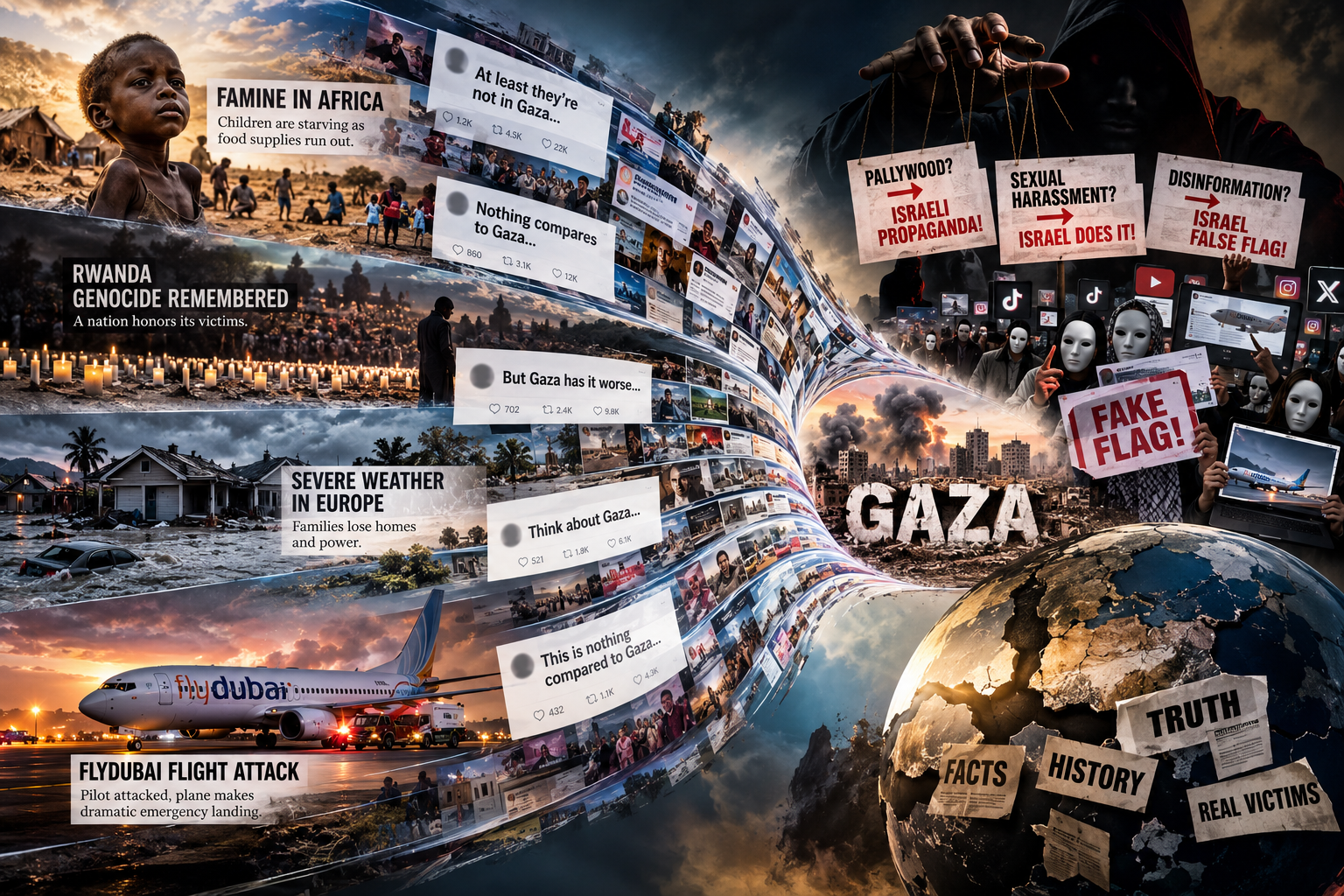
Photo Credits: Sabine Sterk ( AI )
There is a pattern in the international conversation about Israel that has become increasingly difficult to ignore. Wherever suffering appears in the world, no matter how distant, unrelated or historically distinct, someone seems determined to redirect it toward Gaza. A famine strikes part of Africa and before the victims have even been given the dignity of being heard in their own right, social media fills with comments insisting that Gaza has it worse. Rwanda remembers the victims of one of the most horrific genocides of modern history, and instead of allowing Rwandans to commemorate their dead, people arrive to turn their tragedy into another argument about Gaza. Severe weather hits Europe, families lose their homes, communities are flooded and people are left without electricity, and underneath the reports appear the inevitable comments that at least they are not living in Gaza. This is presented as compassion, but I increasingly believe it is precisely the opposite. It is the appropriation of somebody else’s suffering for a political cause.
Real empathy does not require a hierarchy of victims. If a child is starving in Sudan, that child does not become more or less deserving of our compassion depending on what is happening in Gaza. If a family loses everything in a flood, their grief does not require a geopolitical comparison before we are permitted to acknowledge it. If Rwandans remember relatives murdered during the genocide against the Tutsi, their memorial is not an empty stage waiting for someone else to climb onto it carrying a Palestinian flag. Human suffering should never become a competition, because the moment we begin ranking victims according to political usefulness, we have stopped seeing victims as human beings. They become instruments. Their pain becomes currency.
This obsession becomes even more disturbing when history itself is dragged into the same machinery. Jewish history is questioned, Jewish identity is rewritten, Jewish connections to the land of Israel are dismissed, and evidence that would normally be accepted in almost any other historical discussion suddenly becomes suspicious when it supports Jewish continuity. Archaeology becomes propaganda. Ancient texts become propaganda. Jewish communities that existed centuries before the modern conflict are treated as inconvenient details. Even the language surrounding Israel is constantly manipulated until people are encouraged to believe that Jewish history somehow began in Europe and that Jews simply appeared in the Middle East in the twentieth century. The irony is extraordinary. A movement that constantly demands recognition of its own historical narrative increasingly seems unable to tolerate a Jewish historical narrative existing alongside it.
There is also a psychological character to this rhetoric, although we should be careful not to diagnose millions of individuals whom we do not know. What can legitimately be examined is the behavior itself. When every conversation must return to one grievance, when the suffering of another community can only be acknowledged after being converted into evidence for your own cause, and when another people’s history has to disappear for your narrative to survive, the pattern begins to resemble narcissistic behavior. Everything must orbit the same center. There is little room for complexity, competing experiences or the uncomfortable possibility that two peoples can possess histories at the same time. There is even less room for Jewish victimhood, because acknowledging Jews as victims interferes with a worldview in which Israel must permanently occupy the role of villain.
And now I see another development that concerns me even more. Accusations traditionally directed by Israel and Israelis toward their enemies are increasingly mirrored back almost word for word. Israel exposes staged or manipulated propaganda and suddenly Israel itself is accused of staging everything. Israelis speak about sexual violence committed during terrorism and soon Israel is accused of fabricating sexual violence or committing equivalent crimes itself. Israel warns about disinformation and immediately the accusation becomes that Israeli information itself is disinformation. The purpose appears less about establishing what actually happened and more about destroying the possibility that any fact can ever be established. Every accusation is reflected back until perpetrator and victim become indistinguishable.
The attempted attack aboard Flydubai Flight FZ1073 demonstrated how quickly this mechanism can operate. On September 30, a flight bound from Dubai to Tel Aviv descended dramatically after the captain was attacked in the cockpit, with passengers and other pilots ultimately helping bring the crisis under control and the aircraft landing safely in Saudi Arabia. Authorities have continued investigating the circumstances and motive, but what happened online was revealing in its own right. Within roughly an hour, claims were already spreading that Israel, Mossad or Prime Minister Benjamin Netanyahu had staged the incident as a false flag. Thousands of such posts reportedly appeared within the first twelve hours. The investigation had barely begun, yet for some people the conclusion was apparently already available: if Israelis were potential victims, perhaps Israel itself must somehow be responsible.
That response should worry everyone, regardless of their position on Israel. We have entered an information environment in which evidence can arrive second and ideology first. Something happens, photographs emerge, witnesses speak, authorities investigate, flight data becomes available, but millions of people have already chosen the explanation that best fits what they wanted to believe beforehand. The internet then rewards the most sensational version. Algorithms do not ask whether something is true before spreading it. Artificial intelligence can accelerate the production of convincing images, videos, statements and narratives, while social media can distribute them around the planet before professional investigators have even established the basic facts. The result is not merely misinformation. It is the erosion of the concept of truth itself.
Israel is particularly vulnerable to this because the accusations against it have become self sustaining. If Israel responds quickly, people say the response was prepared in advance and therefore proves conspiracy. If Israel waits, the silence is called suspicious. If Israel releases evidence, the evidence is called fabricated. If Israel does not immediately release intelligence, people claim there is no evidence. If Israelis survive an attack, conspiracy theories appear claiming that the attack was staged. If Israelis die, their deaths can be minimized, justified or explained away. It creates an intellectual trap in which no possible Israeli response is permitted to establish innocence because guilt has already been chosen as the starting point.
October 7 demonstrated the danger of that mentality with brutal clarity. Even while Israelis were still identifying murdered relatives and searching for kidnapped family members, denial and justification began appearing. The normal sequence of evidence followed by judgment had been reversed. Judgment came first. Facts were permitted only when they supported the predetermined conclusion. This is how propaganda ultimately becomes more dangerous than an ordinary lie. A lie attempts to convince you of something false. A sophisticated propaganda system tries to make you believe that objective truth itself does not exist, leaving ideology as the only remaining compass.
And this is where I believe the world should be extremely careful. Turning reality upside down may feel like political activism when it is confined to social media, but societies cannot function indefinitely when facts become optional. Courts depend on evidence. Journalism depends on verification. Democracy depends on citizens being able to distinguish disagreement from fabrication. Human rights depend on our willingness to recognize victims even when their identity makes us uncomfortable. If we reach the stage where an event can simply be declared fake because the victims are Israeli, while every unverified allegation against Israel is immediately accepted because it confirms an existing prejudice, we have abandoned every standard we claim to defend.
Supporting Israel does not require believing that Israel is incapable of making mistakes, nor should it. Israel is a democracy whose government can be criticized, investigated and replaced by voters. But criticism and demonization are not synonyms, and skepticism and conspiracy theories are not the same thing. Israel should be judged according to evidence, just as every other country should be. Israelis should be allowed to be victims when they are victims, just as Palestinians should be allowed to be victims when they are victims, without either reality requiring the destruction of the other.
Compassion that can only exist for one people is not compassion. Justice that requires erasing another people’s history is not justice. A political narrative that survives only by consuming every famine, every war, every natural disaster and every historical tragedy around it should invite serious scrutiny. And a movement that responds to uncomfortable evidence simply by reversing every accusation against its opponent risks creating a world in which nothing can ever be proven because everything can instantly be dismissed as propaganda.
That is the real danger. When we lose the ability to say that something happened because the evidence demonstrates that it happened, we do not merely lose an argument about Israel. We lose our common reality. And once a society decides that truth is whatever best serves its preferred political narrative, turning the world upside down becomes remarkably easy.
Getting it upright again may prove much harder.
Related Topics
Related Posts