When Evil Becomes a State: From 1979 to October 7
The most dangerous form of political evil is not the fanatic shouting in the street, the terrorist carrying a rifle, or even the revolutionary preaching hatred from a podium. History has known all of them, and societies have often survived them. The greater danger begins when fanaticism captures the state itself—when an ideology of hatred inherits ministries, courts, intelligence services, prisons, armed forces, diplomatic missions, national wealth and the legal authority of government. At that moment, violence ceases to be an occasional crime committed against the political order and becomes part of the political order itself. This is the deeper meaning of what happened to Iran in 1979. The revolution did not merely replace one government with another; it gradually transformed a modern state into the institutional vessel of a revolutionary ideology whose survival came to depend upon repression at home and permanent confrontation abroad.
Nearly half a century later, the Middle East is still living with the consequences. Reports that the Islamic Republic is attempting to revitalize its network of armed proxies and prepare the ground for a possible multi-front assault against Israel should therefore be understood as something larger than another episode in the Iran-Israel conflict. According to the Israeli intelligence assessments described in recent reporting, officials of the Islamic Revolutionary Guard Corps have been meeting with Hezbollah, the Houthis and Iraqi militias, rebuilding missile and drone inventories, conducting joint training and attempting to restore the operational strength of the so-called Axis of Resistance. If these assessments are accurate, Tehran is not simply preparing for another exchange of missiles. It is contemplating the regionalization of the logic of October 7: simultaneous pressure from several fronts designed to overwhelm Israel militarily, psychologically and strategically.
This is precisely where 1979 becomes indispensable to understanding 2026. Political barbarism does not normally arrive fully formed. It develops through institutions. First an ideology divides humanity into believers and enemies, revolutionaries and traitors, the righteous and the corrupt. Then the state begins to translate those categories into policy. Courts punish ideological deviation; intelligence agencies pursue political enemies; prisons become instruments of social discipline; military organizations acquire theological missions; and foreign policy ceases to be primarily the management of national interests and becomes an extension of revolutionary mythology. Over time, violence is no longer regarded as an unfortunate necessity. It is moralized, sanctified and eventually bureaucratized. Once that process is complete, fanaticism possesses not merely followers but budgets, missiles, intelligence networks, military academies, clandestine organizations and generations of trained operatives.
The Islamic Revolutionary Guard Corps represents perhaps the clearest institutional expression of that transformation. It was never designed merely to defend Iran’s territorial borders in the conventional sense. It was created to defend a revolution and ultimately developed the means to project that revolution beyond Iran. Across decades, Tehran invested enormous resources in relationships with Hezbollah, Palestinian armed organizations, Iraqi militias, the Houthis and other actors. These organizations are not identical, nor should serious analysis pretend that every decision they make is dictated minute by minute from Tehran. Yet the strategic architecture connecting many of them to the Islamic Republic is impossible to ignore. Weapons, training, money, technology, political sponsorship and ideological encouragement created an ecosystem in which Tehran could project power across the region while maintaining varying degrees of distance from the violence committed in its name or in pursuit of shared objectives.
October 7 exposed the monstrous potential of such an ecosystem. Hamas’ assault demonstrated how quickly a border could collapse, how rapidly civilian communities could become killing grounds, and how a few hours of organized barbarism could transform the strategic landscape of an entire region. Israeli assessments have indicated that Yahya Sinwar hoped the attack would ignite a much wider confrontation and draw other fronts into the war. That full-scale regional invasion did not occur on October 7. But if current intelligence assessments are correct, the Islamic Republic is now studying precisely the possibility that failed to materialize then: transforming a devastating single-front surprise into a coordinated regional assault involving multiple armed organizations and theaters simultaneously.
The Shiite clerical regime and the Revolutionary Guard junta have never concealed that their revolutionary project extends beyond hostility toward Israel; hostility toward the United States has been embedded in the political identity of the Islamic Republic from its earliest years. Khamenei spent decades nurturing, financing and empowering the regional architecture around Hamas, Hezbollah, the Houthis and other armed organizations and directing this machinery of pressure toward Israel. When the atrocities of October 7 occurred, Tehran immediately sought distance from direct operational responsibility and denied prior knowledge of the attack. Yet there is a profound difference between proving that Tehran selected the date and operational details of October 7 and recognizing who spent decades helping to build, arm, finance and glorify the militant ecosystem from which such violence emerged. Khamenei repeatedly predicted the destruction of Israel within twenty-five years and made that objective part of his political mythology. In the end, according to reports surrounding his death in the 2026 war, it was Khamenei—not Israel—who disappeared during the opening phase of the conflict. The historical irony was brutal: the ruler who had spent years placing an expiration date on another nation did not survive to see his prophecy fulfilled, and the machinery of confrontation he helped construct ultimately consumed the world he had imagined himself controlling.
There is something profoundly revealing in this contradiction. Revolutionary dictatorships often imagine history as an obedient instrument. They issue predictions in decades, speak of civilizations as though they were temporary obstacles, and convince themselves that ideological certainty can substitute for political reality. Khamenei’s prediction about Israel belonged to precisely this tradition of revolutionary arrogance. Yet states and civilizations do not disappear because a ruler announces their expiration date. More often, regimes obsessed with destroying external enemies gradually exhaust themselves internally. They divert national wealth toward military adventures, replace economic rationality with ideological priorities, drive talented citizens abroad, suppress intellectual life and eventually discover that the state they claimed to strengthen has been hollowed out by the very ideology supposedly protecting it.
This is the great Iranian tragedy of the past half-century. Iran did not enter history in 1979. It entered that revolution carrying thousands of years of civilization, literature, political memory, philosophy, commerce, art and statecraft. Yet the Islamic Republic progressively reduced the international image of this immense civilization to the vocabulary of hostage crises, revolutionary militias, political executions, terrorism, proxy warfare, nuclear confrontation and chants of death against other nations. The catastrophe is not simply that the clerical regime has damaged Iran’s relations with the outside world. It is that an ideological state has repeatedly forced an ancient nation to pay the material and moral costs of ambitions that belong to the ruling system rather than to the ordinary aspirations of the Iranian people.
The alleged preparations for another October 7-style operation therefore illuminate something larger than an intelligence warning. They demonstrate how revolutionary violence reproduces itself when it is allowed to survive institutionally. A terrorist organization can be dismantled; a commander can be killed; a missile depot can be destroyed. An ideological system is more difficult because it reproduces the assumptions that created those instruments in the first place. Destroy one arsenal and another can be built. Eliminate one commander and another can be promoted. Defeat one proxy and another organization can be cultivated. As long as the political center continues to regard permanent conflict as both legitimate and necessary, military setbacks may interrupt the machinery without eliminating the doctrine that keeps rebuilding it.
That is also why the distinction between survival and governance matters so profoundly in the case of the Islamic Republic. A government may become extremely skilled at preserving itself while becoming progressively worse at governing its country. It can perfect surveillance while failing to create prosperity. It can build ballistic missiles while its infrastructure deteriorates. It can finance armed organizations thousands of miles away while citizens at home confront economic insecurity. It can intimidate neighboring countries while becoming incapable of inspiring its own population. In such systems, external conflict eventually acquires an internal political function: the permanent enemy helps justify the permanent emergency, and the permanent emergency helps justify the permanent rule of the revolutionary elite.
The history of the Islamic Republic consequently offers a darker philosophical lesson about the nature of political evil. Evil becomes historically consequential not merely when cruel people commit cruel acts, but when cruelty is converted into an institution and the institution acquires permanence. Language is corrupted first: repression becomes security, fanaticism becomes resistance, assassination becomes justice and death becomes martyrdom. Institutions follow. Eventually the distinction between governing and fighting begins to disappear, because the state understands itself not as the administrator of a country but as the command center of an unfinished revolution. Once a political order reaches that stage, conflict is no longer an emergency from which it seeks escape. Conflict becomes part of the reason for its existence.
This is why the possibility of another October 7 cannot be understood solely by studying Hamas, Hezbollah, the Houthis or any individual militia. The larger question is the political architecture that has connected revolutionary ideology to organized violence across generations. It began when the state created in 1979 made ideological confrontation a component of its identity, developed institutions dedicated to preserving and exporting that revolution, and gradually constructed a regional network capable of extending the battlefield far beyond Iran’s borders. October 7 revealed one terrifying expression of that environment. A coordinated multi-front repetition would represent something even more dangerous: the evolution of massacre from terrorist operation into regional strategy.
The world should therefore understand what is ultimately at stake. The fundamental problem is not one missile factory, one militia, one commander or even one supreme leader. It is the transformation of fanaticism into statecraft. When a destructive ideology captures the institutions of a nation and is given decades to reproduce itself, hatred acquires bureaucracy, theology acquires weaponry, propaganda acquires intelligence services and revolutionary fantasy acquires missiles. What began in Iran in 1979 was therefore not merely a change of government whose consequences remained within Iran. It was the beginning of a political experiment in which an ancient civilization was subordinated to an ideological regime that learned how to institutionalize violence at home and export instability abroad. Nearly half a century later, from the ruins left by October 7 to the possibility of another coordinated regional assault, the Middle East is still paying the price. The ultimate warning of 1979 is painfully simple: when evil seizes a state, barbarism no longer needs to operate from the shadows. It inherits the state itself.
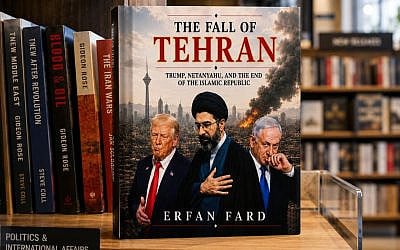
When evil captures a government, it does not remain an idea. Given enough years, it acquires uniforms, intelligence networks, prisons, missiles, proxies and graves. The tragedy that began in Iran in 1979 is that an ancient civilization was forced to watch an ideology turn brutality into an institution—and then export the consequences far beyond Iran’s borders. The Fall of Tehran