
Expose hate. Educate with integrity. Empower through action.
When Evil Becomes Normal – Surrending to Extremism
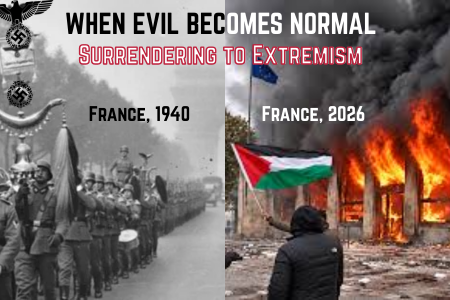
WHEN EVIL BECOMES NORMAL: THE COURAGE TO STAND AGAINST THE MAJORITY
WHEN EVIL BECOMES NORMAL: THE COURAGE TO STAND AGAINST THE EVIL
From Noah to Nazi Europe, from Soviet refuseniks to today’s fight against antizionism — history reminds us that righteousness is not determined by numbers.
Evil Is Not New. Neither Is the Courage to Resist It.
In Parashat Noach, the Torah tells us: “Noah was a righteous man, blameless in his generation.” — Genesis 6:9
Noah lived in a world consumed by corruption, violence, and moral decay. He was surrounded by wrongdoing, yet he refused to surrender his moral compass. He did not measure righteousness by the number of people who agreed with him. He did not conclude that because corruption had become widespread, corruption must therefore be right.
Noah reminds us of a timeless truth: Just because evil becomes the majority does not make it righteous. And just because we are outnumbered does not mean we are on the wrong side of history. Thousands of years later, humanity continues to confront the same moral challenge.
What happens when hatred becomes normalized? When lies become accepted truths? When decent people remain silent because confronting wrongdoing is uncomfortable, unpopular, or dangerous? And perhaps the most important question of all: What happens to a society when it can no longer distinguish between good and evil?
Jew-Hatred: The Moral Test of Every Society
Throughout history, the treatment of Jews has revealed something profound about the moral character of the societies in which they lived.
As Dr. Naya Lekht explains in her Three Eras Framework of Jew-Hatred, in the era of religious anti-Judaism, Jews were portrayed as enemies of God. In the era of racial antisemitism, Jews were portrayed as enemies of racial and national purity. Today, in the third era of Jew-hatred, antizionism increasingly portrays Jews and their national self-determination as enemies of humanity, justice, and human rights. The accusations change. The language changes. The ideological justification changes. But the underlying mechanism remains disturbingly familiar: transform Jews into the embodiment of evil, and hostility toward them becomes not merely acceptable, but supposedly virtuous.
This is why Jew-hatred is more than a Jewish problem. A society that cannot protect its Jews is a society failing one of the most fundamental tests of its own moral and democratic principles. When a society begins tolerating the intimidation, exclusion, or persecution of Jews, it is not merely abandoning a minority. It is undermining the principles of justice, equality, and freedom upon which its own survival depends.
Europe Then and Now: Has Europe Learned Anything From History?
In the 1930s, much of Europe was gripped by moral confusion, political paralysis, and a dangerous willingness to appease extremism.
As Nazism gained power, European governments underestimated Hitler, pursued appeasement, and failed to confront the growing threat until it was too late. Millions of Europeans accommodated, supported, or remained silent in the face of an ideology that openly identified Jews as the enemy.
The Nazis portrayed Jews as the source of society’s problems. The elimination of Jewish influence, rights, and ultimately Jewish existence was presented as necessary for Germany’s national salvation.
And what happened?
France surrendered to Nazi Germany in 1940 and helped deport Jews to their deaths. Across occupied Europe, governments and institutions participated in persecution or failed to protect their Jewish populations. There were courageous exceptions, but they did not erase the catastrophic consequences of collaboration, appeasement, and surrender.
Europe did not save itself through appeasement. Nazi Germany was defeated through years of brutal warfare and the extraordinary sacrifices of the Allied forces — including the Soviet Union, the United States, Britain, and their allies. It took an enormous coalition, tremendous courage, and millions of lives to defeat an ideology that had brought much of Europe under its control.
And now, more than eight decades later, we must ask an uncomfortable question: Has Europe learned anything from history? Today, we see another dangerous ideological convergence: Islamist and Marxist movements finding common cause through their hostility toward Western democracies, including Israel. Under the banner of human rights, liberation, and resistance, violence against civilians is justified, terrorism is romanticized, and Jews are once again portrayed as the obstacle to justice.
More than 80 years ago, the Jew was accused of threatening racial and national purity. Today, the Zionist is accused of threatening humanity, justice, and peace. Different languages. Different ideological banners. The same dangerous mechanism of demonization.
And once again, too many European institutions appear confused about the difference between defending democratic freedoms and accommodating extremism that seeks to undermine those freedoms.
Look at France. France’s surrender in 1940 remains one of the most dramatic examples of a European state collapsing before Nazi aggression. Today, 86 years later, France is on fire and surrendering again to extreme ideologies — Islamist extremism fueling violence, intolerable levels of Jew-hatred, political radicalization, and deepening social fragmentation that is tearing French society apart.
The question is disturbingly familiar: At what point does tolerance of intolerance become surrender?
How many acts of intimidation must occur before authorities respond decisively? How much hatred must be normalized before society recognizes that something is fundamentally wrong? When political leaders excuse extremism, when institutions hesitate to enforce the law, and when ordinary citizens become afraid to speak, democratic society begins surrendering its principles.
And perhaps the most alarming parallel is the recurring portrayal of Jews as the problem that society must eliminate.
In Nazi Europe, the Jew was cast as the enemy. Today, antizionist extremists portray the Zionist, and increasingly the Jewish state itself, as the enemy whose elimination will supposedly bring justice and peace.
Europe must not once again confuse the persecution of Jews with the salvation of society. We should not have to wait for another catastrophe to understand where this kind of moral confusion can lead. History has already shown us the consequences. The question is whether Europe has the courage to recognize the pattern before it is too late.
Canada Then and Now: Is Canada Repeating Its Most Shameful History?
Canada must not imagine that these warnings apply only to Europe. Canada has its own shameful history of excluding Jews, tolerating Jew-hatred, and remaining silent when moral courage was required.
During the Holocaust, as Jews desperately sought refuge from Nazi persecution, Canada’s response became infamous: “None Is Too Many.” Jewish refugees were turned away while their lives were in danger. Within Canada, Jews faced discrimination in employment, education, hospitals, clubs, hotels, and other institutions. Antisemitism was not merely a fringe prejudice. It was normalized, institutionalized, and tolerated.
More than 80 years later, how much has really changed?
Jewish schools have been targeted by gunfire. Synagogues have been vandalized, threatened, and attacked. Jewish businesses have faced intimidation, while Jewish Canadians and students experience harassment and exclusion.
And the response? Condemnations, political speeches, promises of action, and repeated assurances that antisemitism has no place in Canada. Yet Jewish communities continue to face threats.
How many more Jewish schools and synagogues must be attacked before our leaders acknowledge that words are not enough?
Even more disturbing is the normalization of this hostility. Extremist violence is sometimes excused as “resistance,” while intimidation is rationalized when its targets are labeled Zionists.
And too many Canadians simply look away. This is the silent majority that concerns me most. Not because every silent Canadian supports extremism, but because indifference allows hatred and intimidation to become normalized.
Then, Jewish refugees were treated as a problem Canada did not want to confront. Today, Jewish Canadians are left questioning whether their safety and freedom are priorities their country is prepared to defend.
Our political leaders promise public safety, national unity, and action against hatred. Yet the gap between promises and results remains deeply troubling. It is easier to condemn hatred than to confront the ideologies promoting it, and easier to promise protection than to ensure it.
A government cannot claim to defend freedom while failing to protect citizens from intimidation for being Jewish.
But we must also question ourselves. Why do Canadians tolerate this gap between promises and results? Why is hostility toward Zionists accepted in circles that would condemn the collective demonization of other minorities? Why have so many stopped questioning narratives that portray Jews or Israel as uniquely responsible for the world’s injustices?
What happened to our critical thinking? What happened to our moral courage?
The circumstances and ideological language have changed. But the willingness to look away when Jews are targeted remains a dangerous and familiar pattern.
The lesson of “None Is Too Many” was not merely to acknowledge Canada’s past failures. It was to ensure that Jew-hatred, political convenience, and public indifference would never again override our moral responsibility.
And when extremist movements normalize Jew-hatred without effective opposition, the same contempt for freedom can eventually threaten others.
History repeats its worst patterns when societies refuse to recognize them, and refuse to act.
The Soviet Union: An Empire of Repression, and the Courage of the Refuseniks
The defeat of Nazi Germany did not end Jew-hatred.
In the Soviet Union, antisemitism took new political forms. Soviet authorities suppressed Jewish religious and cultural life, restricted Jewish emigration, and developed ideological campaigns that portrayed Zionism as racism, imperialism, and a threat to humanity.
Soviet ideological antizionism became one of the influential foundations of the modern forms of Jew-hatred. The Soviet regime systematically weaponized the language of anti-imperialism and social justice to delegitimize Jewish national aspirations.
In 1975, Arab states, backed by the Soviet bloc, secured passage of United Nations General Assembly Resolution 3379, declaring that Zionism was a form of racism. The resolution was revoked in 1991, but its ideological legacy did not simply disappear.
Antizionism became a vehicle through which old accusations against Jews could be repackaged in the moral and political language of a new era.
And yet, even within the Soviet system, courageous people refused to surrender. They were the refuseniks. Among them was Natan Sharansky, who endured nine years of Soviet imprisonment for demanding the freedom to emigrate and for defending fundamental human rights.
Sharansky and other Jewish dissidents stood against a powerful authoritarian state that sought to control their identities, their beliefs, and their futures. They had no armies and no great political power, but what they had was moral conviction. They understood something the Soviet authorities could not destroy: Truth does not become false because a government condemns it. And freedom does not become illegitimate because a dictatorship forbids it.
The Soviet Union eventually collapsed. The courage of the refuseniks remains an enduring reminder that even the most powerful systems of repression can be challenged.
The Silent Majority: When Inaction Becomes a Choice
In Europe and Canada today, are we recognizing the pattern? When murder is rationalized as liberation, hatred celebrated as justice, and intimidation defended as activism, society is losing its moral compass. Moral inversion, scapegoating, institutional failure, and public indifference are familiar warning signs.
History teaches us that evil does not always require the majority’s participation. Sometimes it advances because too many remain silent.
People convince themselves the threat is exaggerated, someone else will intervene, or speaking out might jeopardize their reputation, relationships, or careers. They trust that institutions will eventually correct themselves.
But freedom is not self-sustaining, democracy is not self-defending, and silence in the face of intimidation is not neutrality. When institutions fail to protect those being targeted, their inaction has consequences.
Defending democratic principles requires education, lawful advocacy, effective legislation, institutional accountability, and coordinated civic action.
The answer to hatred is not more hatred. It is moral courage, truth, solidarity, and action.
We Are Called to Be a Light Unto the Nations
The Jewish tradition calls us to be “a light unto the nations” (Isaiah 42:6), even when standing for what is right is unpopular, when we are outnumbered, or when the challenges we face seem overwhelming.
Noah stood against the corruption of his generation, the refuseniks resisted Soviet repression, and those who fought Nazism confronted one of history’s most murderous regimes. Their circumstances differed, but the principle remains: Courage means refusing to let society determine our moral convictions.
Today, will we recognize the warning signs, challenge the lies, and defend those being targeted? Or will we remain spectators, waiting for others to act?
The free world is worth defending. And defending it is not someone else’s responsibility. It is ours.
Fighting Antizionism Means Changing a Culture
This is why Stop Antizionism exists. Fighting antizionism goes beyond condemning antisemitic incidents. It is about changing a culture that normalizes antizionism, delegitimizes Jewish national identity, and tolerates silence – a culture that must be transformed through education, historical understanding, moral clarity, and action.
At Stop Antizionism, we are turning conviction into global action guided by three principles:
LEARN by deepening the understanding through research and education.
LEAD by building the next generation of courageous leaders.
ACT by turning knowledge into lasting change.
Through educational curricula, leadership training, legislative collaboration, the World Symposium Against Antizionism, and The Third Era: Antizionism and the History of Jew-Hatred exhibition and museum initiative, we are building the foundations for lasting cultural and institutional change.
Our mission is to change how society understands and responds to Jew-hatred.
Be the Noah of Our Generation. Help Us Make History.
History is not changed by those who merely recognize injustice, but by those who act against it.
Those who resisted Nazism did not know when victory would come. Soviet refuseniks did not know when the Iron Curtain would fall. Noah did not wait for his generation to agree with him. They acted because some principles were worth defending, regardless of the odds.
Today, we face our own moral test. Will we allow antizionism to become an accepted form of Jew-hatred, normalize the intimidation of Jews and demonization of Jewish national identity, and surrender the principles generations fought to defend? Or will we stand together?
Be among the courageous few who inspire the many. Be a voice when others remain silent, a leader when others hesitate. Be the Noah of our generation.
Evil does not become righteous because it becomes popular. Jew-hatred is a warning to every free society. And the future belongs to those with the courage to shape it.
Help us make history. Help us stop antizionism.
LEARN. LEAD. ACT.
Related Topics
Related Posts