President of Shahvand Think Tank
Why Iran’s Regime Survived Khamenei’s Death
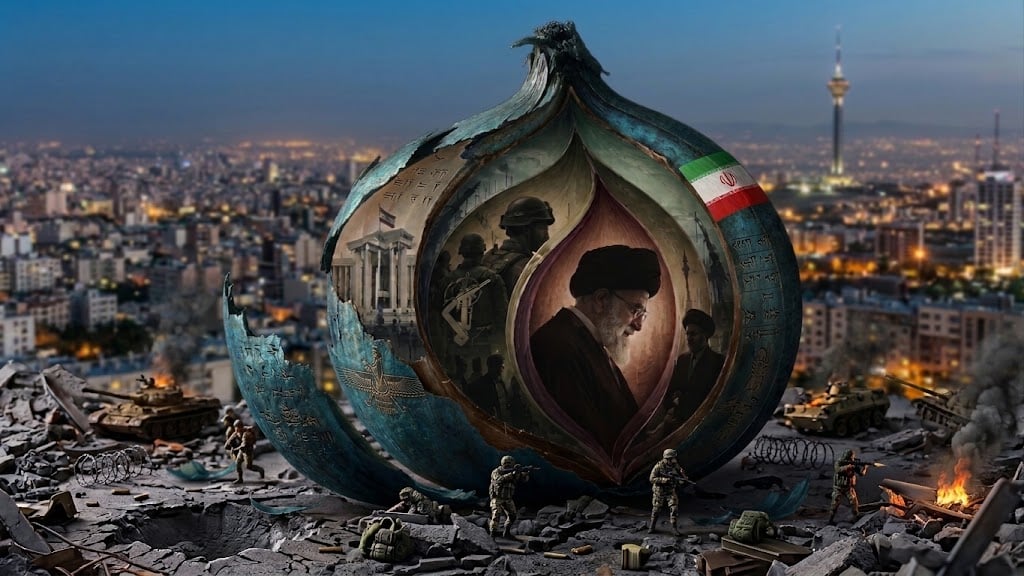
The Onion State: Understanding the Layers of Power. By Shahvand
The Islamic Republic is built like an onion, not a pyramid. Israel and the West must understand its layers before shaping strategy.
For decades, analysts have read the Islamic Republic of Iran through conventional models of authoritarian rule. Some see a centralized theocracy in which power flows down from the Supreme Leader. Others assume that sanctions, economic decline, unrest, or the elimination of its leaders must eventually bring collapse.
The war of 2026 put that assumption to its hardest test. Ali Khamenei was killed, senior commanders were eliminated, and military infrastructure was heavily damaged. Yet the system kept functioning, and Mojtaba Khamenei succeeded his father as Supreme Leader.
The explanation lies not simply in military strength, ideology, or repression. It lies in the architecture of power itself. The closest metaphor is not a pyramid, but an onion.
The Onion State
Over nearly five decades, the Islamic Republic has evolved into a layered political-security organism, built not only to govern but to withstand pressure, redistribute authority, and preserve continuity. Its layers are neither fully autonomous nor fully centralized. They reinforce one another, compete internally, and together protect the foundations of the order.
The outer layer is the visible administrative state: the presidency, parliament, ministries, and bureaucracy that run public services and represent Iran abroad. The middle layer is the parallel political-security state, centered on the Islamic Revolutionary Guard Corps and extended through intelligence services, the Basij, strategic industries, financial networks, and religious foundations. The inner layer is ideological and constitutional: the doctrine of Velayat-e Faqih, the office of the Supreme Leader, and the revolutionary narrative that presents the survival of the regime as the survival of the state.
These layers depend on one another. The presidency administers but does not control the instruments of coercion. The IRGC holds vast operational power, yet its legitimacy remains tied to the ideological center. The result is what I call survival decentralization: when one layer weakens, another compensates; when a leader is removed, surviving institutions redistribute his authority.
War and Succession
This is what the 2026 war revealed. Military commands reorganized, security institutions expanded their responsibilities, and civilian administration continued to operate. The removal of the leadership did not produce the disintegration that a personalized model of dictatorship would predict.
But institutional survival is not political strength. The regime suffered severe military and economic damage, and its continued operation proves redundancy, not invulnerability. The succession also exposed a deeper shift. Ali Khamenei built his authority over decades of personal relationships, arbitration, and appointments. His son inherited the office, but not necessarily that influence. Practical decision-making now depends increasingly on coordination among security institutions, above all the IRGC and the Supreme National Security Council.
This is not a simple transition to military dictatorship. The presidency, parliament, judiciary, and Supreme Leader retain their constitutional roles. What has changed is the relationship between formal authority and real influence. The institutions survived; the distribution of power within them did not stay the same.
The Paradox of Resilience
The same structure that protects the regime also limits it. Military, intelligence, economic, and regional actors hold enough delegated authority to continue operations without waiting for instructions from a single center. This is a form of distributed fire-at-will governance: not chaos, but institutions acting within shared objectives and an internalized sense of what protecting the system requires.
In war, this is an advantage. Destroying one command center does not end operations elsewhere. But an institution that can act without central direction can also resist a unified political decision. Decentralization strengthens survival while weakening coherence.
The pattern extends beyond Iran’s borders. Hezbollah, Iraqi militias, and the Houthis spread Tehran’s influence across the region, yet they also respond to local interests that do not always match Iran’s diplomatic priorities. The outer layers of the onion are not fully controlled by its center.
At home, the same logic blocks reform. Networks enriched by sanctions resist normalization. Security bodies used to exceptional power resist civilian oversight. Ideological organizations treat compromise as a threat. The system adapts tactically while resisting transformation.
Nor should resilience be mistaken for legitimacy. A state can keep its coercive and administrative capacity while facing a profound crisis of legitimacy. Survival is not the same as consent.
The Limits of Pressure
Western strategy toward Iran has long assumed that enough pressure on the leadership will produce either changed behavior or collapse. The Onion State challenges that assumption, because pressure does not fall equally on every layer. Sanctions may weaken the public administration while enriching those who control alternative financial networks. Military strikes may eliminate commanders without dismantling the institutions beneath them. Isolation may constrain the foreign ministry while strengthening the security apparatus.
Diplomacy faces the same problem. The foreign ministry may negotiate and the president may favor de-escalation, but any concession on missiles, nuclear activity, or regional proxies requires the cooperation of the institutions that hold operational power. The real question is not whether Iran’s representatives have the authority to negotiate, but whether the institutions behind them have the authority and the will to enforce what is signed.
For Jerusalem, Washington, and European capitals, this distinction between the authority to negotiate and the capacity to enforce is essential. Agreements made only with the visible hierarchy may never become reality. Strategies built on eliminating leaders may underestimate the system’s capacity to replace them.
The Islamic Republic is neither a dictatorship that depends on one man nor a collection of autonomous organizations without a center. It is a distributed ideological-security architecture built for endurance. Its resilience does not guarantee permanence, and its contradictions do not guarantee imminent collapse.
The strategic question is not merely who governs Iran, but how the institutions around that leadership exercise power, and whether they can act coherently when the center is under pressure. Before strategy comes structure.
Related Topics
Related Posts