
When Extraordinary Accusations Become Ordinary
Last week, on the Brookline PAX listserv, a community forum that includes many Jewish residents, someone shared the results of an Associated Press–NORC poll. According to the survey, roughly one-third of Americans now believe that Israel has committed genocide in Gaza.
The statistic itself was disturbing. What troubled me even more was how unremarkable it seemed. An accusation that, until recently, would have been considered extraordinary is now repeated so routinely that many people accept it as settled fact.
Part of the reason, I suspect, is that there has been remarkably little cost to making the accusation. Politicians, activists, and commentators have invoked the word “genocide” with increasing confidence while facing few consequences if the evidence does not support their claims. Senator Bernie Sanders has repeatedly used the term, as have Representative Rashida Tlaib and other elected officials and activists. The effect is cumulative. When influential voices repeatedly invoke one of the gravest accusations in human history, many people naturally conclude that the matter has already been settled.
The accusation itself has immediate consequences. Investigations, legal proceedings, and historical judgments take years. Public opinion forms in weeks. By the time historians reach their conclusions, the moral verdict has often already been rendered in the public mind. In accusing a nation of genocide, public figures should explain what evidence supports that charge, what evidence undermines it, and how they would know if they are mistaken.
Whether or not history ultimately vindicates those making this accusation, the accusation itself has already reshaped public opinion. That alone should make us cautious. The Holocaust forever invested the word genocide with unique moral force, while Jewish history reminds us how readily extraordinary accusations against Jews have been accepted as truth, often with devastating consequences. Those two histories together should encourage exceptional care before applying such a grave label to the Jewish state.
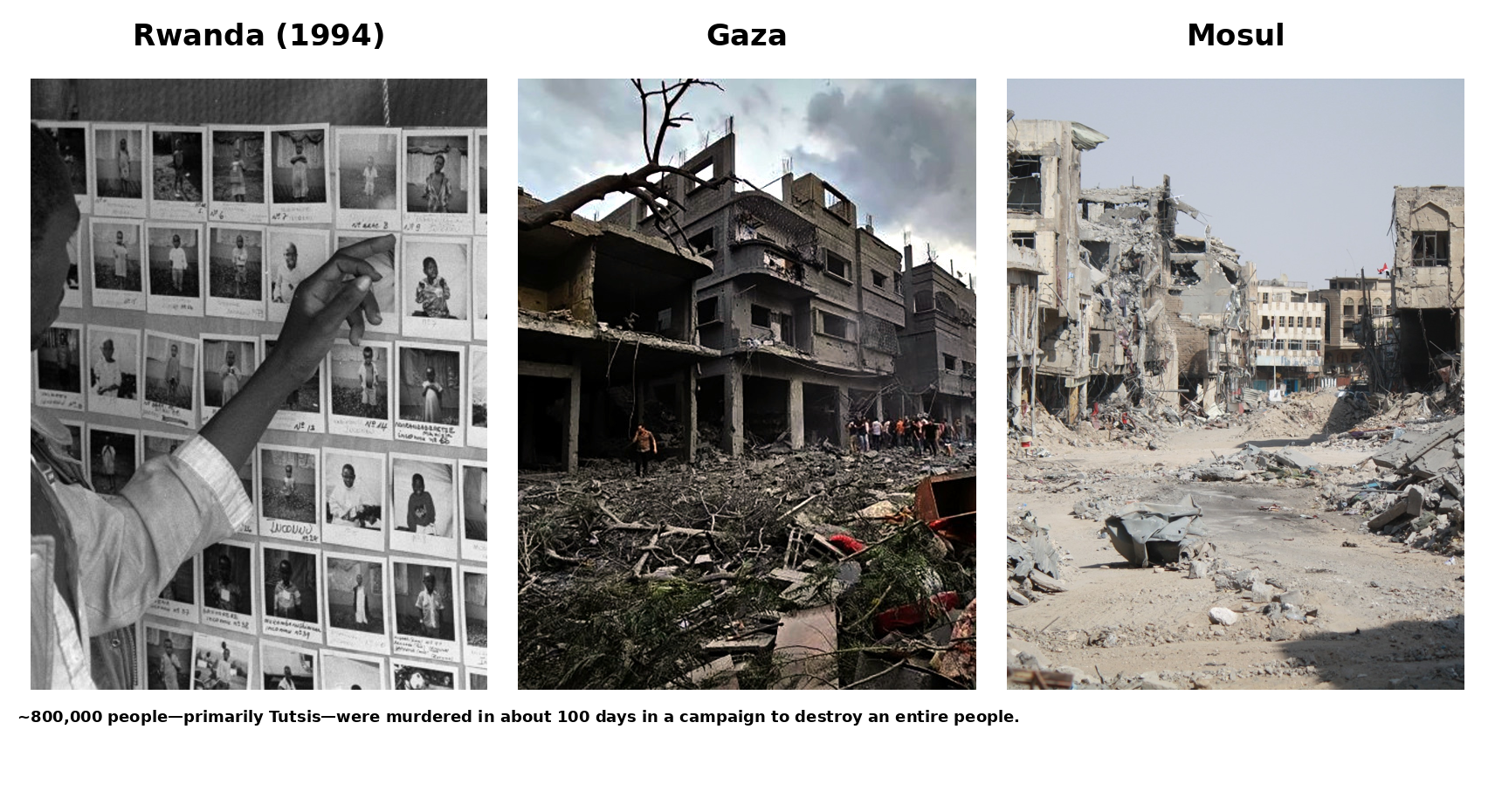
The word genocide evokes the Holocaust and also Rwanda—cases in which the deliberate destruction of a people was itself the objective. Since the Holocaust is unique in so many respects, Rwanda offers the clearer comparison.
In 1994, extremist Hutu leaders organized a campaign to exterminate Rwanda’s Tutsi population. Years of propaganda had dehumanized Tutsis, portraying them as an enemy to be eliminated rather than fellow citizens. Tutsis were identified, hunted at roadblocks, murdered in their homes, churches, and schools—killed simply for their ethnicity. The objective was not military victory but the destruction of a people.
The Battle of Mosul, in contrast, involved a terrorist organization deeply embedded within a dense civilian population. The fighting left much of the city in ruins: entire neighborhoods were destroyed, thousands of civilians were killed, and hundreds of thousands were displaced. Yet Mosul did not become the focus of a worldwide movement that portrayed the battle as evidence of genocide or made the conflict a defining moral test in universities, public institutions, and civic life.
The war in Gaza bears far less resemblance to Rwanda than to Mosul. Israel entered the war after Hamas massacred more than a thousand people and abducted hundreds of hostages. Its stated objectives were to dismantle Hamas’s military capabilities and bring the hostages home. Throughout the war, Israel repeatedly urged civilians to evacuate combat zones, accepted pauses in the fighting to secure hostage releases, and allowed humanitarian aid into Gaza.
Hamas, meanwhile, could have released the hostages and surrendered at any point. Instead, it continued fighting from within densely populated civilian areas, with an extensive tunnel system for its fighters but not for the civilian population; Egypt largely kept its border closed rather than providing broad refuge for Gazan civilians.
Unlike Gaza or Mosul, Rwanda was not defined by the destruction of cities or buildings. The target was not the built environment but an entire people.
None of this means that Israel has fought a flawless war. But it does illustrate why the charge of genocide demands extraordinary scrutiny. The question is not whether people may criticize Israel. The question is why this war has so quickly come to be understood through the language of genocide when other devastating urban wars against terrorist organizations have generally been debated in terms of military necessity, proportionality, and civilian protection.
Perhaps the answer lies partly in something much older than this war.
The history of the Jewish people is filled with extraordinary accusations that large numbers of otherwise decent people came to believe. Jews were accused of poisoning wells during the Black Death, murdering Christian children for ritual purposes, conspiring to control governments and finance, and countless other crimes that bore little resemblance to reality. These accusations were not believed because evidence supported them. They were believed because false accusations against Jews have an astonishing ability to capture the public imagination.
Jean-Paul Sartre observed that antisemitism often begins not with evidence but with conclusions. René Girard argued that societies have a recurring tendency to relieve internal tensions by identifying a scapegoat who can bear collective blame. Rabbi Jonathan Sacks observed that antisemitism continually reinvents itself, changing its language while preserving its essential structure.
The accusations change, but the pattern remains. Yesterday the accusation was ritual murder. Later it was racial conspiracy. Today it is genocide. And false accusations have consequences. They do not remain confined to academic journals, newspaper editorials, or opinion polls. They shape the moral climate in which people live. I have watched this happen in my own community of Brookline, Massachusetts.
During the past two years, as a Town Meeting member and someone active in local civic life, I have attended School Committee meetings, public forums, and discussions about antisemitism. Over time, I began to notice a recurring pattern in which the perspectives of Israel supporters were sometimes discounted, reframed, or viewed with suspicion when they conflicted with prevailing progressive assumptions about Israel.
I saw Jewish residents—including myself—spoken to dismissively when they raised concerns about antisemitism. At a local bookstore protest, the voices and motivations of Jewish protesters were never fully heard. At a School Committee meeting, Jewish parents who raised concerns about antisemitism found themselves accused of targeting a child and promoting violence rather than having their concerns addressed. In another public discussion, Jews who challenged the prevailing progressive assumptions about Israel were implicitly divided into “good Jews” and “bad Jews.” Even a Yom HaShoah message from the school district omitted any explicit mention of Jews. When Holocaust remembrance is separated from the Jewish people and Jewish voices are judged primarily by whether they reinforce prevailing progressive narratives, it becomes easier for extraordinary accusations against Jews to be accepted as ordinary.
At the same time, I have watched antisemitic incidents become more common. Jewish businesses have been vandalized. A student artwork depicting an Israeli flag being pierced provoked deep concern within our community. Most recently, someone was seen walking through Brookline wearing a shirt celebrating Yahya Sinwar, the architect of the October 7 massacre. None of these incidents can be attributed solely to accusations of genocide. But together they reflect a climate in which hostility toward Israel increasingly spills over into hostility toward Jews.
There are terrible wars taking place in Sudan, Yemen, Myanmar, Ukraine, and elsewhere. Each deserves our compassion. Yet no other conflict has become such a defining moral litmus test in so many American communities, universities, and public institutions, and no other conflict has so consistently been described as genocide. Libels directed at Jews have changed over the centuries, but their function has often remained remarkably similar: to portray Jews—or today, the Jewish state—as uniquely evil.
That is why accusations of genocide require extraordinary scrutiny. Before embracing one of the gravest charges that can be leveled against any nation, we need to examine all the evidence carefully—and to remember that false accusations against Jews are rarely harmless. They alter how societies see Jews, how neighbors see one another, and ultimately whether Jews are seen as fellow citizens deserving of equal protection or as outsiders to be feared and condemned. That is why accusations as grave as genocide must never become casual political rhetoric. They require extraordinary evidence, extraordinary scrutiny, and humility.