A Call to the Moral Debate the World Refuses to Face — A Black Jewish Voice Speaks for Israel and Global Jewry
When Extremists Fear Candles, Flags, and Church Bell
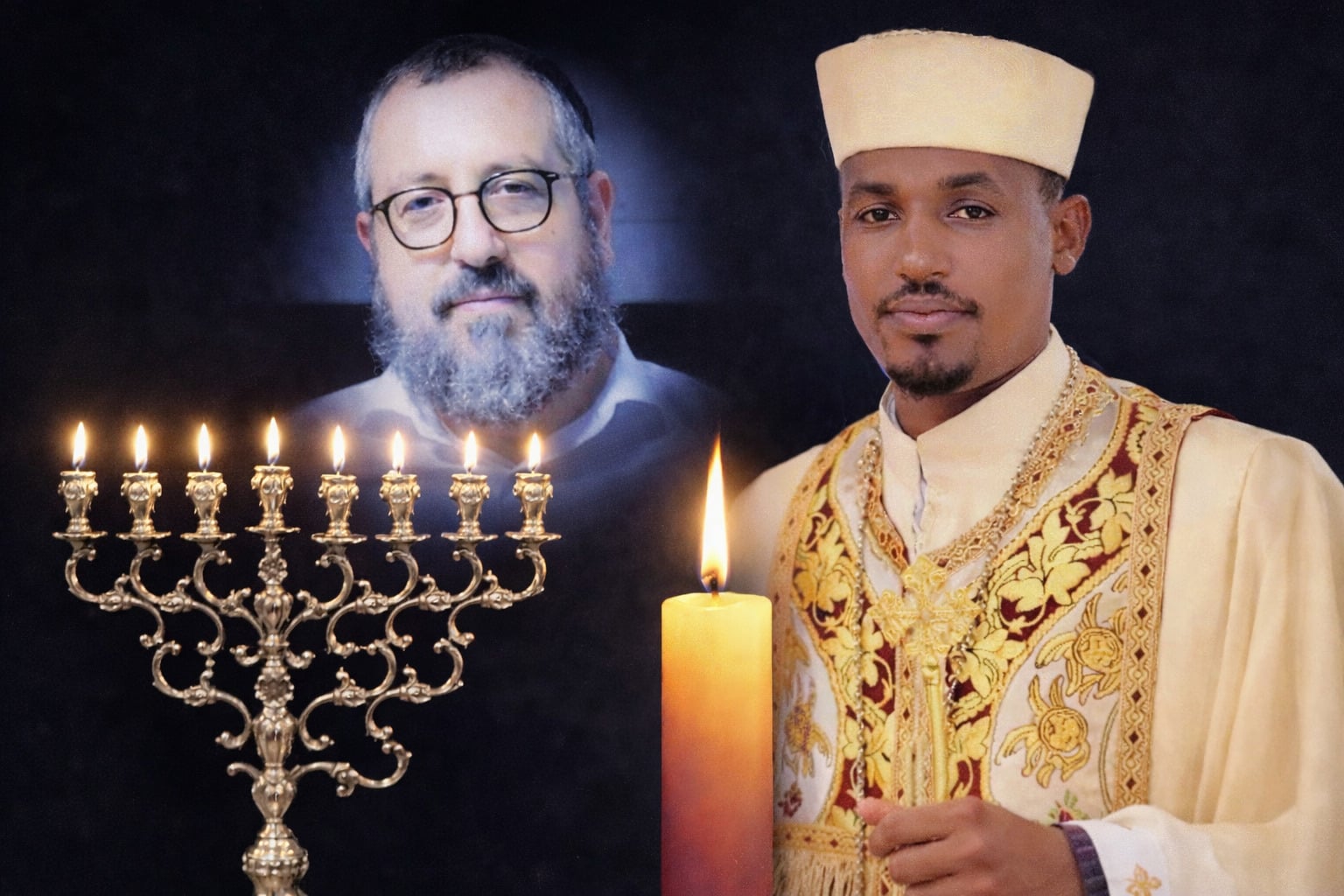
At the funeral of Rabbi Eli Schlanger, a victim in the Bondi Beach mass terror shooting, in Bondi on December 17, 2025, in Sydney, Australia. (AP Photo/Mark Baker, Pool) Kesis Desalegne Nemomsa, a victim in the Horo Guduru Wollega, Ethiopia mass terror shooting December 14, 2025 (Photo credit and commercial-use permission: Bewuntu Yenager)
To secure both the Red Sea and democracy itself, Israel and the West must stand with free peoples of faith not with forces that would silence them.
By Dr. Shmuel Legesse
In a world where dictators disguise themselves as democrats and extremists wave the banner of freedom, moral clarity has become a rare commodity. The battle for the future of democracy will not be decided only in Washington or Brussels but also in synagogues in Sydney, churches in Addis Ababa, and along the Red Sea, where the Horn of Africa meets Jerusalem’s horizon.
As an Ethiopian-Israeli educator and advocate of Moral Diplomacy, I have watched the same forces that question Israel’s legitimacy turn their violence against Jews celebrating Hanukkah in Australia and against ancient Christian communities marking holy days in Ethiopia. These are not isolated events. They are symptoms of a single moral crisis: the targeting of faith, identity, and human dignity by ideologies that cannot tolerate difference.
Faith Under Fire — From Hanukkah to Holy Communion
During Hanukkah the Jewish festival of light, resilience, and freedom Australian Jews were attacked in an antisemitic terror incident meant to turn celebration into fear. The timing was not accidental. Hanukkah commemorates resistance to forced conformity and religious erasure. That is precisely what extremists seek to crush. The same pattern appears thousands of miles away in Ethiopia, where the Tewahedo Ethiopian Tewahedo Orthodox Church, one of the oldest continuous Mosaic Christian traditions in the world has faced attacks during religious holidays, the desecration of sacred sites, and violence against worshippers. In both cases, faith itself becomes the target. The message is chillingly consistent: public religious identity is intolerable.
This is why antisemitism and anti-Christian persecution cannot be treated as separate phenomena. They are part of the same moral assault on freedom of conscience.
The New Mask of Authoritarianism
Authoritarianism no longer arrives only with tanks and uniforms. In our generation, it often comes disguised as populism or as an ideological “awakening.” Across Europe, both socialist and radical extremists’ movements have begun to erode pluralism, branding dissent as treason and demanding that faith bow before ideology.
In parts of the Middle East and Africa, extremist and nationalist factions including some radical religious and traditional extremists’ movements, now grant greater dignity to abstract causes or symbols than to human beings themselves, turning ideology or even nature into an idol while neglecting the divine image in humanity. They exploit democratic openings only to seal them once in power, silencing women, minorities, and moderates alike. This is not a clash of religions. It is a clash between moral conscience and moral blindness. Wherever politics replaces the sanctity of human life with the pursuit of dominance, extremists, whether racial, religious, or ideological democracy, begin to die. Nowhere is this more visible than in the Horn of Africa. The Red Sea is not only a shipping lane; it is a moral and strategic lifeline, a crossroads where Africa, the Middle East, and Asia meet. Whoever controls it will shape global trade, security, and freedom of religion for generations.
Today, the region stands at a dangerous intersection. Dictatorship and authoritarian rule persist in Eritrea, while ongoing extremism, war, and grave human rights abuses afflict both Sudan and Ethiopia. Regional powers seek influence through ports and strategic islands along the Red Sea in Eritrea and Djibouti; Iran other extremists look for footholds through proxies; and authoritarian and extremist regimes compete for dominance in Ethiopia, even as conflict continues to destabilize Sudan. The loss of Ethiopia’s historical access to the Red Sea and the ongoing struggle for control of this corridor have intensified regional rivalries. For centuries, Ethiopia’s connection to the Red Sea served not only as a trade route, but as a civilizational bridge linking Africa to the Middle East and the wider world. It is both geopolitically and morally perilous for such a vital passage to fall under forces hostile to freedom of conscience, pluralism, and democratic stability.
The West, together with Israel, should support a balanced, pro-democracy alliance in the Horn of Africa one that empowers historic communities such as the Amhara and Tigrinya in present-day Ethiopia and Eritrea, communities that have long upheld a rich mosaic of justice, equality, and cultural identity. For centuries, they have served as cultural, linguistic, and religious bridges between Africa and the Middle East, sustaining traditions of coexistence and resilience. Such an alliance must also ensure shared power, justice, and equality for all peoples of the region. Strengthening these communities is not colonialism; it is a moral partnership rooted in mutual dignity, regional stability, and democratic values. A stable, pluralistic Horn of Africa would block extremist infiltration, prevent Iranian expansion, and preserve the Red Sea as a corridor of conscience rather than coercion.
Democracy Arrested in Broad Daylight
Democracy’s arrest in broad daylight is not only political; it is moral. Extremists have learned to speak the language of rights while denying the most basic right of all the right to exist. From European capitals to African villages, movements that claim to liberate often replace dialogue with dogma and conscience with control. In Ethiopia, citizens are denied fundamental freedoms: the right to move, to work, to worship, and to live without fear. Invisible borders trap people within their own country; crossing them can mean arrest, violence, or death. In Nigeria, Christian communities have been slaughtered by extremist militias, often with little meaningful global response. In Ethiopia today, repression is no longer enforced by the state alone. It is increasingly outsourced to violent, radicalized youth groups that operate as enforcers of fear. Ordinary citizens report being killed or physically attacked for peaceful expressions of civic and religious identity including displaying the historic Ethiopian flag or wearing Christian symbols associated with the traditional green, yellow, and red. In some cases, these assaults occur with the assistance of local police or in their direct presence, and are followed not by protection, but by further assault and intimidation. Flags are confiscated, voices silenced, and bodies bruised not because of violence committed by the citizen, but because of the symbols they carry. When confused and weaponized youth are permitted to act as unofficial militias, and when law enforcement punishes victims instead of attackers, democracy has crossed the line into coercion. What should be a harmless expression of belonging has been criminalized. When a government fears a flag, it signals not strength but insecurity. Democracies do not beat citizens for their colors; authoritarian systems and extremists do.
History offers a sobering warning. More than a century ago, Ethiopia shocked the world at the Battle of Adwa in 1896, when Emperor Menelik II’s army defeated a European colonial power and preserved African sovereignty. That victory reverberated from the Red Sea across East Africa and beyond, making Ethiopia a global symbol of Black freedom, dignity, and equality. Decades later, when Benito Mussolini’s fascist regime encouraged by Adolf Hitler’s racial ideology invaded Ethiopia in 1935, it sought not only territorial conquest but symbolic erasure. The Ethiopian flag and its colors were banned and targeted precisely because they represented resistance to racism and colonial domination.
When modern governments fear those same colors today, they echo a darker chapter of history, one that free societies once vowed never to repeat. When ancient faiths are silenced, humanity loses part of its moral memory. The burning of Jewish, Israeli, or American flags by radicals follows the same logic: erase symbols to erase people.
Moral Responsibility Without Borders
I write this not as a distant observer, but as a Jewish life-matter advocate and as someone who has stood publicly and internationally against the shedding of innocent blood from the Horn of Africa to Sydney, Australia. When Jews were attacked during the celebration of Hanukkah in Sydney, I spoke out not because it was politically convenient, but because my Jewish faith does not permit silence in the face of violence. As a student of the late Rabbi Lord Jonathan Sacks (z”l), who taught that Jews are called to be “a light unto the nations,” I believe moral responsibility does not end at the borders of tribe or nation. Judaism teaches that every human being is created b’tzelem Elokim in the image of God. As the Torah commands, “You shall not murder” (Exodus 20:13), and as the Mishnah teaches (Sanhedrin 4:5), “Whoever destroys a single life is considered as if he destroyed an entire world.” That belief obligates me to speak whether the victims are Jewish worshippers in Sydney, New York, or Jerusalem; Christian communities in Oromia Region, Addis, Ethiopia; or any innocent people targeted by hatred and extremism. The grief of Australian Jews and the suffering of Orthodox Christians and Amhara civilians in Ethiopia are my grief. Moral diplomacy begins where silence ends.
As Imam Mohammad Tawhidi, a prominent international Muslim leader and member of the Global Imams Council, rightly stated, this was a “barbaric terrorist attack an act of pure evil.” He cited the Qur’an: “Do not take a life made sacred by God” (Qur’an 6:151). Such violence must be unequivocally condemned by leaders of all faiths and nations from Addis Ababa to Washington, from New York to Geneva. When conscience speaks in one voice, extremism loses its power.
A Call to the United States and Its Moral Authority
The United States and its allies possess both the moral authority and the strategic interest to act. When international religious freedom was elevated as a diplomatic priority, it affirmed a foundational truth: defending faith is not charity; it is the defense of democracy itself. That same clarity is urgently needed today for Ethiopian Orthodox Christians, for Jews facing antisemitic violence, and for all faith communities under threat. Silence is complicity. Action is the language of conscience.
A Lesson from Israel/our Torah
As an Ethiopian Israeli/Jew and a student of Rabbi Jonathan Sacks, I learned that the Jewish story is humanity’s laboratory of moral diplomacy. Jews survived exile not through power alone, but through purpose by affirming that every human being is created in the image of God. Israel’s task, and its gift to the world, is to demonstrate that democracy can defend itself without losing its soul. If democracy forgets faith, it forgets why freedom matters. And if faith forgets democracy, it forgets that truth without compassion becomes tyranny. The choice before us is not between strength and morality, but whether we have the courage to defend both.
From Hanukkah candles in Australia to church bells in Ethiopia, the message is clear: when one faith is attacked, all freedoms are endangered. But when moral nations stand together Jews, Christians, Muslims, and all people of conscience the light does not go out. That truth was embodied by Ahmed al-Ahmed, a 43-year-old Muslim fruit vendor and father of two, who wrestled a rifle from a terrorist’s hands and saved Jewish lives. His courage reminds us that moral clarity does not belong to one faith alone; it belongs to anyone willing to say “no” to the murder of innocents. The question before every society is simple and urgent: where are the Ahmed al-Ahmeds of our time? Who will stand up, in every land, and say that killing the innocent is wrong without hesitation, without excuse, and without fear?
As Rabbi Jonathan Sacks taught, to defend a civilization, you must first defend its moral foundations. From Jerusalem to Addis Ababa, from Washington to the Red Sea, the free world must stand not only with strategy but with soul.
Related Topics
Related Posts