When Foundational Concepts Become Questions
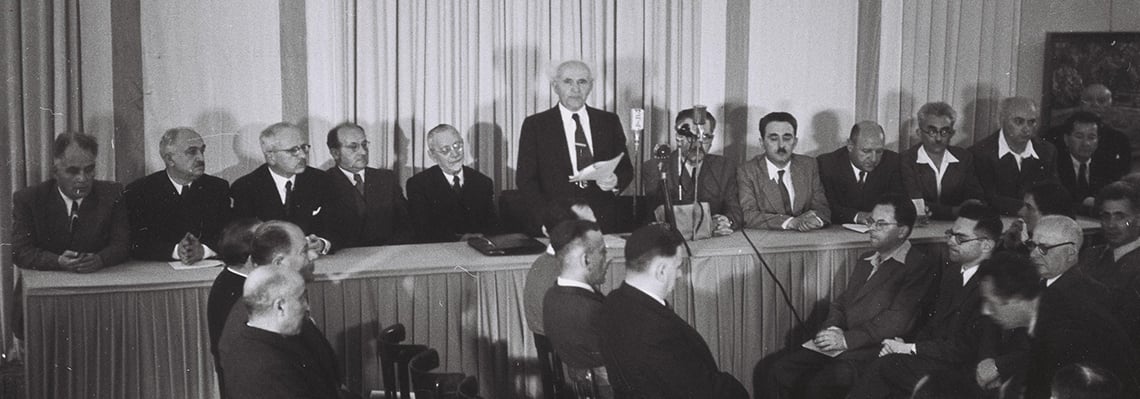
The Declaration of Independence of Israel deserves the same critical scrutiny. It is unquestionably one of the foundational texts in the history of Israel. Yet its foundational status cannot exempt it from historical analysis. The Declaration was drafted under dramatic circumstances, marked by war, uncertainty, and intense political pressures. Above all, it was the outcome of a compromise: a compromise between secular and religious forces, between different conceptions of nationalism, and between divergent political interests. Its historical significance is beyond dispute. But historical significance does not mean that every one of its formulations should be regarded as normative for twenty-first-century Israel. The respect owed to a foundational text must never become an immunity from criticism.
Zionism, the Constitution, and the Declaration of Independence thus point to the same underlying question: How should a democratic society approach its foundational concepts when the reality that gave rise to them has undergone profound change? This question is not confined to Israeli politics. It forms part of a much broader transformation in our relationship to authority, knowledge, and legitimacy.
The need to reassess our values stems, among other things, from the social and technological revolutions that are reshaping every sphere of human existence. The digital revolution and the extraordinary expansion of artificial intelligence provide a striking illustration of a world that is now evolving faster than our ability to comprehend the transformations taking place. This is not simply a technological revolution. We are confronted with a far-reaching historical transformation. Assumptions that had appeared stable for centuries are now being called into question before our very eyes. Under such circumstances, we must be prepared to ask questions that, only yesterday, might have seemed almost heretical.
Does the university remain the exclusive source of authority in matters of knowledge? Does the contemporary democratic system represent the culmination of political progress, or merely another stage in a historical evolution that will continue to change? Do general elections necessarily constitute the most effective means of governing a state? These questions do not imply that the answers must be negative. They simply mean that no institution should be exempt from critical scrutiny merely because it is familiar to us.
The same question applies to the security of citizens. For decades, we have regarded military power as the ultimate guarantee of our existence in the region. This conception may have been justified under certain historical circumstances. But both the nature of threats and the nature of conflicts have changed. Technological superiority, firepower, the ability to eliminate opposing combatants, or the capacity to bombard civilian populations do not, in themselves, constitute a guarantee of victory.
The universal diffusion of technology has shifted an essential part of conflicts beyond the battlefield. They are now also fought in cognitive, economic, scientific, ideological, and moral domains. This does not mean replacing one supposedly miraculous solution with another. It means recognizing that certain responses that once appeared self-evident no longer are. A society that ceases to reassess its assumptions risks jeopardizing its future—and even the very conditions of its survival.
The same applies to certain universal concepts with which we have grown up, such as freedom and equality. We often present them as self-evident realities, whereas they are, above all, normative ideals toward which humanity aspires. Are all human beings truly born equal? Are we genuinely free, or are we, from birth, situated within a political structure that we never chose?
Asking these questions in no way means that we should abandon freedom of expression or commonly accepted moral principles. Quite the contrary. To preserve a value, one must be capable of questioning the way in which that value acquires meaning in a changing world. Fidelity to a value does not necessarily consist in preserving intact the historical formulation once given to it.
At a time when humanity is undergoing an unprecedented acceleration of historical change, we must beware of formulations and symbols that have become anachronistic.
A developed society is not measured by its ability to preserve its principles indefinitely, but by its capacity to subject them to the test of doubt. It must be able to distinguish universal values from the interests of particular groups and to develop a political culture capable of responding to a reality that has become global.
Societies do not collapse because they transform their ideas. They collapse when they cease to examine them. Israel’s future will therefore depend not only on the strength of its army. It will also depend on its ability to develop an intellectual culture that is not afraid to question—and, when necessary, to abandon—the fundamental assumptions it once set out to construct.
Perhaps the greatest danger facing Israel’s intellectual elite lies less in error than in intellectual conformity. This is why no foundational concept should enjoy immunity from criticism. A free society is not measured by the number of symbols it holds sacred, but by the number of questions it dares to ask.