
This Way Up: Spiritual Means to Psychological Ends
When Heaven Comes Down: A Shared Grammar in Jewish and Chinese Thought
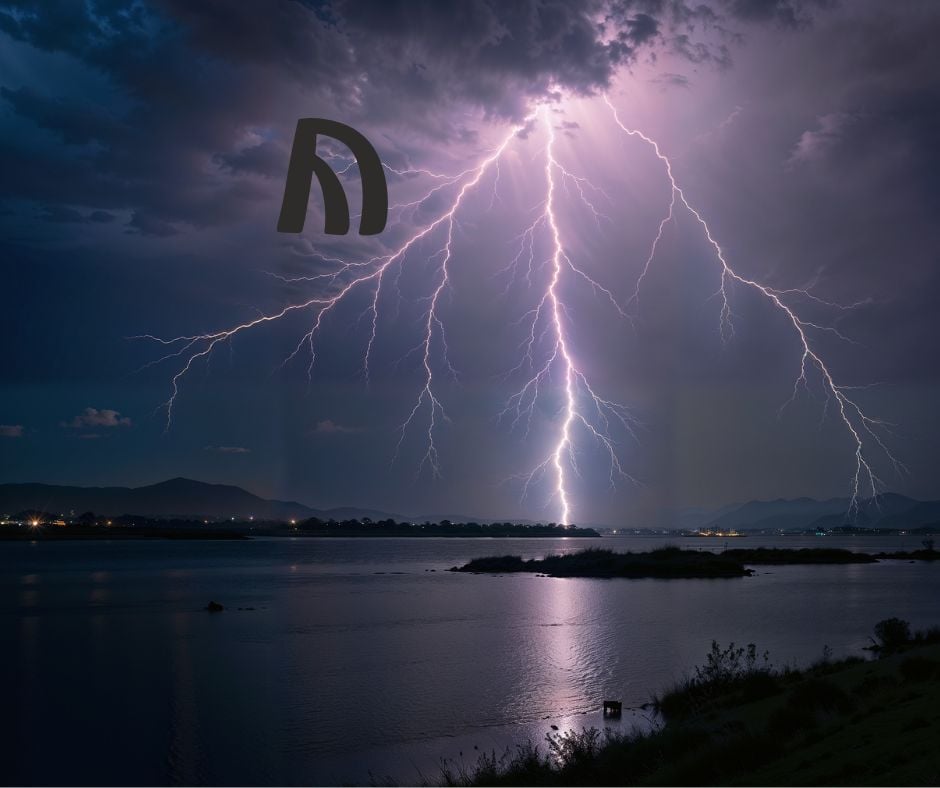
Shefa descending from Above! (courtesy of Canva)
With May approaching—marked both as Asian Heritage Month and Jewish Heritage Month—we are offered a timely opportunity to reflect on what could become a meaningful alliance between two ancient civilizations; also a meeting rooted in shared assumptions about how human life is meant to be lived.
Consider, for a moment, a simple but revealing feature of classical Chinese writing: it traditionally ran from the top of the page downward. This was not merely a stylistic choice. It reflected a worldview. The task of the human being, in much of Chinese thought, is to receive what descends from above: to align with the Tao, and to embody a pattern that originates beyond us. Order is not invented; it is transmitted.
A parallel idea appears, with striking clarity, in the Jewish tradition. In Book of Exodus 19:20, we read: “The L-rd descended upon Mount Sinai.” Revelation has heaven coming down to us. As Rabbi Shmuley Boteach notes in Judaism for Everyone, the Jewish mission is not to escape the world, but to draw divinity into it—to make the earthly realm a dwelling place for the sacred.
In Chinese culture, this downward movement is cultivated through practice. Whether in feng shui, calligraphy, tea ceremony, or traditional medicine, the aim is to facilitate a proper flow from above to below. Harmony depends on alignment with a pattern that precedes us.
Judaism expresses the same orientation through a different set of tools. Through mitzvot—commandments enacted in daily life—the individual becomes a conduit. The work is not architectural in the external sense, but internal: to shape oneself into a vessel capable of receiving and sustaining what descends. In this framing, the ancient Temple is not only a historical structure but a template. Each person is called to become a kind of living sanctuary, a beit hamikdash in miniature, with the ner tamid—the eternal light—burning within.
This shared “grammar of descent” is not the only point of contact between Jewish and Chinese traditions, but it is a revealing one. Both cultures emphasize continuity, discipline, reverence for learning, and the moral weight of daily action. Both place value on family structure, respect for elders, and the transmission of wisdom across generations. And both resist the idea that meaning is purely self-generated.
There are differences, of course, and they matter. But difference does not negate the possibility of alliance; it clarifies its terms. Where one tradition speaks in the language of covenant and commandment, the other speaks in the language of harmony and balance. Yet both are, in their own way, concerned with the same question: how does the human being live in alignment with something greater than the self?
At a time when public discourse is increasingly fragmented, there is something quietly powerful in noticing shared structures across cultures that have endured for millennia. Not because they erase difference, but because they offer a foundation for mutual recognition.
Perhaps the most compelling alliances are not built on identical beliefs, but on compatible visions of what it means to live well.
–
The Chinese–Jewish Exchange brings together resources, scholarship, and conversation to explore the shared values of two ancient civilizations, with the goal of strengthening ties and advancing a constructive alliance between Chinese and Jewish communities. To learn more about the project, please visit The Chinese-Jewish Exchange..
Related Topics
Related Posts