
CEO of Time to Stand Up for Israel
When History Is Rewritten, Israel Pays the Price
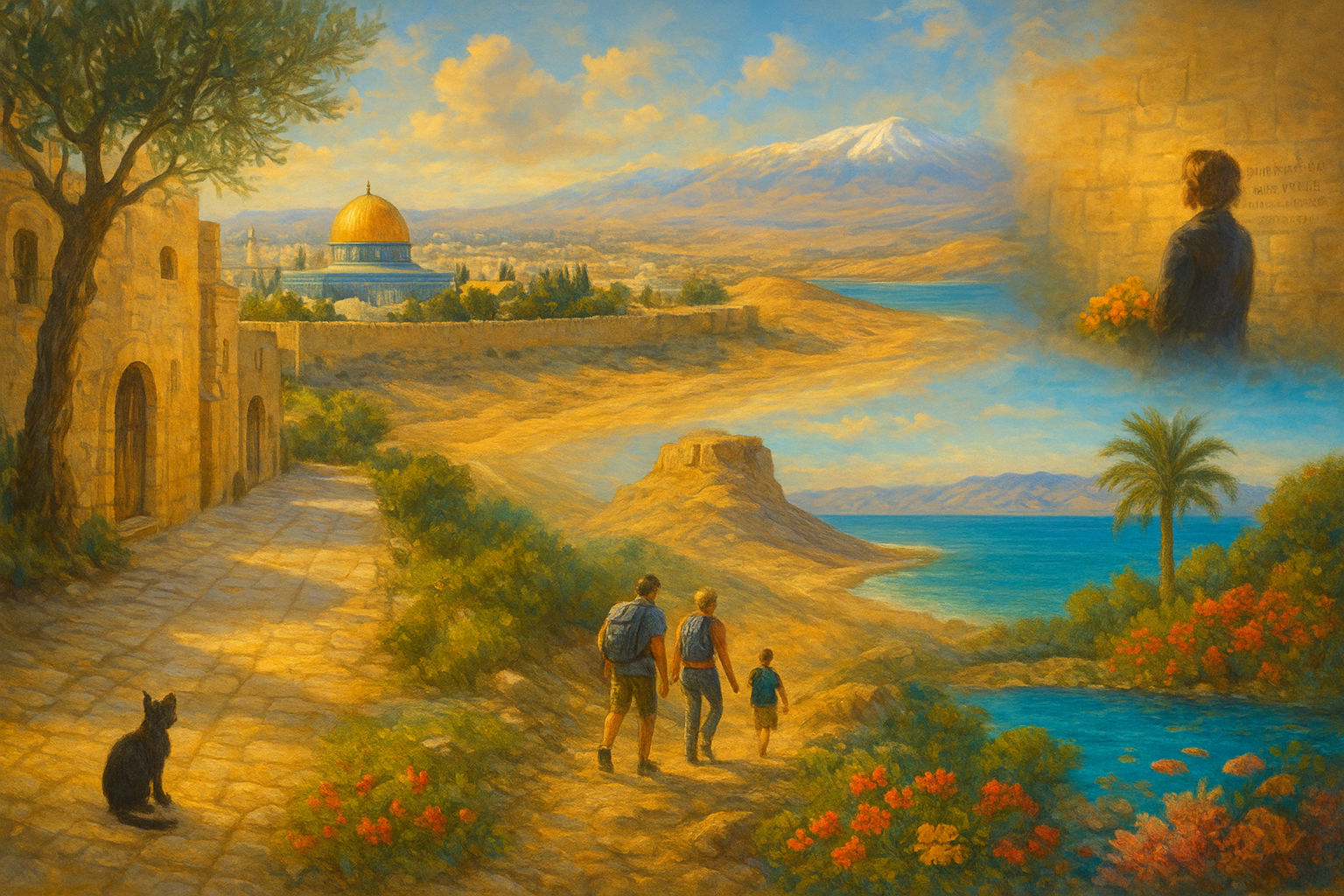
Photo Credits: Sabine Sterk (AI)
There are moments when history is debated. And then there are moments when history itself appears to be rewritten.
As someone who has spent much of my life connected to Israel, who has lived in the Middle East and studied its history, archaeology, religions and civilizations, I find the current distortion of Israel’s history deeply troubling.
I first experienced Israel as a child. I arrived in Haifa in 1978, at the age of eleven, and although I was young, I remember something that has stayed with me ever since: Israel felt like home.
Since then, I have returned many times. I have walked through Jerusalem, visited archaeological sites, studied historical maps and read extensively about the civilizations that have existed in this small but extraordinary piece of land.
The more I learned, the clearer one thing became:
The Jewish connection to this land is not a modern invention.
It is thousands of years old.
Yet today, millions of people are being presented with a radically different story. A story in which Jews are portrayed primarily as foreign Europeans, Israel as a colonial project and the entire Jewish connection to the land as something invented in the twentieth century.
That is not history.
That is a political narrative imposed upon history.
Before Israel, there was no Palestinian Arab state
One of the most frequently repeated statements today is that Israel is “occupying Palestine.”
The word Palestine itself has a long and complicated history. It has been used as a geographical designation and, at different periods, as an administrative term. The Romans used the name Syria Palaestina. Islamic rulers subsequently used forms of Filastin. The British later administered the territory under the Mandate for Palestine.
But a geographic name is not the same thing as an independent sovereign state.
Before the establishment of the State of Israel in 1948, there was no independent sovereign Arab state called Palestine.
For centuries, the territory was ruled by empires and foreign powers, most recently the Ottoman Empire. After the First World War, it came under the British Mandate.
That historical distinction matters enormously today.
Because when people are repeatedly told that Israel “stole a country called Palestine,” they are being encouraged to imagine a historical state that did not exist in the form being described.
This does not erase the existence of Arab communities.
It does not deny Palestinian identity.
It does not deny the suffering experienced by Palestinians.
But acknowledging those realities does not require erasing Jewish history.
Judea did not disappear because the name changed
Long before Islam emerged in the seventh century, Jewish kingdoms existed in this land.
Jerusalem was the capital of ancient Israel and Judah.
Judea was not an invention of modern Zionism.
Hebrew inscriptions, coins, archaeological remains, ancient manuscripts and historical sources provide extensive evidence of Jewish life and sovereignty in the region.
The Jewish people were not strangers arriving without a history.
They originated in this land.
The destruction of Jewish sovereignty did not erase that connection.
Neither did centuries of foreign rule.
Neither did exile.
And neither did the eventual creation of modern nation-states.
Names changed. Empires changed. Borders changed.
The historical connection remained.
Israel did not begin in 1948
This is one of the most important distinctions missing from today’s debate.
The State of Israel was established in 1948.
But Israel itself did not begin in 1948.
The modern state emerged after a Jewish national movement had developed over decades, following centuries of Jewish persecution and amid the continuing Jewish connection to the historic homeland.
The Zionist movement sought to establish Jewish national self-determination in the ancestral homeland.
Whatever one’s political views about Zionism, it is historically inaccurate to describe it simply as an arbitrary European colonial project disconnected from Jewish history.
European Jews certainly played an enormous role in modern Zionism, particularly because many lived in Europe.
But Jews from Europe were not abandoning one homeland to colonize another unrelated one.
They were returning, in a modern national movement, to the land at the centre of Jewish history, religion and collective memory.
And Jewish communities had continued living in the land throughout many centuries.
A message from Australia illustrates the problem
Recently, someone from Australia wrote to me after reading one of my articles.
The person argued that Australian First World War memorials referred to Palestine as a country in which Australians fought and died.
Australians absolutely did fight and die in Palestine during the First World War.
But the territory was then part of the Ottoman Empire.
The Ottoman defeat was followed by the British Mandate.
Calling the territory “Palestine” did not mean that an independent Palestinian Arab state existed there.
This distinction should not be controversial.
Yet it has become surprisingly difficult to make.
When I attempted to explain this, the response was that I was supposedly denying that an indigenous population had been replaced by European nationals who followed Judaism.
That accusation demonstrates precisely why historical discussion is necessary.
The Jewish people cannot simply be transformed into Europeans who happened to adopt Judaism.
Judaism is not merely a religion detached from a people and a place. Jewish history, Hebrew language, Jewish traditions and the land of Israel are intertwined across thousands of years.
The modern Jewish population of Israel includes people whose families came from Europe, but also Jews whose families came from Iraq, Iran, Yemen, Syria, Egypt, Morocco, Tunisia, Libya, Ethiopia and other parts of the Middle East and North Africa.
Reducing Israeli Jews to “European colonizers” is therefore not merely historically simplistic.
It erases the diversity and history of the Jewish people themselves.
The power of repetition
Why does such a simplified narrative become so powerful?
Because repetition works.
A statement appears in a headline.
It appears in a social-media post.
It is repeated by celebrities, politicians, commentators and activists.
It becomes a slogan.
Eventually, people stop hearing it as an argument and begin hearing it as a fact.
This is particularly dangerous in the age of social media.
A dramatic image can reach millions before anyone has checked its origin.
A misleading map can circulate worldwide within hours.
A historical claim can be detached from its original context and presented as proof of something it never actually demonstrated.
And artificial intelligence is making this problem even more serious.
We have entered an era in which convincing images, videos and even apparently authoritative documents can be manufactured at extraordinary speed.
The battle over Israel’s history is therefore no longer confined to academic books.
It is taking place on our phones.
Israel’s history is not disposable
There is something deeply troubling about the double standard applied to Jewish history.
Imagine telling another ancient people that their historical connection to their homeland was irrelevant because they had lived in exile.
Imagine telling them that because other populations had lived there for generations, their own history had somehow expired.
Yet this argument is repeatedly directed at the Jewish people.
Jewish history is treated as something that can be acknowledged ceremonially but ignored politically.
Jerusalem can be recognized as central to Judaism, yet the Jewish connection to Jerusalem is sometimes treated as irrelevant when discussing Israel.
Ancient Judea can be acknowledged archaeologically, while the word “Judea” itself is treated as politically suspicious.
Hebrew inscriptions can be displayed in museums while the modern Jewish national connection to the land is dismissed as colonialism.
This contradiction deserves to be challenged.
Supporting Israel does not require denying Palestinians
Being strongly pro-Israel does not require pretending that Palestinian history does not exist.
It does not require denying Palestinian suffering.
It does not require claiming that every Israeli policy has always been correct.
And it does not require believing that every Palestinian is responsible for the actions of political organizations.
But it does require refusing the idea that Israel’s existence is somehow historically illegitimate simply because another national movement also developed in the same land.
Two peoples can have historical connections to the same territory.
Two peoples can have national aspirations.
And two peoples can have experienced suffering.
Acknowledging one does not require erasing the other.
What is being defended?
For me, defending Israel is not about defending every government decision.
It is about defending something much more fundamental:
The right of the Jewish people to exist as a people in their historic homeland.
It is about refusing to accept that Jewish history began with the Holocaust, or that Israel began with a United Nations vote, or that the Jewish connection to Jerusalem was invented by twentieth-century politicians.
It is about refusing to allow the history of Judea to disappear beneath modern slogans.
And it is about recognizing that the State of Israel is not an accidental creation without roots.
It is the modern expression of an ancient people returning to sovereignty in its historic homeland.
Truth matters
I do not expect everyone to agree with me.
Nor should history be immune from criticism.
Israel, like every country, can and should be examined critically.
But criticism must begin with facts.
It must distinguish between an empire and a nation-state.
Between a geographical designation and sovereignty.
Between ancient identity and modern nationalism.
Between historical evidence and political interpretation.
And between legitimate criticism of Israel and claims that effectively erase the Jewish people from their own history.
The answer to historical distortion is not another distortion.
It is more history.
More archaeology.
More primary sources.
More honest discussion.
More willingness to examine uncomfortable evidence.
Because when history is rewritten, it does not remain confined to history books.
It shapes how people see the present.
And when the Jewish people’s historical connection to Israel is systematically weakened, Israel itself is increasingly portrayed as an illegitimate intruder rather than what it is: a modern Jewish state rooted in an ancient Jewish homeland.
That is why historical truth matters.
Not because history belongs to one side.
But because without history, the present can be manipulated by whoever tells the most compelling story.
And when the truth about Israel is replaced by repetition, slogans and selective memory, we should not remain silent.
We should open the books, examine the evidence and remember.
Because the Jewish story did not begin in 1948.
And it certainly does not end with today’s headlines.
Related Topics
Related Posts