
When Human Beings Transformed the World into Images
The Birth of Abstraction: When Human Beings Transformed the World into Images
Approximately forty-five thousand years ago, deep within the darkness of nearly four hundred caves, Homo sapiens began to paint. Until then, this species had lived a nomadic existence, relying on the gathering of plants and hunting for its subsistence, while mastering the use of fire for cooking, illumination, and warmth. In Ice Age Europe, early humans had already developed distinctions between different types of animals according to their size and their relationship to human beings: they differentiated between animals that were hunted and those that were consumed, as well as between those they perceived as threatening and those that fled from them.
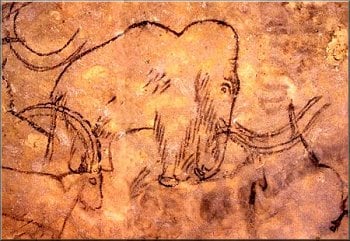
At a certain point, one of these early humans entered a cave and stood before its sinuous walls, a burning torch in his hand. The flickering flame cast dancing shadows across the uneven surfaces. Passing a finger over the damp limestone, the human being created lines. Before his eyes there was no horse, yet the image of a wild horse existed in his imagination. He took a piece of charcoal, coated his finger with a greasy substance, and began to trace curved and straight lines, thick and thin, black and red. Through an almost magical act of creation, he brought a horse into being, then another, as well as a bison, a lion, and a mammoth. These forms were precise, almost alive. A moment of extraordinary significance in human history had arrived: abstraction and art were born.
The act of painting appears to us as something self-evident, requiring no explanation. This was certainly not the case for a prehistoric human being who had never before seen a painting. We must therefore ask: how did the idea occur to Homo sapiens of translating a real creature, such as a horse, into a symbolic form through lines drawn on the wall of a dark cave, in such a way that the human eye could immediately recognize it? How did the idea arise of transforming the object itself—the horse—into an image? In other words, how did human beings succeed in converting a real object into a linear sign that the eye could recognize as a horse? How did the idea emerge that reality could be represented through an abstract visual sign?
Research has not yet solved this enigma, which remains one of the greatest mysteries in the development of the human species. For hundreds of thousands of years, human beings hunted, produced sounds, communicated, controlled fire, and developed increasingly sophisticated forms of behavior. Yet the idea of representing the surrounding world through lines had apparently not emerged. At what point did the understanding arise in the hominid mind that something absent or nonexistent could be made present through a sign?
More than three million years ago, early human species such as Homo habilis, Homo erectus, and the Neanderthals developed stone tools for hunting and learned to control fire. They even buried their dead and placed tools and ornaments alongside them. Yet millennia passed between the emergence of Homo sapiens in East Africa and the revolution that transformed the human world: early humans observed their environment and began to represent wild animals.
Why did they choose to paint animals? They could have painted human beings, the faces of their relatives, or the tools they struggled to manufacture. Why did they not paint the sun, the moon, the stars, the trees, the streams, the hills, or the abundance of fruits and plants that surrounded them?
In my view, this was neither fortuitous nor arbitrary. Cave paintings were not a spontaneous phenomenon but the result of a process of reflection taking place within the human mind. The imagination of early humans was filled with fascinating stories, perhaps comparable in certain respects to the fairy tales and legends of later societies. The protagonists of these narratives must have been majestic, impressive, and revered animals that stood out through their presence in the natural environment. The painter endowed them with human characteristics as well as extraordinary abilities. In his mind, he constructed complex plots that he must have recounted around evening fires.
These narratives were the source of his desire to undertake the considerable intellectual effort required to transform a story, through a process of abstraction, into lines adapted to the curves and irregularities of a cave wall. It can therefore be argued that narrative myth gave rise to abstraction, rather than the reverse. In this sense, abstraction, through the process of transforming a narrative into an idea, generated—or at least reinforced—human consciousness. Myth gave rise to abstraction, which was followed by metaphor and consciousness.
An examination of the magnificent paintings of the Upper Paleolithic, discovered during the last century in the caves of Chauvet, Lascaux, and Altamira, reveals works that, at first sight, seem impossible to imagine without the sophistication of contemporary artists. The images on the cave walls are not accidental. The mind of the nomadic hunter-gatherer already possessed the ability to perceive patterns and contrasts: between male and female, large and small, life and death, prey and predator, light and darkness, movement and stillness.
Their paintings expressed their capacity to observe a living object in nature and transform it into an image, while distinguishing among different representations and transforming them into concepts. This phenomenon did not develop merely as an individual cognitive expression. Rather, it emerged within a community capable of transforming information, sensations, and emotions into symbols. These symbols served as substitutes for words, speech, language, and the human effort to establish systems of meaning and definition. Is it merely coincidental that, in all these caves—separated from one another both geographically and chronologically—painters chose the wild animal as their primary subject?
Approximately 20,000 years separate the paintings of Chauvet Cave from those of Lascaux—a period longer than the span of time separating us today from the works of Lascaux. How did these artists, separated by such vast stretches of time and without any apparent knowledge of one another, manage to produce similar images? Despite chronological gaps of thousands of years, representations of animals maintained a remarkable degree of consistency, both in style and technique. We can discern neither a clear process of improvement nor one of decline.
When examining these cave paintings, one does not perceive a chronological process of development or an evident progression toward greater artistic perfection, despite the thousands of years separating works within and between different caves.
Moreover, we may ask why cave paintings have been discovered primarily in Western Europe and Indonesia, dating to approximately 44,000 years ago. Why have comparable works not been uncovered in the caves of Asia, closer to East Africa? Could these questions be related to the extinction of large wild animals and their disappearance from the European landscape? Did this disappearance provoke a crisis in hunting and, in response, a human reaction to this transformed reality?
Who was the community of Homo sapiens that sent some of its members deep into dark caves to paint animals on their walls? Were these cave works intended to be seen by the community as a whole, or only by a small and select group? Were the artists men or women? Were they young people or adults? Did a restricted group of particularly talented painters practice outside the caves, producing works that simply have not survived? If this was indeed the case, it would challenge the theory that social equality prevailed among nomadic hunter-gatherers and was disrupted only later by the agricultural revolution. Despite the extensive research devoted to this subject, we cannot escape the conclusion that the phenomenon of cave painting remains, to this day, an enigma awaiting decipherment.