
Seeking honest leadership, and new narratives.
When Israelis Become Targets Everywhere
Credit: Shutterstock
There was a time when many people insisted there was a bright moral line between opposing Israeli government policies and targeting Israelis themselves.
That line disappeared.
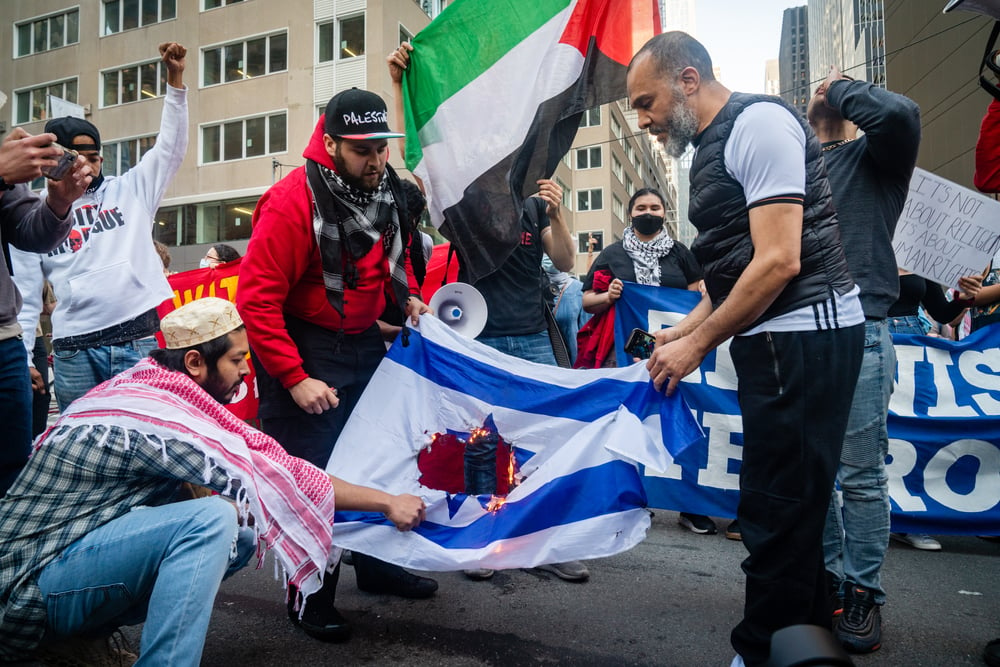
Today Israelis are being harassed in hotel lobbies, filmed in restaurants, confronted on streets, denied service, verbally abused at airports, and publicly humiliated online simply for speaking Hebrew, carrying an Israeli passport, wearing a Star of David, or existing visibly as Israelis in public spaces.
And much of the world is pretending not to notice what this means.
What began as political activism against a government has increasingly evolved into something darker: the normalization of treating ordinary Israelis as legitimate public targets.
They are not targeting diplomats. They are not targeting policymakers. They are targeting tourists. People like you and me, whose only “crime” is that they carry an Israeli passport and “dare” speak Hebrew in public.
The implications of this shift are profound, not only for Israelis and Jews, but for liberal democratic society itself.
The Collapse of the Individual
One of the defining features of prejudice is collective guilt.
The moment an individual ceases to be judged as an individual and instead becomes morally responsible for an entire nation, ethnicity, or people, society enters dangerous territory. This is precisely what is happening to Israelis across parts of the world today.
An Israeli checking into a hotel is no longer seen as a guest. They are seen as a political symbol. A Hebrew-speaking family at a restaurant is no longer simply eating dinner. They are treated as representatives of a global conflict.
This transformation is deeply significant because it strips Israelis of individual humanity and replaces it with ideological abstraction. Once that happens, harassment becomes easier to justify. Humiliation becomes activism and public intimidation becomes “resistance.”
Three Warnings From Around the World
What makes this phenomenon so alarming is that it is no longer isolated. These incidents are occurring across democracies, cultures, and continents, suggesting not random anger, but the normalization of a new social permission structure.
There are tens of thousands of documented anti-zionist, anti-Israel and antisemitic incidents that have been recorded since October 7, 2023. Here are just three examples:
In October 2023, a mob stormed the airport in Makhachkala, Dagestan, after rumors spread that a flight arriving from Israel carried Israeli passengers. Crowds flooded the terminal searching for Jews and Israelis while shouting antisemitic slogans. Videos showed people checking passports and attempting to identify passengers by appearance and nationality. Flights were halted and security forces struggled to regain control.
The images were chilling not only because of the violence, but because they felt like scenes pulled from another century. The idea that a mob could hunt for Jews or Israelis in an airport should have shocked the conscience of the world.
Instead, much of the reaction was disturbingly muted.
The event demonstrated how quickly anti-Zionist rage can collapse into open ethnic targeting once Israelis are no longer viewed as individuals but as symbols deserving collective punishment.
And here is a second example. Just days after October 7, crowds gathered outside the Sydney Opera House in Australis, where the building had been illuminated in solidarity with Israeli victims of Hamas terrorism.
What followed sent shockwaves through Jewish communities worldwide.
Videos circulated of demonstrators chanting hostile slogans, including allegations of antisemitic chants that became the subject of national controversy and political debate in Australia. Regardless of disputes over exact wording, the atmosphere was unmistakably hostile enough that many Australian Jews described feeling publicly unsafe for the first time in their lives. This was a precursor for what came after and known as the Bondi Beach Massacre.
The event was not taking place outside an Israeli embassy or military institution. It was taking place at a civic landmark in response to the murder of civilians.
And yet Israelis and Jews watching from around the world saw something deeply unsettling: public rage directed not merely at Israeli policy, but at Jewish grief itself.
Across Europe, and most recently at a hotel in California, Israelis increasingly report incidents of being confronted or ostracized simply for speaking Hebrew or revealing their nationality.
On a weekly basis, videos have surfaced online showing Israelis being verbally harassed in restaurants, filmed in hotel dining rooms, or pressured to leave public spaces after other guests discovered they were Israeli.
In many cases, the aggressors frame their actions as political activism. But the actual targets are ordinary civilians with no connection to policymaking whatsoever.
This distinction matters.
If a Russian tourist was harassed at dinner over the Ukraine war, or a Chinese student targeted abroad over Beijing’s policies, many people would immediately recognize the behavior as xenophobic collective punishment.
But Israelis increasingly exist in a moral gray zone where hostility toward civilians is rationalized as part of a broader political struggle.
That normalization is extraordinarily dangerous.
The Dangerous Language of “Zionist”
The modern anti-Zionist movement increasingly uses the word “Zionist” not as a political category but as a moral stigma. In practice, this often means that nearly every Israeli Jew, and many Jews globally, are treated as inherently suspect. The problem is not criticism of Israel. Democracies must tolerate criticism. The problem emerges when “Zionist” becomes a socially acceptable substitute for collective hostility.
History shows us that societies rarely announce prejudice openly at first. Instead, they create new acceptable vocabularies that allow old hatreds to return wearing contemporary moral clothing. The target changes names. The mechanism stays the same.
October 7 Changed Israeli Psychology
Since October 7, many Israelis already carry deep psychological trauma that includes grief, fear, insecurity, and a profound sense of abandonment by parts of the international community.
For many Israelis, the shock has not only been the violence itself, but watching segments of the world rapidly rationalize, excuse, or contextualize attacks against civilians. Now Israelis abroad increasingly feel another fear: That they are unsafe not because of something they personally did, but because of who they are. This has enormous long-term implications.
It reshapes how Israelis view the world. How Jews view public visibility. How Israelis travel. How Jewish communities define security. How future generations understand belonging in the international community.
The Death of Universalism
Many of the same spaces that champion inclusion, anti-racism, and minority protection suddenly become morally ambiguous when the targets are Israelis or Jews connected to Israel.
That contradiction is impossible to ignore.
If no other nationality would be considered fair game for collective intimidation in hotels, cafes, universities, or airports, then why are Israelis increasingly treated as the exception? When universal principles only apply selectively, they cease to be universal at all.
And here is one final thought.
There is a profound difference between protesting a government and treating ordinary human beings as political targets.
One is democracy. The other is the beginning of something far more dangerous.
Related Topics
Related Posts