
A Moroccan Journalist
When Israelis Become What They Fear
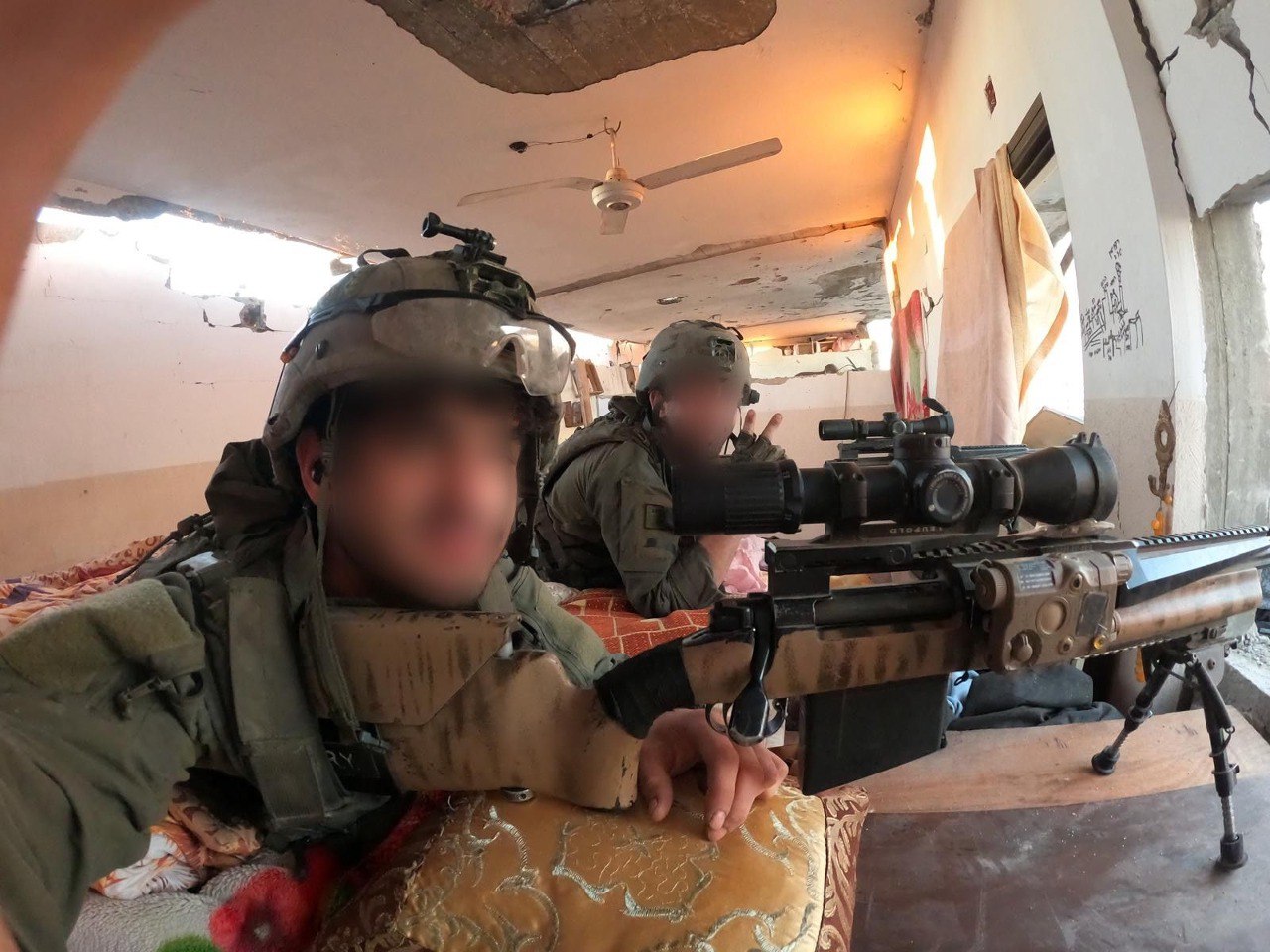
An IDF sniper unit deployed in Gaza in 2024. (Wikipedia)
What is often silenced in mainstream discourse is that the socialization processes shaping Israelis and Palestinians are not as radically different as they are made to appear.
We are told, again and again, that Palestinians are indoctrinated from childhood into hatred – that they are taught to become “terrorists,” and that this indoctrination somehow justifies their killing, even if they are still children, because the assumption is that one day they will grow up to “become Hamas” or “become threats to Israel.”
This narrative is a powerful one because it frames violence against Palestinians as preemptive self-defense, erasing the humanity of entire generations.
But if we use the same anthropological lens on Israel itself, the contrast is far less stark than official rhetoric suggests. Israelis, too, are socialized into violence, only within the legitimizing framework of the state. From a young age, school curricula, public ceremonies, and cultural memory valorize the IDF not simply as a defense force but as a glorified institution – the embodiment of national survival, honor, and continuity.
The “sacred picture of the IDF,” as some call it, makes military service not merely obligatory but almost ritualistic: a rite of passage into adulthood.
Of course, the socialization of Israelis into military service cannot be separated from collective trauma and memory. Israelis don’t just grow up with a state telling them that the IDF is sacred; they grow up with the inherited weight of Jewish persecution across centuries.
The destruction of the Temple, centuries of persecution, the expulsions from Europe, the pogroms, the Shoah, the Holocaust – these events are not distant history, but living memory, constantly rehearsed in schoolbooks, museums, commemorations, and family narratives.
These memories are ritualized through Yom HaShoah, through Holocaust museums, through stories passed from grandparents to children. They form what Marianne Hirsch calls “postmemory”: trauma transmitted so powerfully across generations that it becomes lived as if it were one’s own.
The state is framed as the long-awaited home after millennia of statelessness and suffering, and military service becomes the supreme duty through which every citizen must “give everything” to protect it, to compensate for centuries of helplessness, and to ensure that “never again” remains not just a slogan but a destiny.
Youth movements like Gadna prepare teenagers with pre-military training camps, television shows exalt elite units, and ceremonies on Memorial Day seamlessly link the sacrifices of fallen soldiers to the safety of the nation – in the same way Palestinians venerate their martyrs as guardians of the homeland.
Through Pierre Bourdieu’s notion of “habitus,” one could say that Israeli youth embody this militarized duty as second nature: military service is not debated; it is assumed.
This cultural memory functions as what Maurice Halbwachs called a “social framework of memory”: it does not simply recall the past, it organizes the present. Israeli children are taught that the state is not just a polity – it is redemption, the guarantor of survival, the incarnation of justice after exile.
The IDF, in this frame, becomes the institution through which survival is guaranteed, and through which past trauma is symbolically reversed. This is why today we see a near-total normalization of military enthusiasm among Israeli youth.
This helps explain why so many young Israelis embrace the IDF not grudgingly but almost joyfully, as if enacting a collective healing. Surveys reveal that most express readiness – even eagerness – to serve in Gaza, despite the devastation there.
The TikTok videos of IDF soldiers smiling with guns, dancing on destroyed property, or mocking Palestinian suffering are not aberrations; they are symptoms of an ideological formation where violence is not only normalized but celebrated.
When soldiers perform destruction as entertainment, they are engaging in the same dehumanization that is so often attributed exclusively to Palestinians.
In fact, these videos reveal something deeper: a symbolic reversal of Jewish history. Jewish identity has been historically remembered as one of powerlessness – centuries of being defenseless, persecuted, and displaced. Now, with military might, that memory is rewritten.
Destroying Gaza’s homes becomes, in this tragic logic, not merely war but a performance of strength, a proclamation that Jews will never again be victims without defense. The soldiers’ joy in destruction is inseparable from the trauma of history – a ritualistic way of declaring that the persecuted have finally become protectors.
In performance studies terms, this is a ritual of inversion: weakness is turned into strength, victimhood into mastery.
The parallel with Palestinians is disturbing but unavoidable. On October 7, the world watched horrifying Hamas videos showing militants attacking civilians with gleeful cruelty. Yet when IDF soldiers post their own videos – grinning while leveling homes, ridiculing Palestinian corpses, or turning Gaza’s ruins into a backdrop for military machismo – the structure is hauntingly similar.
Both operate through a refusal to humanize the “other,” reducing them to dogs, animals, enemies not worthy of life. The difference lies not in the act of dehumanization itself but in the framework through which it is legitimized.
In cultural studies terms, this is the mirroring logic of enemy-making: each side imagines itself as defending “life” while constructing the other as “death.” But the crucial point is that these are not simply individual moral failures; they are institutionalized pedagogies.
The anthropological irony is that this “destiny” mirrors what Palestinians themselves internalize. Just as Israelis are told they must sacrifice everything for their homeland, Palestinians are told they must resist everything to preserve theirs.
Both are trapped in what Edward Said once called “competing victimhoods,” where collective memory feeds collective militancy. The rituals differ – one is the flag of the IDF, the other the keffiyeh and the memory of Nakba – the symbols differ, but the underlying structure – trauma translated into sacred duty – is strikingly similar.
Palestinians, too, cultivate memory as a living force: the Nakba is not history but an ever-present wound, commemorated every May 15, passed down in refugee camps, retold in family stories of lost villages, and echoed in poems and songs that repeat themes of dispossession and return.
The keffiyeh, folk songs of exile, films about the Nakba, the keys of return, and the figure of Handala all perform the same work of cultural transmission, binding generations together through shared symbols of loss and defiance.
Under occupation, they grow up seeing martyrdom as resistance and resistance as survival under dispossession because all other avenues are closed.
Like Israelis who grow up seeing military service as an ordained fate, an existential mandate, and a redemptive enactment of collective trauma and survival, Palestinians also live in what Jan Assmann would call a “cultural memory regime” that binds identity to trauma.
Both are products of ideologization, both shaped by powerful narratives, both carrying guns with a sense of righteousness.
Each side enshrines its past suffering into a moral imperative for the present. And in doing so, each reproduces the cycle of violence – not because of some essential hatred, but because collective trauma has been institutionalized into collective duty.
The only real difference is that Israel’s violence is exercised under the banner of the state, giving it the legitimacy of “law,” while Palestinian violence is framed as “terrorism.” Yet the lived realities – the destruction, the trauma, the refusal to humanize – are far less different than the narratives would have us believe.
If there is one truth I want to state clearly, it is this: in all of this lies the deepest tragedy. Israelis, having endured all this – centuries of persecution, exile, pogroms, the Holocaust – should have been the first to recognize suffering and the sacred duty of never inflicting it on others.
They more than anyone should have carried within them a heightened sensitivity to human vulnerability, a moral awareness born of trauma.
Instead, the state’s militarized memory has transformed this inheritance into something else: not a call to protect others from such horrors, but a justification to perpetuate them. In Gaza and the West Bank, Israelis have become what they once feared, reproducing for others the very conditions of dehumanization and despair that defined their own past.
Related Topics
Related Posts