
When it Really is Antisemitism
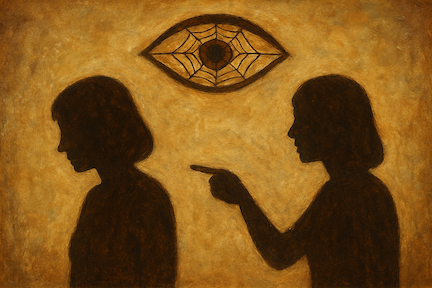
(How I Lost a Thirty-Year Friendship in One Absurd Accusation)
Leave it to Geraldine — my friend of thirty years — to detonate a friendship with one wild, baseless accusation. Two weeks before my wedding, fresh off a flight from New York City back to Scotland, retina freshly torn and laser-repaired, she sent me a text message that made my jaw drop.
She didn’t call. She didn’t look me in the eye. She ended a three-decade friendship with one accusatory text.
In that text, she claimed I had her friend — a security guard — fired from a private Jewish school in New York City.
A school I had never been to.
A school I didn’t know the name of.
A man I had never met.
A man whose name I didn’t know.
My only “connection”? I am Jewish. And once, months earlier, she had mentioned during one of our phone calls, that her friend worked at a Jewish school… and she said I sounded “nervous.”
She wasn’t wrong. I probably did sound nervous. Because ever since October 7th — ever since the war and the explosion of hatred online and in the streets — I braced myself whenever she mentioned anything about Jews or Israel. I knew what was coming: a rant. A tirade. Geraldine, with her rage and a flood of curse words in every sentence. I would just listen quietly until she changed the topic.
That’s what she heard — not guilt, not fear, not some secret plot to get a stranger fired. She heard my dread. The dread of another monologue dripping with hostility toward anything Jewish, anything about Israel, anything connected to me.
And now, with this text, she leapt straight into an old antisemitic trope as if she were picking from a menu: Jews control everything. Jews have secret influence. Jews can pick up a phone and get people fired.
According to her logic, I had somehow called a school I’d never visited and said:
“Hi, this is Julia. I’m Jewish. Please fire… Bob? Well, I do not know what his name is, but he is the security guard who is not jewish. Whoever he is. Yes, yes, I’ve never met him, don’t know what he looks like, but if you could just remove him from his livelihood, that would be great. Thanks!”
And the school — apparently thrilled to obey — immediately fired him because… what? I have secret magical Jew powers?
It would be hilarious if it weren’t so disgusting.
I’ve dealt with antisemitism before.
In college, at a party, a fellow student walked up to me and told me he “wished Hitler had finished the job.” This wasn’t even a stranger. He was a friend of my boyfriend at the time — someone I had gone to events with, along with his girlfriend. He had always been friendly, which made the moment even more jarring. And yet, he felt the need to say this hateful, cruel thing to me — just to get me. My dad’s Aunt Basha and her two children were murdered at Auschwitz. He did not know this. It was not information I shared with people, and I wondered: if he had known, would he have been happy that they were murdered?
He was drunk, and that’s when people’s truest feelings spill out. His “true feelings,” it turned out, were that he wished all Jews had been killed. I’ve seen the same comment repeated endlessly on social media now: “Hitler should have finished the job.” People full of malice write this — hidden behind locked accounts, spewing venom with no consequence. At the party, he said it straight to my face. I’ll give him that — it wasn’t hidden, wasn’t anonymous — it was out in the open for me to hear, to see. I saw his face, and it was full of venom. I have never harbored hate toward a group of people, or even a single person. I did not even feel hatred toward him. I felt anger and then sorry for him — sorry that someone could carry such hate at such a young age.
And the first version of this hate hit even earlier. In grade school, I used to visit my friend June’s house. She was a gifted musician. Her father, who was Korean-born, was a strict disciplinarian who made her practice the piano while I waited. Her home was the opposite of mine — four kids, barely any rules. At June’s house everything was structured and orderly.
Every time I visited, her father made me wash my feet in a tub filled with a few inches of water. I thought it was cultural. Shoes off, feet washed. I was a kid. What did I know?
One day at school, June told me quietly:
“He makes you wash your feet because he thinks Jews are dirty.”
I never went back. And I tucked that memory away in the “this is too much to process” box where childhood traumas go until we’re old enough to understand them. I never even told my parents. All four of my grandparents fled Europe for New York; everyone left behind perished. They came to America so their children and grandchildren wouldn’t suffer what they did.
But hate has a way of following us — from Europe to New York and now to the digital world — where it multiplies. The venom, the blaming, the scapegoating. The poison.
December 2024: my retina torn, my wedding weeks away, and then Geraldine’s text — accusing me not just of ruining a stranger’s livelihood, but of wielding mythical control over a Jewish institution.
It triggered everything. College. Grade school. The endless online harassment where strangers now call me a genocider or a killer.
All for simply being Jewish.
And in that moment, Geraldine was out of my life.
She did me a favor.
Two weeks later, I stepped into a new life — marrying a man who treats me with respect and tenderness. A man who, though not Jewish, took time to research Israel and Judaism not because I asked him to, but because he wanted to understand my world. A man who protects me when he can, who softens the harshness of trauma with gentleness and love.
Why would I carry someone into that future who vibrated on a frequency of bitterness and rage? Why bring along anyone who made me feel small, unsafe, or judged for my very existence? A supposed friend who wouldn’t even give me the decency of defending myself against her wild accusation? After her accusation, she blocked me.
I’ve also come to realize that Geraldine may be struggling with paranoia and her own unraveling, maybe pushed along by the rising anti-Jewish sentiment and the barrage of horrors in the world.
A few months after everything detonated, curiosity got the better of me and I checked her Facebook page through my husband’s account. Buried between cat videos was a meme — a cartoon man with the grotesquely exaggerated nose, clutching a sack of money. And another post: a reposted video implying that Jewish women fabricated the rape accounts of October 7th.
That was the moment I understood: this wasn’t just a friendship breaking. Something darker had already taken root. I felt sick.
I thought of my mom, who Geraldine loved and once called a “saint”… my mom Esther. I thanked God my mom wasn’t here to see not only this, but the hatred that has festered even in old friends. My mom was a very kind woman, and I never saw any hate in her. I am grateful to have been brought up with her as an example of how to live.
Hate is a poison. And I refuse to take it in. I never looked at her Facebook page again. This was a thirty-year friendship, and so perhaps I went back thinking that this whole thing was just a misunderstanding — a bad dream. It was not. It was real.
It’s been a year now, and the damage from the retinal tear is still with me. There’s a dark spot in my vision, like a small, full black moon that never quite moves. Sometimes it looks like a faint spider web is across my field of vision. At night, flashes bloom at the edges, tiny bursts of light where there shouldn’t be any. My sight will never be what it was — but strangely, in some ways, I’m seeing more clearly than ever.
Some things can’t be fixed. There is loss that never fully heals. And there are truths — ugly, unfair, sometimes outright evil — that we’re forced to carry simply because we’re human. Accepting them doesn’t make them easier. But naming them, witnessing them, is its own kind of clarity. Or as my dad used to say: “It is what it is.”
I wish Geraldine blessings — truly.
But in the immortal words of the Rabbi in Fiddler on the Roof, who offered a blessing for the czar:
“God bless Geraldine… but instead of a blessing for the czar, I have a blessing for Geraldine: keep her far away from me.”
Amen.