Expose hate. Educate with integrity. Empower through action.
When Leaders Fail, Jews Get Blamed
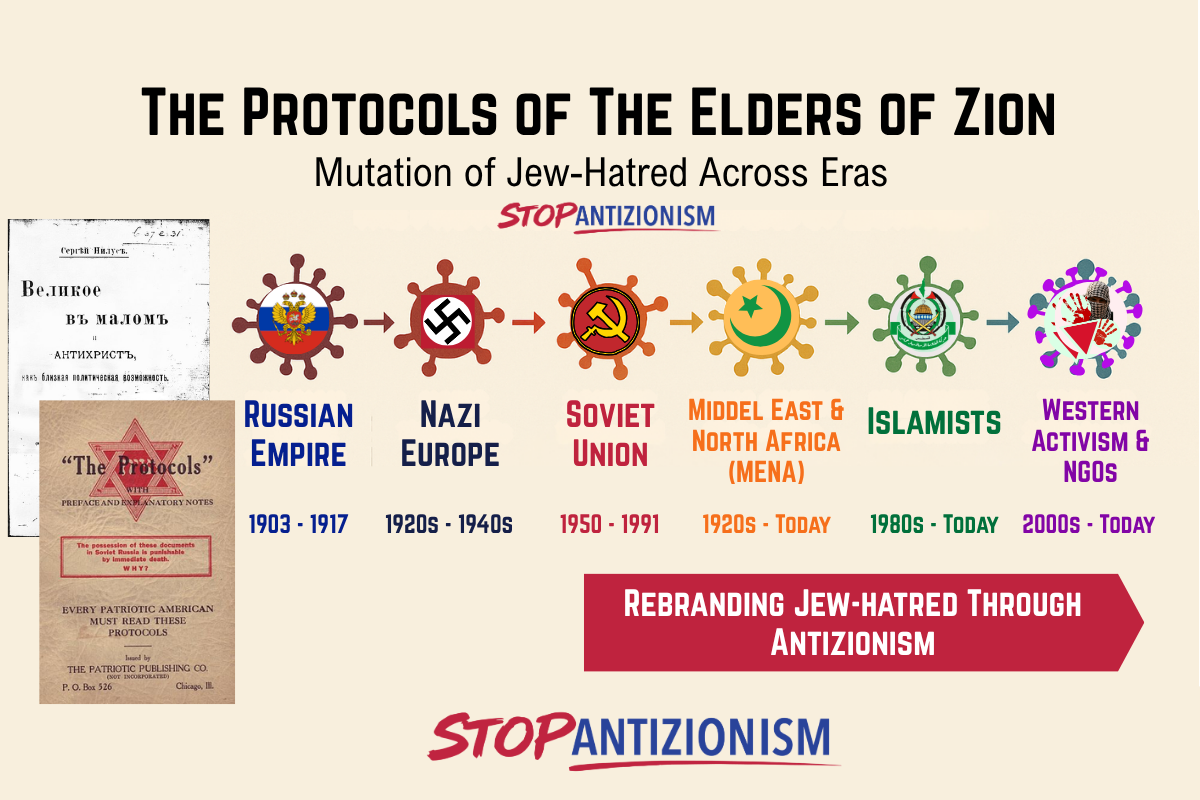
The Protocols of the Elders of Zion - Mutatio nof Jew-hatred across eras. When Societies Stop Solving Problems, They Start Blaming Jews A Civilizational Warning Hidden in Plain Sight
When Societies Stop Solving Problems, They Start Blaming Jews
A Civilizational Warning Hidden in Plain Sight
There is a saying I grew up hearing in the Soviet Union, whispered in kitchens and muttered in schoolyards: “Во всех грехах жиды виноваты” — “The Jews are guilty of all sins.”
As a child, I could not grasp the absurdity of it. I would come home from school in tears, telling my parents I no longer wanted to be Jewish. It took years, and a journey to Israel, to understand the deeper truth hidden inside that proverb. It was not a statement about Jews. It was a confession of a civilization’s own failure.
The Blueprint for Blame
More than 120 years ago, in the dying days of the Russian Empire, a document was fabricated that would become the most destructive lie in modern history: The Protocols of the Elders of Zion.
It was not a spontaneous outburst of hatred. It was a calculated political weapon, engineered by the Tsarist secret police at a moment when the empire was imploding under economic stagnation, violent polarization, military humiliation, and revolutionary unrest. Rather than confront these failures, the regime chose the oldest diversionary tactic in history: scapegoating the Jews.
The Protocols presented itself as a secret Jewish blueprint for world domination. It was a forgery, later exposed as a plagiarism of a 19th-century French political satire. But exposure did not blunt its power. It had already been translated into dozens of languages and adapted to fit every era’s political vocabulary. It gave broken societies a ready-made script: Your suffering is not caused by bad leadership or failed institutions. It is caused by the Jews. That lie required no self-reflection, demanded no reform, and converted national failure into hatred.
The Same Conspiracy in New Clothing
What makes the Protocols uniquely dangerous is not its content, but its adaptability. The vocabulary changed with each era. The target never did.
In the Russian Empire, Jews were scapegoats for a collapsing regime. Rather than address revolutionary unrest, agrarian crises, and endemic corruption, the Tsarist authorities orchestrated pogroms and produced the Protocols to redirect public fury toward a defenceless minority – the Jews. In Nazi Germany, the accusations were sharpened into extermination. The slogan of Der Stürmer, “Die Juden sind unser Unglück!” (“The Jews are our misfortune”), distilled centuries of libel into a single weaponized phrase. A society broken by hyperinflation, mass unemployment, and national humiliation needed a simple explanation for its suffering. The Nazis provided one.
In the Soviet Union, explicit antisemitism had become inconvenient after the Holocaust, so the conspiracy was updated. “Jews” became “Zionists.” State-sponsored Jew-hatred wore the costume of anti-imperialism and social justice. After Israel defeated Soviet-backed Arab armies in 1967, the Kremlin intensified the libel and exported it to Arab governments, international organizations, and eventually Western universities, one of the most successful ideological exports of the 20th century. In my school, teachers repeated the slogans: “Zionism is imperialism.” “Israel is the colonizer.” My classmates did not call me a Zionist. They called me zhydovka. The code was transparent. “Zionist” meant Jew.
In Arab nationalist states, the Protocols filled a different but equally familiar function. Military defeats, political stagnation, and the failure to destroy Israel demanded an explanation that absolved leaders of responsibility. Rather than confront internal corruption and economic failure, Arab regimes distributed the Protocols through state-funded media, incorporated it into school curricula, and presented it as a factual historical document. Generations of students were taught that Jewish world domination was not a conspiracy theory but an established truth, a blueprint their enemies had written themselves and been caught with.
Islamist movements took this further still. In their hands, the Protocols were elevated from political propaganda to sacred text. Hamas embedded references to Jewish conspiratorial power directly into its founding charter. Hezbollah distributed the Protocols as educational material. In Iran, state television broadcast dramatizations of its contents as historical fact. For these movements, the Protocols did not need to be proven. It confirmed what theology and ideology had already declared: that Jews were not only a political enemy but a cosmic villain. The document moved from the schoolroom to the mosque, from propaganda to scripture.
Today, in Western activist spaces, the language of world domination has given way to accusations of colonialism, apartheid, and genocide. The vocabulary is more palatable to secular ears, but the underlying structure is identical. The Jewish people, or the Jewish state, are portrayed as uniquely powerful, uniquely malevolent, and uniquely responsible for global suffering.
Every era changed the libels and conspiracies. But the core accusation never changed: Jews are the hidden architects of the world’s suffering. Dr. Naya Lekht’s research reveals a consistent and chilling historical pattern. In each era, society defines its own supreme virtue, and Jew-hatred constructs Jews as the ultimate violators of that virtue, using the moral language of the time. As values shift, so does the accusation. In the religious era, Jews were enemies of God. In the racial era, they were enemies of the human race. In the human rights era, they are enemies of justice. The target remains the same; only the indictment changes.
What makes this so uniquely dangerous, as Dr. Lekht explains, is that Jew-hatred never presents itself as hatred. It presents itself as moral righteousness, as the defense of something sacred. Whether the target is the Jewish religion, the Jewish race, or the Jewish nation, each era convinced itself that persecuting Jews was not only justified but virtuous. Jew-hatred has always perceived itself as a virtuous hatred. That is precisely how it justified the killing.
And no era, no movement, no rebranding ever actually changed the accusation. They only dressed it differently.
For a deeper examination of how antizionism functions as the third era of Jew-hatred, Dr. Naya Lekht, along with Ben Cohen of the Foundation for Defense of Democracies, and Einat Wilf, explored this pattern in depth under What is Antizionism at the World Symposium Against Antizionism 2026.
A Radicalization Manual
The Protocols is not merely a book. It is a mechanism, a step-by-step process through which ordinary societies are turned against Jews. The sequence is grimly predictable: a society experiences genuine crisis; leaders fail to solve the underlying problems; a scapegoat is identified; the Protocols provide the conspiracy framework; the population becomes radicalized; discrimination and violence become justified.
This is not a historical curiosity. It is a pattern still unfolding in democratic societies that consider themselves immune. The mechanism works because it offers what governance cannot always provide: simplicity. Fixing real problems requires discipline, effort, and honesty. Blaming Jews is effortless and emotionally satisfying. It replaces accountability with an enemy and provides temporary relief while the underlying wound grows deeper.
Jew-Hatred as a Symptom of Civilizational Crisis
History delivers its verdict with striking consistency. The Russian Empire collapsed. Nazi Germany was destroyed. The Soviet Union disintegrated. Arab regimes that blamed Israel for their failures produced repression and stagnation for their own people. Not one of them solved the problems they blamed on Jews.
This is the lesson that must be stated plainly: a surge in Jew-hatred is not a sign of Jewish wrongdoing. It is a sign of societal failure. When leaders cannot govern, they reach for the Cycle of Libels. The Protocols become the blueprint. Jews become the answer to questions that honest leadership should be asking about itself.
A country that normalizes Jew-hatred fails not only its Jewish community. It fails all communities. Once a society accepts that one minority can be blamed for its problems, truth becomes disposable, institutions weaken, and law becomes selective. The same political culture that persecutes Jews will eventually turn against other minorities, dissidents, and ordinary citizens. A democracy that cannot protect its Jewish community is no longer a democracy. It has abandoned the foundational principle that no people shall be made a scapegoat for the failures of those who govern them.
Ben Shapiro’s discussion of Jew-hatred as a civilizational symptom at the World Symposium Against Antizionism 2026, examines precisely why societies that cannot overcome Jew-hatred are unlikely to overcome their deeper failures.
Canada: A Warning Closer to Home
Canada, a country my parents immigrated to because it represented everything they had fled from in the Soviet Union, in reverse. Canada was pluralism made real, decency institutionalized, a place where being Jewish was not a liability.
That Canada is disappearing.
Over the past decade, Canada has been gripped by converging crises: home prices beyond reach for a generation, rising violent crime, stagnant productivity, ballooning deficits, and the growing influence of authoritarian regimes, including Iran, China, and Qatar, over Canadian institutions. These are hard problems. They demand governing.
Instead, the political establishment reached for the oldest substitute for governance: redirect the anger. The genocide libel. The apartheid libel. The colonizer libel. Ancient Jew-hate frameworks were revived in modern costume and directed at Israel and, by inevitable extension, at Jewish Canadians. Jew-hatred surged to levels not seen since the 1930s. Jewish schools received bomb threats. Synagogues were vandalized. Wearing a Star of David became a calculated risk. Terrorist organizations publicly thanked Canada for its stance. When a designated terrorist group celebrates your foreign policy, you have not made a moral stand. You have made a choice about which side of history you stand on.
When Mark Carney replaced Justin Trudeau as Prime Minister, many in the Jewish community hoped for a reset. On October 2025, instead of confronting the ideology poisoning Canadian institutions, he announced that if Benjamin Netanyahu were to set foot in Canada, he would have him arrested.
The Cycle of Libels performed. Canada’s housing crisis, its deficit, its fraying social fabric left unsolved. But the Israeli Prime Minister? Him, we will prosecute. It was scapegoating dressed as principle, the oldest political reflex executed in the very place it most needed to be repudiated.
Canada will not solve its domestic crises by demonizing Israel. Every society that has tried this approach failed, not only to solve its problems, but ultimately to survive them. A democracy that cannot protect its Jewish community has already begun to fail all its communities.
On June 1, 2026, Prime Minister Mark Carney stood before the Jewish community at Holy Blossom Temple in Toronto, desperate for leadership. He acknowledged the rise in antisemitism. He expressed concern. And then he failed to name it. He did not say what any honest observer of history can plainly see: that antizionism is the third era of Jew-hatred, the direct ideological heir of the Protocols, wearing the costume of social justice.
Prime Minister Carney’s response to the antisemitism crisis came in the form of a newly appointed Ministerial Advisory Council on Rights, Equality, and Inclusion. The gesture raised more questions than it answered. Two appointed members carry records that are deeply problematic for a body tasked with combating Jew-hatred. Omar Alghabra previously refused to support the designation of Hamas, Hezbollah, and Islamic Jihad as terrorist entities, and criticized Canadian media for labeling the Al-Aqsa Martyrs’ Brigades as terrorists, an organization Canada had already formally blacklisted. Avnish Nanda provided legal representation to participants of an anti-Israel encampment at the University of Alberta, which B’nai Brith Canada linked to a coast-to-coast wave of campus occupations that left Jewish students feeling unsafe and excluded, and which the university’s own Board of Governors later acknowledged contained a symbol of hatred toward the Jewish community. Neither appointment proves malicious intent. But both appointments prove something equally damaging: a failure of seriousness. A prime minister genuinely committed to dismantling Jew-hatred does not staff the committee addressing it with members whose records undermine its credibility before it holds its first meeting. And a prime minister who actually understood the urgency would not need a committee at all. He would act. The advisory council is not a solution. It is the appearance of one, which, at this stage in Canada’s radicalization, may be worse than doing nothing.
There is a name for Carney’s advisory council kind of gesture. In the Soviet Union, it was standard political practice: when public pressure demanded a response, the regime created a committee. The committee held meetings, issued statements, and generated the appearance of action while ensuring that nothing would actually change. The people appointed to it were selected not for their ability to solve the problem, but for their willingness to manage it indefinitely. Carney’s advisory council follows that template with uncomfortable precision. It is not a mechanism for change. It is a mechanism for deferral, designed to absorb community frustration and convert urgency into process. The Soviet Union perfected this art. Democratic governments that borrow it should be recognized for what it is: not leadership, but theater.
The Antidote
The Protocols has survived for more than 120 years because it offers a seductive shortcut: blame instead of accountability, conspiracy instead of reform, hatred instead of truth. Societies that choose this path do not become stronger. They decay.
Antisemitism is not merely a Jewish issue. It is a civilizational diagnostic. When Jew-hatred rises, it is a warning light on the dashboard of civilization, telling us that leaders are failing and institutions are decaying. The Protocols is not just a lie about Jews. It is a mirror held up to failing civilizations.
When leaders blame Jews, demand solutions. When activists spread libels, name the pattern. The crisis is never with the Jews. It is always with the society that needs Jews to blame.
Confronting the Pattern: What Can Be Done
Naming the problem is the first act of resistance.
That is the principle behind Stop Antizionism, a growing initiative working to expose antizionism for what history plainly shows it to be: the third era of Jew-hatred and a civilizational crisis that threatens not only Jewish communities but the democratic societies that tolerate it.
The work is rooted in education, because the Cycle of Libels and the weaponization of token Jewish voices in the demonization process depend above all on ignorance. When people cannot recognize the pattern, they cannot resist it. Stop Antizionism brings that pattern into classrooms and lecture halls, working with middle schools, high schools, universities, and professional communities to teach people how to identify the mutation of Jew-hatred across eras, how the Protocols became a blueprint for each generation’s libels, and why a society that scapegoats Jews is a society already in trouble.
At the heart of this effort is a Global Declaration affirming that antizionism is Jew-hatred, that it follows a documented historical pattern, and that normalizing it is not a political position but a civilizational failure. The Declaration invites individuals, communities, and institutions to go on record, to say clearly what history has already established.
Confronting hate does not begin with legislation or government committees. It begins with people who understand what they are looking at and refuse to look away.
Related Topics
Related Posts