Jamaica's Rabbi
When man no longer needs to work, what will he live for?
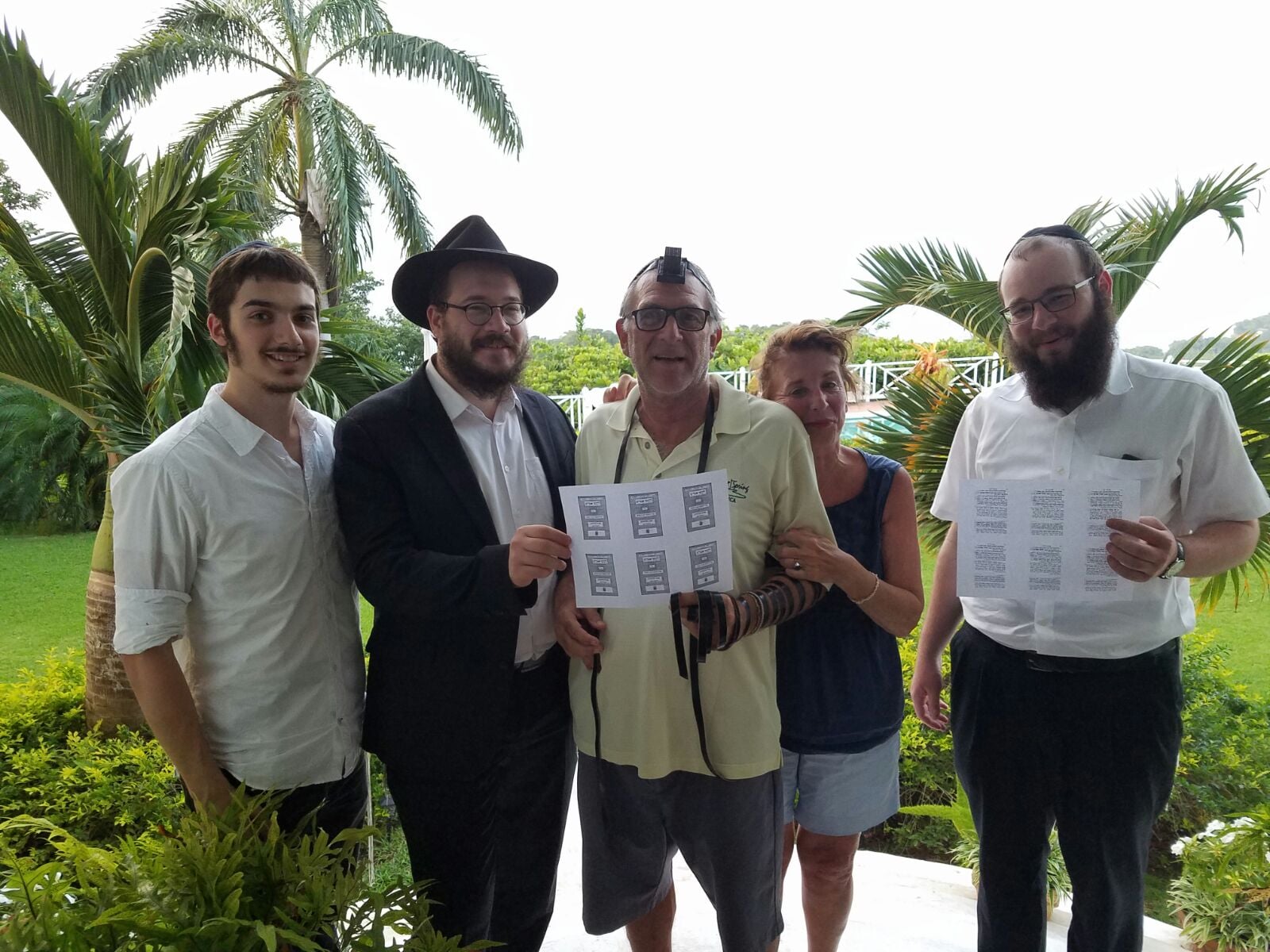
A historic moment: the Tanya is printed for the first time in Port Antonio, Jamaica, in August 2016. Rabbi Yaakov Raskin with Robert Floria, holding the freshly printed pages. Photo credit: Chabad of Jamaica
Last November, at the US-Saudi Investment Forum, Elon Musk made a remarkable statement. He said: “My prediction is that work will be optional.” Advancements in artificial intelligence and robotics, he proclaimed, would eventually make money, and the work needed to earn it, irrelevant.
But that leads to a far deeper question, one that anyone who hears this should be asking: What will the world look like when we no longer need to work to make a living? What will we be spending our days doing?
Over 800 years ago, the great Jewish philosopher Maimonides had an answer to this question. He described a time in the future in which there would be neither famine nor war, neither jealousy nor competition, and material abundance would be available to all. In the very last chapter of his magnum opus, the Mishneh Torah, he writes: “The occupation of the entire world will be solely to know G-d.” (Laws of Kings, Chapter 12, Law 5)
Long before electricity, robots or AI made the dream of a work-free future seem realistic, a Jewish scholar envisioned a world in which humanity would be liberated from its material struggles and dedicate itself to knowing its Creator. This is the Jewish vision of the Messianic era.
Technology may be bringing us closer to the circumstances described by Maimonides. But who is preparing us for their purpose?
A revolution that began in a Russian prison
Sunday November 29, marks the 19th day of the Hebrew month of Kislev. Among many Jews, it is known as the “New Year of Chassidism”. It commemorates the day in 1798, when Rabbi Schneur Zalman of Liadi – the founder of the Chabad movement – was released from a Russian prison after 53 days of imprisonment. After being wrongfully accused of treason, he was released when the charges were found to be baseless.
His liberation represented something much deeper than simply one man’s freedom. It marked a new chapter in revealing the deepest teachings of the Torah, making them accessible to the common person. Rabbi Schneur Zalman, also known as the Alter Rebbe, preached the that we must not only believe in G-d, but also strive to know and understand Him. As King David told his son Solomon, “Know the G-d of your father and serve Him with a whole heart” (I Chronicles 28:9).
Through his teachings, particularly his foundational work, known as “the Tanya”, the Alter Rebbe gave us tools to understand our souls, navigate our inner struggles and discover the Divine purpose within everyday life.
This was a revolution, as spirituality was no longer reserved for scholars or holy men. It could now be accessed by every individual. Through the teachings of Chasidism, simple folk – farmers and craftsmen, as well as mothers and young people – could each develop a personal and meaningful relationship with their Creator.
More than two centuries later, perhaps his teachings are more relevant than ever.
We are becoming more intelligent. Are we becoming wiser?
Today, a child with a smartphone has access to more information than some of the wisest scholars of previous generations. We can communicate across continents in an instant. Artificial intelligence can write, calculate, translate and solve problems that once required years of hard work.
Yet with all this advancement, so many people are still struggling to find the simple things in life: meaning, happiness and inner peace. We have connected the entire world and solved almost every theoretical problem, yet we are still learning how to connect with the person sitting across the dinner table.
The problem is that in pursuing endless progress, society has taught machines how to think for us and solve our problems. Yet with all this time and mental energy freed up, the question remains how we are going to spend our precious earthly time.
My teacher and mentor, Rabbi Menachem M. Schneerson taught that technology itself is not the destination. It is a means to achieving something greater. All scientific and technological advancements ultimately serve a single purpose: to bring humanity closer to the Divine creator.
That is why, in addition to the technological progress we make each day, we must also invest in the spiritual and moral development of our people. A country’s success can’t be measured only by its wealth, infrastructure or technological capacity. In the new world which is being ushered in, humanity’s progress should be measured by the kindness of its citizens, the strength of its families, and the values we pass on to the next generation.
We don’t have to wait
The beautiful message I would like to share on this 19th day of Kislev is that we do not have to wait for artificial intelligence to free up our time to begin discovering G-d. We can begin today.
It can start with a meditation practice: Take a few minutes each morning to contemplate why you were created. Study something meaningful and joyful. Help another person without expecting anything in return. Teach your children that their worth is not determined by how much money they earn or their social status, but by the good they do for others, and bring into this world.
We have spent centuries learning how the world works and refining it via technological advance. It is time to dedicate ourselves to understanding the purpose of existence. Ultimately, we are here to do more than just exist. We are here to thrive and understand G-d.
More than 2,700 years ago, the prophet Isaiah envisioned a day when “the earth shall be full of the knowledge of G-d, as the waters cover the sea” (Isaiah 11:9). That day may come sooner than any of us may realize.
Related Topics
Related Posts