
CEO of Time to Stand Up for Israel
When Medicine Becomes a Political Weapon
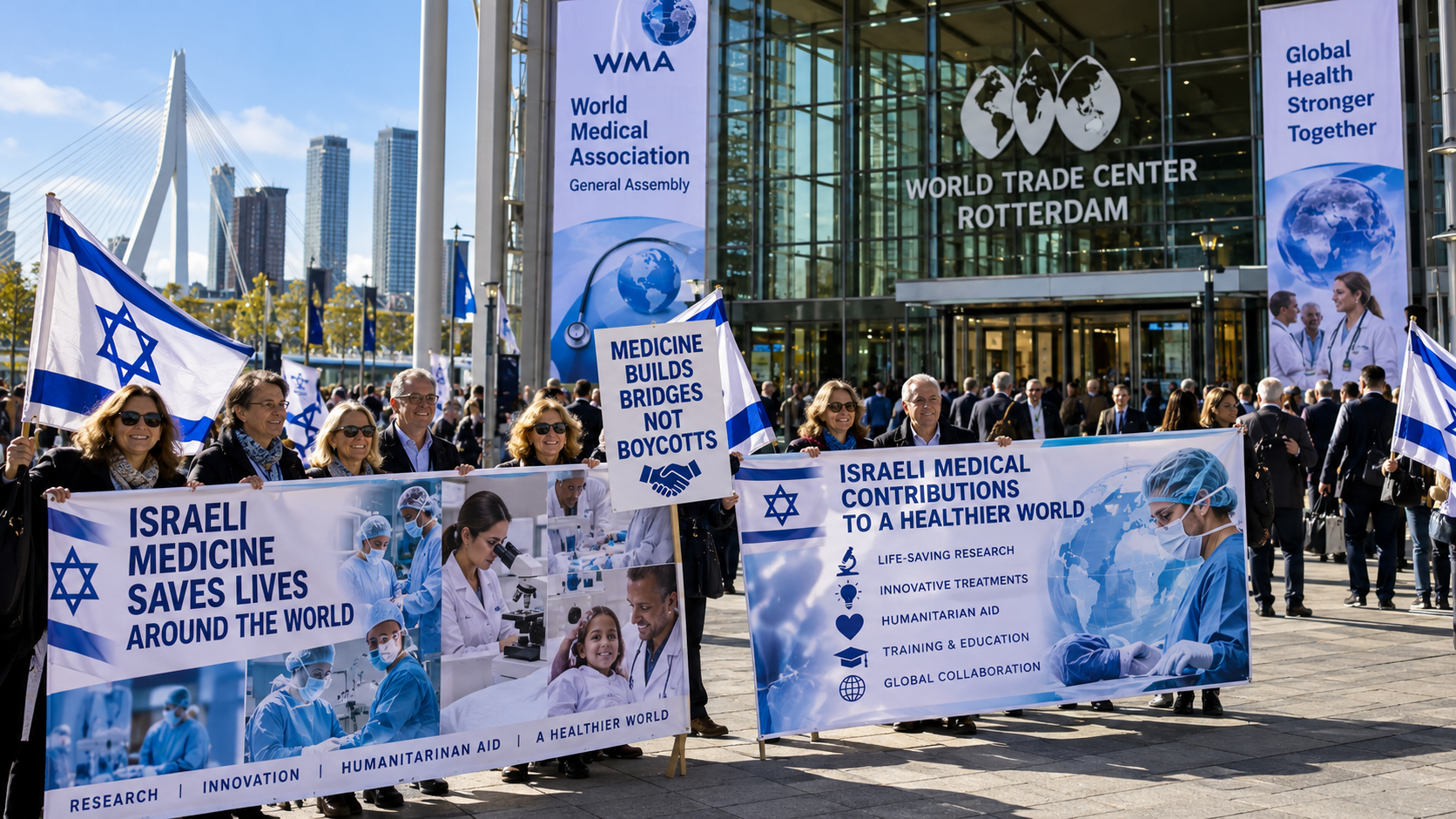
Photo Credits: Sabine Sterk ( AI)
An opinion on Israel, medical ethics, and the dangerous consequences of allowing ideological hostility to interfere with international healthcare cooperation.
Last week, Rotterdam hosted a congress of the World Medical Association, bringing together representatives of medical associations from more than 110 countries. Among them was the Israeli Medical Association, representing a country whose contributions to medical science, emergency medicine, research, and humanitarian healthcare have benefited patients far beyond its own borders. Yet instead of concentrating entirely on the challenges facing modern medicine, concerns emerged that certain groups might attempt to turn this international gathering into another opportunity to isolate Israel. Reports circulated about a possible boycott of the Israeli Medical Association. For those of us who believe that medicine must remain a bridge between people, regardless of nationality, religion, or political disagreements, the very possibility was deeply disturbing. It raised a fundamental question. How did we reach a point where medical professionals, whose first responsibility is to protect human life, could become targets of political exclusion simply because they represent Israel?
Because of these concerns, we decided to be present outside the World Trade Center in Rotterdam. We carried banners explaining Israel’s contributions to international healthcare and the importance of maintaining professional cooperation. We wanted delegates to understand that excluding Israeli doctors would not advance medical ethics, improve healthcare in Gaza, or save a single patient. It would merely introduce another political division into a profession that depends on exchanging knowledge, sharing discoveries, and cooperating across borders. Ultimately, no proposal to boycott Israel was brought before the congress, which was precisely the outcome we had hoped for. That was encouraging, although it does not establish whether such a proposal would otherwise have been introduced. Nevertheless, the controversy itself revealed something far more troubling about the political atmosphere surrounding Israel.
Consider the extraordinary contradiction. Israel is a relatively small country, yet it has become an internationally recognized center of medical innovation. Israeli researchers and physicians have contributed to developments in cancer treatment, cardiovascular medicine, medical imaging, rehabilitation, digital healthcare, and emergency response. Israeli hospitals have treated patients from different religious and ethnic communities, including Palestinians and victims of the Syrian civil war. Israeli medical teams have also participated in humanitarian missions following devastating disasters abroad. After the earthquake in Haiti in 2010, Israeli medical personnel established a field hospital. Following the earthquakes in Turkey in 2023, Israeli rescue and medical teams were deployed to assist survivors. These are not abstract political statements. They are practical examples of a country investing knowledge, expertise, and resources in preserving human life.
Of course, Israel is not the only country contributing to global medicine, nor should its achievements place its government beyond criticism. Medical ethics apply to every nation, including Israel. Allegations concerning the conduct of healthcare institutions or professionals deserve serious, impartial examination. But there is an enormous difference between investigating specific conduct and advocating the collective exclusion of an entire national medical association. The former can uphold professional accountability. The latter risks turning nationality into a reason for professional punishment. Once that principle is accepted, what prevents similar campaigns against doctors from other countries whose governments are involved in wars, political controversies, or human rights disputes?
What troubles me even more is the broader mentality behind attempts to isolate Israel. For decades, an extraordinary amount of political energy has been directed toward challenging the legitimacy, achievements, and international standing of the Jewish state. The Palestinian national movement and its international supporters are not a single uniform group, and many Palestinians genuinely want peaceful coexistence and economic opportunity. Nevertheless, influential political factions, particularly Hamas and other organizations committed to armed confrontation, have repeatedly promoted a vision in which opposing Israel takes precedence over building functioning institutions and creating a prosperous future for their own population. That choice has had devastating consequences, especially for the ordinary families whose lives have been shaped by repeated wars, political repression, insecurity, and missed economic opportunities.
I often wonder what Gaza could have become if its leadership had invested more consistently in economic development, education, infrastructure, entrepreneurship, and peaceful cooperation. Situated along the Mediterranean coast, Gaza possesses geographic advantages that could support trade, tourism, agriculture, and business development. Its people include talented doctors, engineers, teachers, entrepreneurs, and young professionals whose ambitions deserve far more than a future defined by conflict. Imagine the possibilities if resources devoted to constructing military tunnels and acquiring weapons had instead been invested in reliable electricity, water infrastructure, hospitals, universities, and industries. Imagine if political leadership had consistently prioritized transparent institutions, economic independence, and the welfare of families. That would not have removed every obstacle. Restrictions on movement and trade, repeated hostilities, political fragmentation, and the enormous destruction caused by war have also constrained Gaza’s development. But recognizing these realities does not excuse the decisions of leaders who have deliberately invested in violence at the expense of civilian welfare.
Israel’s own history offers a powerful lesson about the importance of construction. Since its establishment in 1948, the country has absorbed successive waves of immigrants, confronted wars and terrorism, struggled with limited natural resources, and faced serious internal political and social challenges. Yet alongside these difficulties, generations of Israelis invested in education, agriculture, technology, infrastructure, scientific research, and healthcare. Universities expanded, hospitals developed, agricultural techniques transformed difficult landscapes, and businesses grew into internationally competitive industries. These achievements were not inevitable. They required investment, institutions, determination, cooperation, and a belief that tomorrow could become better than yesterday. Israel’s success does not mean that every Israeli policy has been correct or that every Israeli citizen has benefited equally. It demonstrates that even under difficult circumstances, a society can achieve remarkable progress when building its future remains a central national ambition.
This brings us back to the World Medical Association congress in Rotterdam. What does the international medical community gain by allowing the Israeli Palestinian conflict to dominate professional cooperation? Would excluding Israeli researchers accelerate cancer research? Would preventing Israeli physicians from participating in international discussions improve emergency medicine? Would cutting professional ties with Israeli hospitals make healthcare more accessible to Palestinians? I cannot see how. In fact, such measures could undermine the very cooperation that patients on both sides may need. Israeli and Palestinian medical professionals have worked together in different settings, and opportunities for cooperation should be expanded wherever possible, not sacrificed to political symbolism. A patient waiting for lifesaving treatment does not benefit from a boycott. A child requiring complicated surgery does not become healthier because international delegates refuse to exchange knowledge with Israeli colleagues.
There is another uncomfortable question that deserves attention. Why does Israel so frequently become the centerpiece of international political campaigns, including campaigns in institutions whose primary responsibilities have little to do with the Middle East? Across universities, cultural organizations, sporting institutions, and professional associations, attempts to exclude Israelis have repeatedly appeared. Some participants sincerely believe these campaigns are a means of protesting government policy or expressing solidarity with Palestinian civilians. Others go much further, using language that denies Jewish historical connections to Israel or treats Israeli identity itself as something unacceptable. The distinction matters. Criticism of government decisions is legitimate. Holding individual Israelis collectively responsible for those decisions, or seeking to remove them from international professional life solely because of their nationality, is something entirely different.
The obsession becomes particularly destructive when political activism starts replacing practical solutions. International attention can help expose suffering and mobilize humanitarian assistance, but attention alone cannot build a functioning economy, establish accountable government, or create a culture of coexistence. These things require difficult choices, responsible leadership, investment, education, and the willingness to abandon destructive political strategies. Palestinian civilians deserve a future in which their opportunities are not determined by the military ambitions of armed organizations. Israeli civilians deserve a future in which they can live without the constant threat of terrorism and war. Neither future will be achieved by transforming doctors, scientists, students, or ordinary citizens into instruments of political confrontation.
The lesson of Rotterdam is therefore much larger than the absence of a boycott proposal. It is a reminder that international institutions must protect their fundamental purposes. Medicine exists to heal. Universities exist to educate. Scientific organizations exist to advance knowledge. Humanitarian organizations exist to relieve suffering. When these institutions allow political hostility to determine who may participate, they risk weakening the very principles that give them legitimacy. This does not mean abandoning ethical responsibility or refusing to discuss human rights. It means applying professional standards consistently, examining evidence carefully, and resisting the temptation to replace individual accountability with collective punishment.
I am proud that we stood outside the congress with a positive message about Israel’s medical contributions rather than accepting the possibility of exclusion in silence. Our presence was peaceful, our purpose was clear, and the outcome was welcome. But I would much rather live in a world where such demonstrations were unnecessary, where an Israeli doctor could attend an international medical conference without becoming the subject of a political campaign, and where the achievements of a nation were recognized without requiring its supporters to defend its right to participate.
Ultimately, the choice facing the region and the international community is not between caring about Israelis and caring about Palestinians. It is between encouraging cooperation and perpetuating division, between rewarding constructive leadership and allowing destructive ideologies to determine the future. We should demand accountability wherever it is warranted, defend medical neutrality, and encourage every society to invest in the institutions that improve human life.
Because medicine should never become a weapon against the very people it exists to heal. And a world that chooses boycotts over cooperation may discover that the greatest victims are not governments, but patients who needed the knowledge that politics kept apart.
Related Topics