CEO of Time to Stand Up for Israel
When Medicine Becomes a Political Weapon
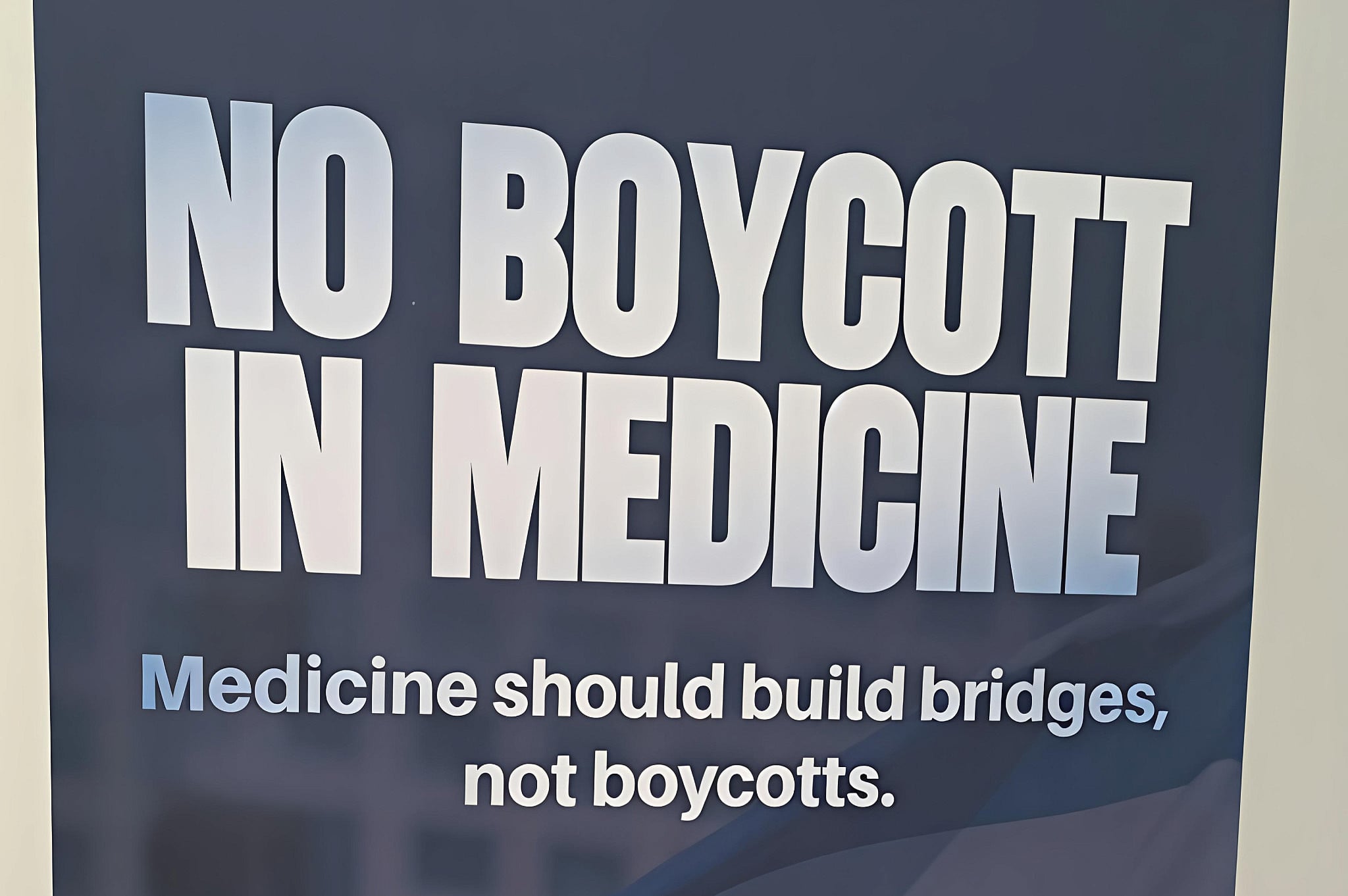
Photo Credits: Sabine Sterk
From October 7 until October 10, the World Medical Association will hold its General Assembly at the World Trade Center in Rotterdam. The dates themselves are painful. October 7 is not an ordinary date for Israelis or Jews. It is the anniversary of the Hamas massacre that shattered families, communities and an entire country. Yet while an Israeli medical delegation comes to Rotterdam, a campaign supported in the Netherlands by Artsen voor Gaza is demanding that the Israeli Medical Association be suspended from the World Medical Association. The KNMG has so far resisted that demand, and I sincerely hope it continues to do so. Whatever one’s opinion about the Israeli government, the war or individual military decisions, excluding Israeli doctors and their professional association from an international medical organization crosses a dangerous line. Medicine should be the place where political divisions become less important, not where they are imported and institutionalized. Doctors are supposed to meet across borders precisely because disease, cancer, viruses, trauma and human suffering do not ask for passports before they strike.
There is something particularly disturbing about targeting Israeli medicine when one considers the reality of Israeli healthcare itself. Jewish, Muslim, Christian and Druze doctors, nurses, researchers and other healthcare professionals work together throughout the Israeli medical system. Israeli hospitals have treated Palestinian patients, and during the Syrian civil war thousands of wounded Syrians received medical treatment in Israel. Israel has also repeatedly sent medical teams abroad following disasters and wars. In Ukraine, Israel established the Kohav Meir field hospital, equipped with an emergency department, inpatient wards, a maternity ward, laboratory facilities and medical imaging. Israeli government figures state that approximately 7,000 patients were ultimately treated there. This is what Israeli medicine looks like beyond slogans and demonstrations. It is doctors treating people whose nationality, religion or politics may be entirely different from their own because medicine begins with the patient.
And then there is science. This is where a boycott becomes not merely symbolic but potentially self defeating. Medical research today is international by definition. A Dutch cancer patient may benefit from research performed in Israel, a diagnostic technique developed elsewhere in Europe, a drug produced by an American company and a clinical trial involving hospitals across several countries. You cannot simply cut one country out of that network without consequences. Israeli researchers have made substantial contributions in immunology, cancer research, infectious diseases, medical technology and many other fields. The Weizmann Institute, for example, has a long history in T cell research. The late Professor Zelig Eshhar was a pioneer whose work contributed to the development of CAR T cell therapy, an approach that has transformed treatment possibilities for certain blood cancers. Weizmann researchers continue to work on next generation approaches intended to make such immunotherapies more effective and accessible.
The same argument applies to infectious diseases. Israel has decades of experience studying West Nile virus because the virus is endemic there. Israeli researchers established extensive mosquito surveillance, sequenced viral material and documented the circulation and genetic diversity of different West Nile virus lineages. Research from Israel has explicitly described the country as an important source of knowledge about West Nile circulation across Africa and Eurasia because of its geography, bird migration routes and long experience with human infection. More recent Israeli research continues to improve molecular diagnosis of the disease. In a world in which viruses cross borders considerably faster than politicians can respond to them, deliberately weakening scientific cooperation is difficult to reconcile with protecting public health.
This is also why the argument from Dutch researchers deserves to be heard. Dutch and Israeli scientists do not operate in separate universes. They participate in international studies, clinical trials and research networks together. One project may be led from the Netherlands and another from Israel. The medicine, diagnostic method, biological material or technology being studied may originate in either country. Researchers working on cancer mediated T cell dysfunction, for example, may depend on collaboration with Israeli scientists who possess highly specialized expertise. Break those connections and the consequences do not stop at a university boardroom. Eventually they can reach the laboratory, the clinical trial and ultimately the patient waiting for a better treatment. Academic cooperation is not a favor one country grants another. It is an international ecosystem in which discoveries move between laboratories until they become something that can save or improve a human life.
None of this means that Israeli institutions must be above criticism. They should not be. Nor should Palestinian institutions, Dutch institutions, governments, armies, international organizations or medical associations anywhere else in the world. Serious allegations deserve serious examination. The WMA itself has expressed grave concerns about healthcare conditions in Gaza, and the KNMG has supported those concerns. That position can coexist perfectly well with maintaining professional contact with Israeli physicians. In fact, the KNMG previously emphasized that doctors worldwide should remain in contact with one another in order to defend medical neutrality, access to healthcare and the protection of healthcare workers. That principle becomes meaningless if dialogue is maintained only with people with whom we already agree.
There is a profound difference between accountability and exclusion. Ask difficult questions. Demand explanations. Discuss Gaza. Discuss Israeli victims. Discuss Palestinian patients. Discuss the responsibilities of governments, hospitals and medical organizations. But do it around the same table. Once medicine adopts the logic that doctors and researchers should be isolated because of the country whose medical association they belong to, we enter dangerous territory. Today it is Israel. Tomorrow another war, another government or another political movement may determine which nation’s doctors are considered morally acceptable enough to participate. Scientific knowledge cannot function that way, and neither can medical ethics.
This is why the demonstration in Rotterdam matters. A small group of doctors, together with a representative of Time To Stand Up For Israel, will be present at the entrance of the WTC in support of the Israeli delegation. Especially on October 7, I believe that presence matters. Imagine arriving in another country on the anniversary of the worst massacre in your country’s recent history and being confronted with demands that your professional medical association should be expelled from the international medical community. Israeli doctors have spent years treating the wounded, caring for civilians during war, conducting research and continuing to work in hospitals serving an extraordinarily diverse population. Whatever political arguments surround Israel, those physicians should know that there are also people in the Netherlands who believe that medicine must remain a bridge.
Why are we standing there? Because we oppose a medical boycott of the Israeli Medical Association. Because medicine should remain a place for dialogue, cooperation and the exchange of knowledge. Because the patient must remain at the center regardless of nationality, religion or ethnicity. Because Israeli medical teams have treated people far beyond Israel’s borders. Because Israeli research contributes knowledge that is used far beyond Israel. And because scientific cooperation does not prevent criticism. It makes it possible for professionals to confront difficult questions while continuing to work together for something greater than politics.
Perhaps the most important message we can send in Rotterdam is therefore remarkably simple. We do not have to agree about everything. We do not even have to agree about Israel. But doctors must continue talking to doctors, researchers must continue working with researchers, and medical knowledge must continue crossing borders. A virus does not boycott Israelis. Cancer does not distinguish between Dutch, Jewish, Arab or Palestinian patients. Trauma does not ask which flag somebody carries.
Medicine should not do so either.
Related Topics
Related Posts