When Mourning Tries to Seize the Blessing
Israel is not arguing about a medical procedure. It is arguing about who may touch the forbidden place where death, name, lineage, and future meet. Posthumous sperm retrieval and posthumous reproduction have moved from the edge of Israeli life into its legal and moral center. Since October 7, requests for retrieval rose sharply, and in April 2026 a Beersheba family court allowed the family of Yotam Haim to use his sperm with a surrogate after finding clear evidence that he had wanted children. This is no longer a hypothetical dispute. It is a live pressure point in Israeli law, grief, and public imagination.
But if we are going to speak about this as Jews, we should not begin in the clinic. We should begin with a Name.
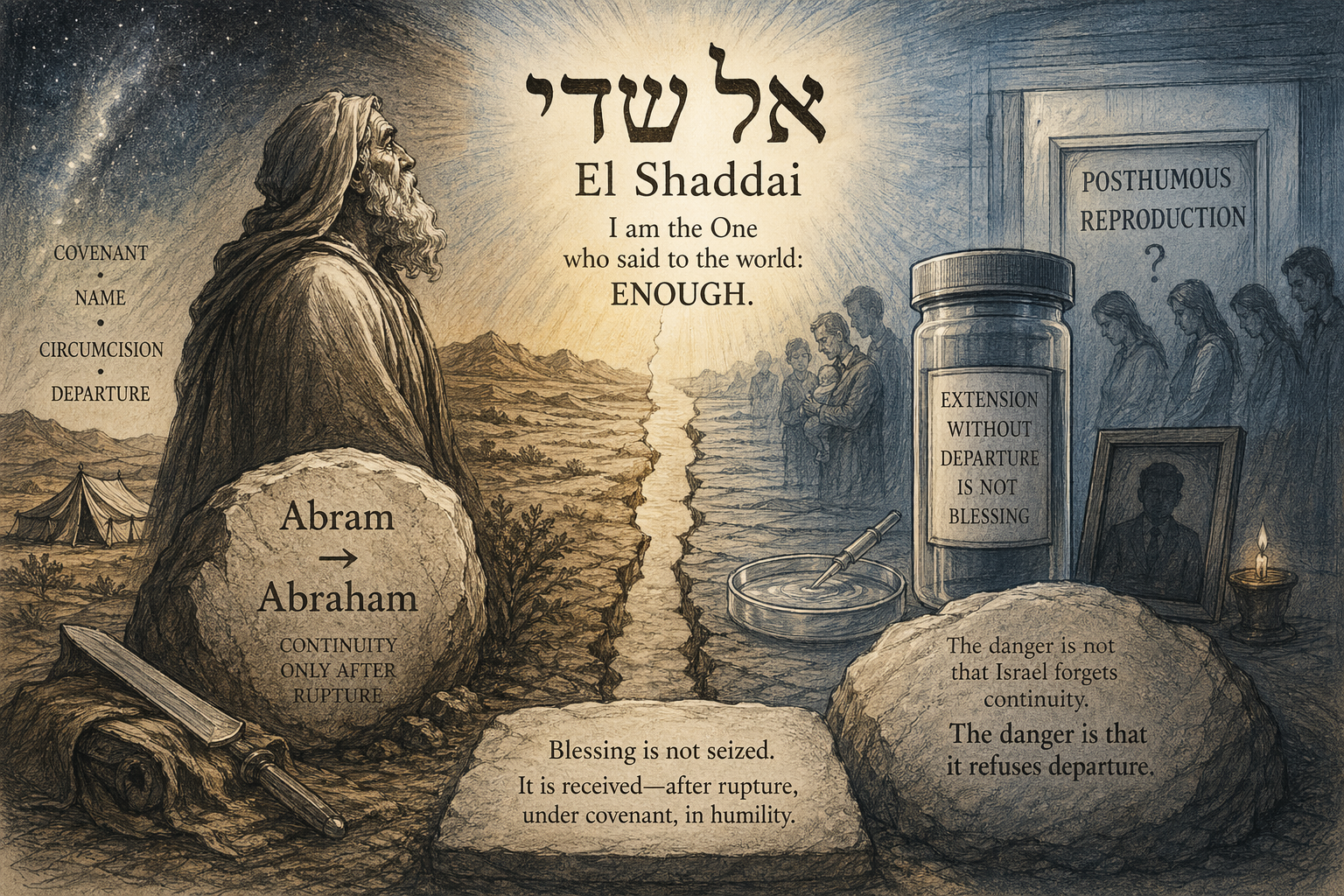
El Shaddai appears in Torah not as the deity of biological continuity, but as the Name under which continuity is interrupted before it is blessed. In Genesis 17, Abram is old, and the promise of offspring has already become almost absurd in biological terms. God appears as El Shaddai, and what follows is not the natural extension of Abram’s line. It is departure from the old identity: covenant, the changing of a name, and circumcision. Abram does not simply continue. He becomes Abraham. Fertility is bound to cut, obligation, and form. It is not mere continuation of flesh. It is continuity only after rupture.
El Shaddai does not sanctify the biological cycle; He interrupts it, restrains it, and only then allows lineage to become covenant.
That is why the rabbinic gloss on Shaddai matters so much here. The Talmud gives us the unforgettable line: Ani Hu She’amarti La’olam Dai — “I am the One who said to the world: Enough.” This is not a minor flourish. It is a theology of limit. El Shaddai is not the patron of infinite extension. He is the Name under which power also restrains itself. He blesses, but He also sets measure. He opens life, but He does not surrender life to every possible exercise of human will.
And that is exactly what makes the present debate so grave. Modern reproductive culture speaks almost entirely in the language of possibility. If something can be done, the burden shifts immediately to explaining why it should not be done. But Jewish tradition does not begin there. It remembers that not every possibility is a commandment, not every capacity is a blessing, and not every extension of biological material is fidelity to the dead. Sometimes the holiest word is not yes, but enough.
The defenders of posthumous reproduction usually speak in a language that is emotionally powerful and morally thin. They speak of continuity. They speak of honoring the wishes of the dead. They speak of bringing life out of catastrophe. After war, terror, and mass bereavement, this language has obvious force. But grief is not automatically wisdom. A bereaved family may long for a grandchild. A wounded society may long for symbolic victory over death. A state at war may even begin to imagine reproduction as national defiance. None of that answers the deeper question: whether a child may be summoned to bear the burden of someone else’s interrupted future.
To say this is not to judge bereaved parents or widows. It is to refuse the cruel illusion that grief, because it is sacred, automatically knows how to legislate life. Mourning deserves tenderness, but tenderness is not the same as surrendering every boundary to mourning. A society may honor the dead, protect the bereaved, and still say: this threshold must not be crossed without fear and trembling.
This is where the halachic background becomes indispensable. Israeli legal scholar Avishalom Westreich has shown that posthumous reproduction in Israel cannot be treated as a detached bioethical novelty. It touches the old Jewish grammar of yibbum, fatherhood after death, and the anxiety that a name should not disappear from Israel. In other words, this is not just a question of sperm, consent forms, and reproductive rights. It is a question about whether the living may reopen the genealogy of the dead and call that reopening compassion.
Once that happens, the child is in danger of ceasing to be first a child. The child becomes continuity. The child becomes memorial. The child becomes answer, repair, symbolic victory, refusal of disappearance. The child becomes, in effect, an instrument in the management of mourning. That is too much to place on any human being before birth. A society that cannot distinguish between welcoming a child and conscripting a child into the labor of grief has already lost something essential.
And there is a still deeper danger. A child born into this structure may be loved, protected, and cherished — and still be burdened by an invisible assignment. He or she may enter the world already surrounded by a sentence no child should have to carry: you are the answer to death. That sentence may never be spoken aloud. It may appear only in photographs, anniversaries, silences, family expectations, and national sentiment. But it will be there. And no society has the right to place that metaphysical weight on a child and call it healing.
Even the consent argument is far less secure than public sentiment often assumes. Israeli research on attitudes toward posthumous reproduction has already shown that consent cannot simply be presumed, especially when the initiative comes not from a spouse but from parents or family members. A general desire to have children during life is not the same as consent to become a posthumous father. The sentimental fantasy that “of course he would have wanted his line to continue” is not a serious moral standard. The dead do not become communal property because the living are shattered.
This is why El Shaddai matters now. He interrupts the modern fantasy that every technical victory over loss is morally ennobling. He reminds us that blessing without boundary is not blessing at all. In Jewish terms, life is not holy merely because it extends itself. Life is holy because it comes under covenant, measure, naming, and judgment. The same tradition that commands fruitfulness also knows how to say: do not seize what has not been given to you.
Here the problem of avodah zarah returns in an unexpected form. The logic of idolatry is not exhausted by bowing before foreign gods. It also appears wherever one order is substituted for another: image for presence, power for command, possession for blessing, memorial continuity for life itself. Continuity, too, can become an idol. A nation can worship survival so intensely that it forgets what kind of life survival was meant to protect.
This is the point at which the Israeli debate becomes more than a legal dispute and more than a family tragedy. It becomes a test of whether Jewish life can still distinguish blessing from seizure. The question is not whether technology can prolong a biological trace. The question is whether a society wounded by death can resist turning life itself into an instrument of consolation.
The danger is not that Israel forgets continuity. The danger is that it refuses departure. El Shaddai does not promise life by abolishing rupture. He gives blessing only after rupture has been marked, named, and brought under covenant. Where mourning refuses departure, it may begin to seize what only blessing can give.
Israel therefore faces a question much larger than fertility law. Can a society of deep mourning remain faithful to life without trying to administer the blessing? Can it remember its dead without recruiting the unborn into the work of consolation? Can it honor continuity without turning continuity into an idol?
The most important Jewish sentence in this debate may already have been spoken centuries ago: Ani Hu She’amarti La’olam Dai — I am the One who said to the world: Enough. There are moments when that word is not a denial of life, but the last defense of its sanctity.
Yochanan Schimmelpfennig