When My Students Asked Me to Step Aside
This summer I became a student again.
The Leffell Space Program at the Leffell School, a Jewish day school in Westchester just north of New York City, went through a transition at the end of school last year. Raz Idan, who founded the program and guided our students through their first high-altitude balloon (HAB) mission, moved on to a new chapter, and the leadership of the program passed to me. I wrote here this past spring about that first HAB launch, when our balloon climbed to 91,000 feet.
I am grateful for everything Raz built. I also knew that in September I would be standing in front of a class of tenth, eleventh, and twelfth graders, some of them veterans of our first launch and some who had never touched a radio, teaching a discipline where I was far from an expert. A geneticist by training, I have taught science, engineering and hands-on making for over two decades, but I had never flown anything to the edge of space.
I was not doing it alone. My colleague Javier Rosenzwaig, our Technical Director, holds a master’s degree in electronic engineering, and he co-teaches the program with me.
Still, I spent the summer getting ready.
I learned as much as I could about space science, balloon flight, and radio. Then I built a full-year curriculum. In the fall, students would learn the fundamentals of space flight while preparing our second balloon mission, HAB-2. In the spring, they would build our satellite ground station, funded by a grant from Amateur Radio Digital Communications (ARDC), and fly HAB-3. I organized the class into teams, from Mission Operations to Flight Systems to Recovery, wrote lessons, prepared slides, homework, quizzes, and gathered readings and online resources.
I also went back to studying for an exam.
Radio is how we talk to the balloon in flight, and once the ground station is running, it is how we will communicate with satellites. I could not ask students to master something I had not mastered myself. There is a particular humility in sitting at the kitchen table memorizing FCC regulations and learning the names and applications of radio equipment. In August, I passed the FCC Technician exam and received my amateur radio license and my sequentially assigned callsign: KE2JDE.
Then there was the calendar.
HAB-2 needed to fly by mid-October. After that, upper-level winds strengthen through the winter, and a balloon that drifts a manageable distance in the spring or fall can end up far out over the ocean in January. That left us roughly six weeks from the first day of school to launch.
A week before school started, I sat down with Ari Messinger and Oren Podietz, the two twelfth graders who had led much of the work on HAB-1 and knew that mission better than anyone. I walked them through my plan and the curriculum. They listened carefully and told me they liked it.
Then they looked at each other.
One of them said, “Dr. Aviv, if we really want HAB-2 ready in a six-week sprint, instead of starting with your curriculum, can we take over and get the teams ready? After the launch, we can pick your plan back up.”
I had spent months building that curriculum. They were now asking me to put it aside. My immediate reaction? Pure joy.
They were right, and I knew it before they finished the sentence. I said yes.
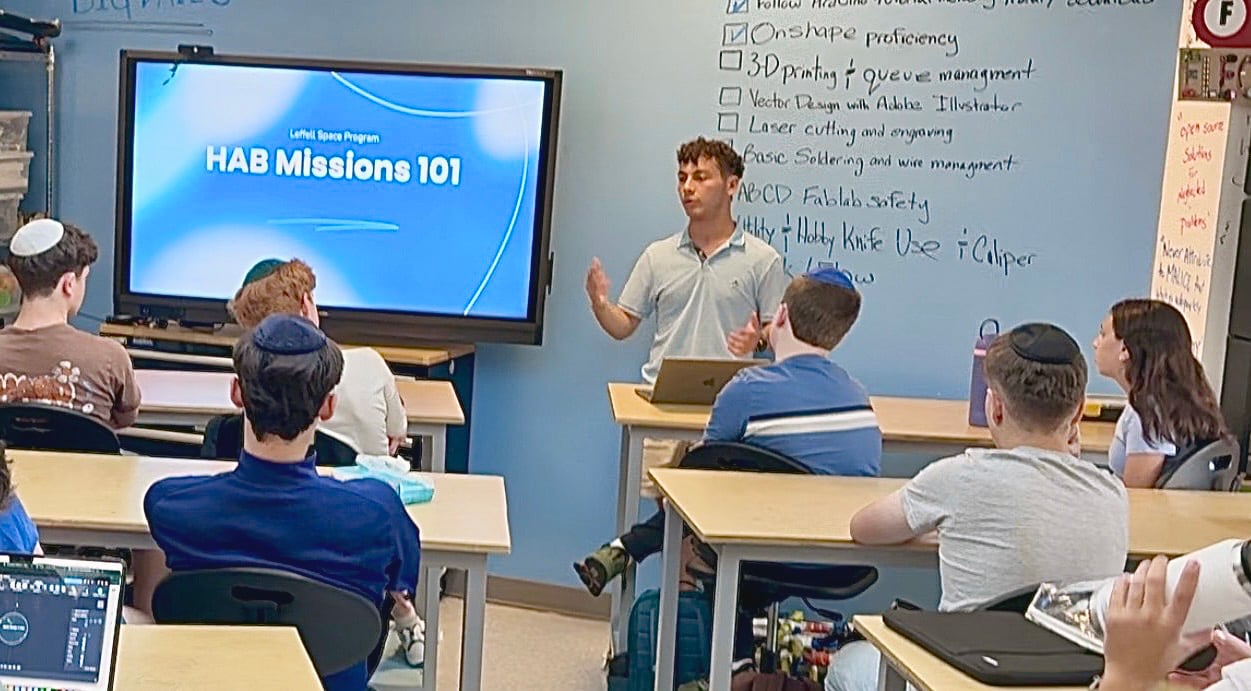
They taught the first class. They called it “HAB Missions 101” and walked their classmates through the essential systems of a flight: electrical power, computing and data handling, telemetry, tracking and command, thermal protection, structure, and mission payload.
They distinguished between the payload (the box the balloon carries) and the mission payload (the sensors, cameras, and artwork inside it). The mission payload, they explained, is the mission’s “why.”
They covered requirements lists, block diagrams, flight predictions using tools such as SondeHub and Google Earth, and the mass budget, which keeps each payload under five pounds so the flight stays exempt from most FAA balloon rules.
Then they divided the class into Mission Operations teams. Each team owned a piece of the operational side of the flight: predictions, mass and power budgets, FAA regulations, launch procedures, tracking and recovery, and overall flight readiness. And they put everyone to work.
It was dense. The jargon came fast. The newer students were scribbling notes while the veterans nodded along.
I sat in the back with Javier and also took notes.
What struck me was not the vocabulary, though there was plenty of it. It was that none of it sounded contrived. These students were not reciting what someone had taught them. They understood the systems because they had built them, broken them, fixed them in a field in Hudson, NY, and chased them across three states for a recovery.
A year ago, at the beginning of their HAB-1 build, the payload was a handful of loosely wired sensors. Now those same students were teaching their classmates with the precision and calm of people who had earned the right to.
I had anticipated being the person at the front of the room. Now I was learning what it meant to move to the back.
That does not mean I am sitting idle. For the next six weeks, my job is logistics, safety sign-offs, launch permissions, and, on launch day, working the radio alongside the students.
The curriculum is not wasted, either. It is waiting. After the launch, I hope my students will let me take a turn at teaching.
HAB-2 is our sprint. The marathon starts when the balloon comes back down. Next, students will begin building our ground station and tracking satellite passes. In the spring, they will fly HAB-3. Within three years, we hope to launch our own CubeSat, a satellite about the size of a loaf of bread, into orbit.
The Talmud records a teaching of the 3rd-century sage Rabbi Hanina bar Hama: “Much have I learned from my teachers, more from my colleagues, and most of all from my students” (Taanit 7a). I had known those words for years. This summer, two of my students taught me what that last part means.
I spent the summer preparing to teach. It turns out the first lesson of the year was mine to learn.
In a few weeks, if the winds cooperate, HAB-2 will lift off aiming for 100,000 feet. I will be on the radio as KE2JDE, listening for a signal from the mission payload my students built: the mission’s why, and mine.