When ‘No Threat’ Is the Most Dangerous Message of All
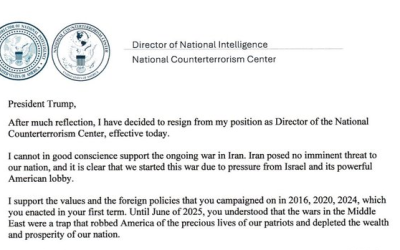
Joe Kent, Head of the National Counterterrorism Center, resigned from his position on March 17, stating in a letter to President Trump that “Iran poses no imminent threat” to the United States.
For many Americans, that may sound like a policy disagreement. For me, it is something far more dangerous. I, an American citizen and resident, am alive today only by chance after surviving a terrorist bombing in Jerusalem in 2003 that was funded and supported by the Iranian regime.
When someone in one of the highest counterterrorism positions in this country says Iran is not a threat, I do not hear analysis. I hear a complete disconnect from the reality of what is going on in today’s world, the reality that victims like me have lived with for decades.
Iran has spent years building, funding, and directing terror networks across the globe. Hamas, Hezbollah, and proxy militias are targeting civilians and even American service members. This is documented policy and history.
And yet, we are now being told that this is not a “real threat.”
Joe Kent’s message denying the very real and imminent threat of jihadist hate and terror within the United States, funded by Iran, has quickly spread far beyond Washington, shaping how people think about America’s conflict with Iran, their perception of the short- and long-term danger, and their willingness to confront the problem.
So many Americans are questioning whether confronting Iran is necessary. They seem more worried about the prospect of being at war at all than confronting the reality that Iran has been waging a “death to America” war through terrorism for decades. Have we already forgotten what happened almost 25 years ago on 9/11?
That is what makes statements like Mr. Kent’s so dangerous. They ignore how modern terrorism actually works.
Iran does not need the traditional warfare of sending tanks across borders to pose a threat. It funds, trains, and empowers others, terror proxies, as a tactic of modern warfare. Iran’s networks stretch far beyond the Middle East. These networks have already taken root in Europe and are becoming an increasingly treacherous influence here in the United States.
Europe has already recognized this threat. The European Union has invested heavily in programs like the Radicalization Awareness Network (RAN), dedicating significant resources to countering extremism and preventing radicalization before it turns into violence. They are doing this because they have seen the consequences firsthand, in attacks, in recruitment, and in the spread of ideology that targets innocent civilians.
And yet, while Europe is spending millions trying to undo the damage, we are sending the opposite message here in the United States. When leaders suggest that Iran is not a threat, or when we downplay the role of those who indoctrinate, we are giving violent, deadly radicalization the means and space to grow locally.
The threat of groups like the Muslim Brotherhood has long operated through ideology and infrastructure, not just violence. Organizations like CAIR have become part of the public conversation in America, shaping narratives and influencing how issues are discussed. Whether intentionally or not, this creates an environment where the line between advocacy and the normalization of dangerous ideas blurs.
The United States is not immune to any of this, and that is why this moment matters.
When a top counterterrorism official says Iran is not a threat, it does more than reflect one opinion. It sends a signal that what victims have lived through, and what we continue to live with every day, is somehow exaggerated, distant, or no longer relevant.
It tells the public that the system behind the evil forces terrorizing American citizens at home and around the globe is not important enough to be actionable. I think Mr. Kent needs to look the hundreds, if not thousands, of American victims of terror attacks funded, encouraged, and directed by Iran in the eye and tell us that the problem is not imminent. That the US government does not have to take it or us seriously.
We have lived the consequences of the policy of doing nothing. We have lived every day with the memory of witnessing innocent civilians murdered by Iranian terrorists and their proxies. We have spent days, nights, years – decades – living with the aftermath.
We are alive to testify that the threat is very, very real. And the most dangerous thing we can do right now is pretend it does not exist.