Clarity for Leaders in Law, Policy, Finance, and Covenant
When One Bleeds, the Other Trembles: Jewish Conscience and the Cry of Nigerian Christians
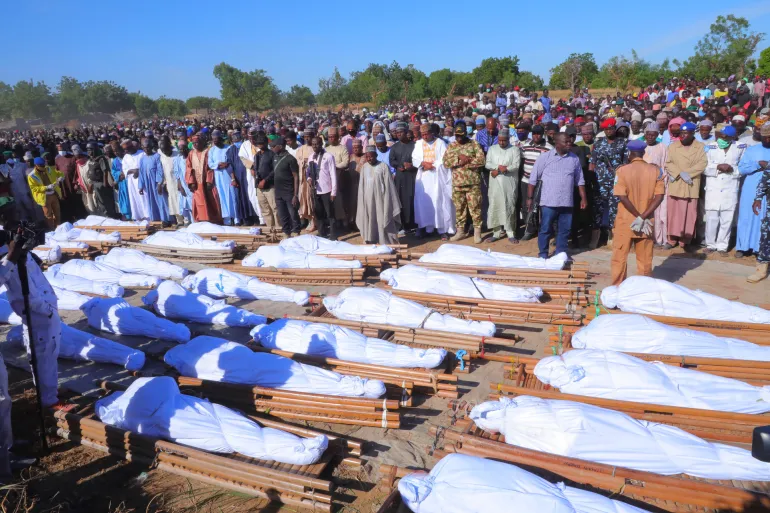
People attend a funeral for those killed by suspected Boko Haram fighters in Zaabarmar, Nigeria, on November 29, 2020 [Jossy Ola/AP Photo]
When gunmen attacked the mission in Yelwata, Benue State on June 13–14, 2025, they slaughtered between 100 and 200 Christian villagers and displaced some 3,000. Entire families were incinerated, children and mothers among the charred ruins, while the world barely whispered. The massacre was carried out under cover of darkness; its horror was reported, but almost nowhere did it spark protest marches or moral uproar in Western capitals.
That silence echoes across centuries. The same world that turned blind eyes to pogroms, to Kristallnacht, and to the death camps now turns away while Jews are again being beaten and harassed in the streets of Paris, London, New York, and Los Angeles. Synagogues are attacked, Jewish students are hunted on campuses, and Israeli flags are ripped down while the cameras look elsewhere. The perpetrators often shout the same Islamist slogans used by the militants who burn churches in Nigeria. It is the same ideology of hate, the same appetite for annihilation, clothed in a different geography. When Christians are slaughtered in Benue and when Jews are assaulted in Brooklyn or Marseille, the spirit behind the violence is the same—an ideology that sanctifies murder in the name of God. The world that once rationalized Jewish death now rationalizes Christian death and still calls itself enlightened.
In Nigeria today, the toll is staggering. In the first 220 days of 2025, more than 7,000 Christians were reportedly killed, an average of thirty-two per day, and over 100 churches attacked per month. Between 2009 and 2023, some 52,000 Christians have been murdered across Nigeria, according to Intersociety’s cumulative report. The targets are disciples in remote villages, worshippers inside churches, pastors abducted for ransom, entire congregations extinguished. Many of the attacks overlap with disputes over land or grazing, yet the pattern is unmistakable: faith is a direct vector of persecution.
While this slaughter unfolds, Afro-Gazan Christians in Gaza’s Al-Jalaa district report persistent racism and marginalization from local Arab communities. Black Palestinians have long spoken of being treated as outsiders in Gaza’s hierarchy, a reality that rarely penetrates Western discourse. Yet many in the Western Black diaspora loudly align with “Palestine,” ignore the suffering of both Nigerian and Afro-Gazan Christians, and echo anti-Jewish rhetoric often fueled by jealousy and anti-whiteness toward Ashkenazi Jews—while dismissing the Semitic lineage and the ethnic diversity of the global Jewish people. They ignore the Mizrahi, Sephardi, Yemenite, Persian, and African Jews—people of colour whose very existence dismantles the colonial narrative they claim to champion. To these activists, it seems acceptable for such Jews to be accosted, erased, or even killed, so long as their deaths do not disrupt the grievance economy that fuels their cause. The same Western voices that decry “colonialism” turn their eyes away from African Christians burned alive for their faith.
No worldwide protests rise for them. No campus campaigns demand sanctions for their killers. The moral selectivity is staggering. Some who proclaim solidarity with the oppressed have grown comfortable excusing or denying Islamist violence because acknowledging it would fracture their narrative of perpetual grievance. At its core, much of this activism has revealed itself less about genuine compassion for Gazans and more about hostility toward Jews—an ancient hatred repackaged in modern slogans.
In that silence lies a test: will Jewish conscience also remain silent? Many Jews may feel hesitation. They may ask: What is Nigeria’s treatment of Jews? Are reports exaggerated? What is the status of Igbo Jews? Are we, in intervening, playing a politics we do not fully understand? These are valid questions, born of caution and humility. But they must not become shackles. To withhold our voice because of uncertainty is to betray the foundational demands of Torah and prophetic justice.
The history of Jews in Nigeria is complex. The Igbo Jews maintain synagogues, practice Jewish ritual, and seek recognition. Their acceptance by mainstream Judaism is mixed and contested. Some Nigerian Christians hold theological suspicion of Jews, and some local power structures harbor latent antisemitism or indifference. Yet these complexities do not absolve the Jewish people of moral duty. They demand deeper, wiser engagement.
The pivot from hesitation to advocacy must rest not on activism of convenience but on covenantal command. The Torah instructs “Lo ta’amod al dam re’ekha” — “Do not stand idly by the blood of your neighbor” (Vayikra 19:16). Silence when blood is spilled is forbidden. Prophetic ethics demand “Petach picha le’ilém … shefot tzedek, vedin oni ve’evyon” — “Open your mouth for the mute … judge righteously, defend the poor and needy” (Mishlei 31:8–9). We are commanded to act with justice in Yeshayahu 1:17 — “Limm’du heitev, dirshu mishpat, ashru chamotz, shiftu yatom, rivu almanah.” “Learn to do good; seek justice; relieve the oppressed; judge the orphan; plead for the widow.” The prophets teach that righteousness without intervention is hollow. And the sages, in Sanhedrin 73a, ask: by what verse do we obligate saving lives and rescuing victims? Answer: “Do not stand idly by the blood of your neighbor.”
When we see Christian families slaughtered in Nigeria or Black Christians silenced in Gaza, we must not view them as others. Their suffering is tied to ours. Their persecution is an affront to the same God who delivered Israel from exile. Their tears cry from the same soil that once swallowed our martyrs. Jewish memory forbids selective compassion.
To act is to engage with strategy, not naïveté. Jewish communities and institutions can collaborate with Christian relief networks, fund documentation projects, support legal advocacy, and pressure governments to redesignate Nigeria as a “Country of Particular Concern” for religious-freedom violations. We can open journalistic networks to amplify Christian voices, insist that media name faith-based persecution, and support missions to Nigeria that can verify, testify, and protect.
The Israeli Jewish world carries moral capital. Our voices matter in Western capitals, in global forums, and in UN corridors. When we stand, the world listens. We must amplify Nigeria’s Christian martyrs and their Afro-Gazan counterparts as our own—by right of covenant, not political alignment.
When Jews and Christians stand in solidarity, bound by shared suffering and devotion to the God of Israel, we reclaim a witness in a world eager to classify and marginalize. Our collaboration need not erase difference; it transforms difference into alliance.
The Christian Church in Nigeria is bleeding. The Jewish people cannot remain indifferent. When the world looks away, our memory must compel us to speak. When the powerful remain silent, our tradition must amplify the weak. Whether the victim is beneath a kippah or behind a cross, the command remains: do not stand idly by. The covenant demands nothing less.
We Jews do not envy or erase. We do not wish for another’s destruction. We stand for life, even when the world looks away.
Let us not wait for another massacre to awaken our conscience. God deliver us from a faith that hears suffering and shrugs. May Jewish history not repeat itself in our silence. May we be the voice for those whose only weapon was prayer and whose only crime was faith.
Related Topics
Related Posts