
When Providence Becomes a Party Instrument
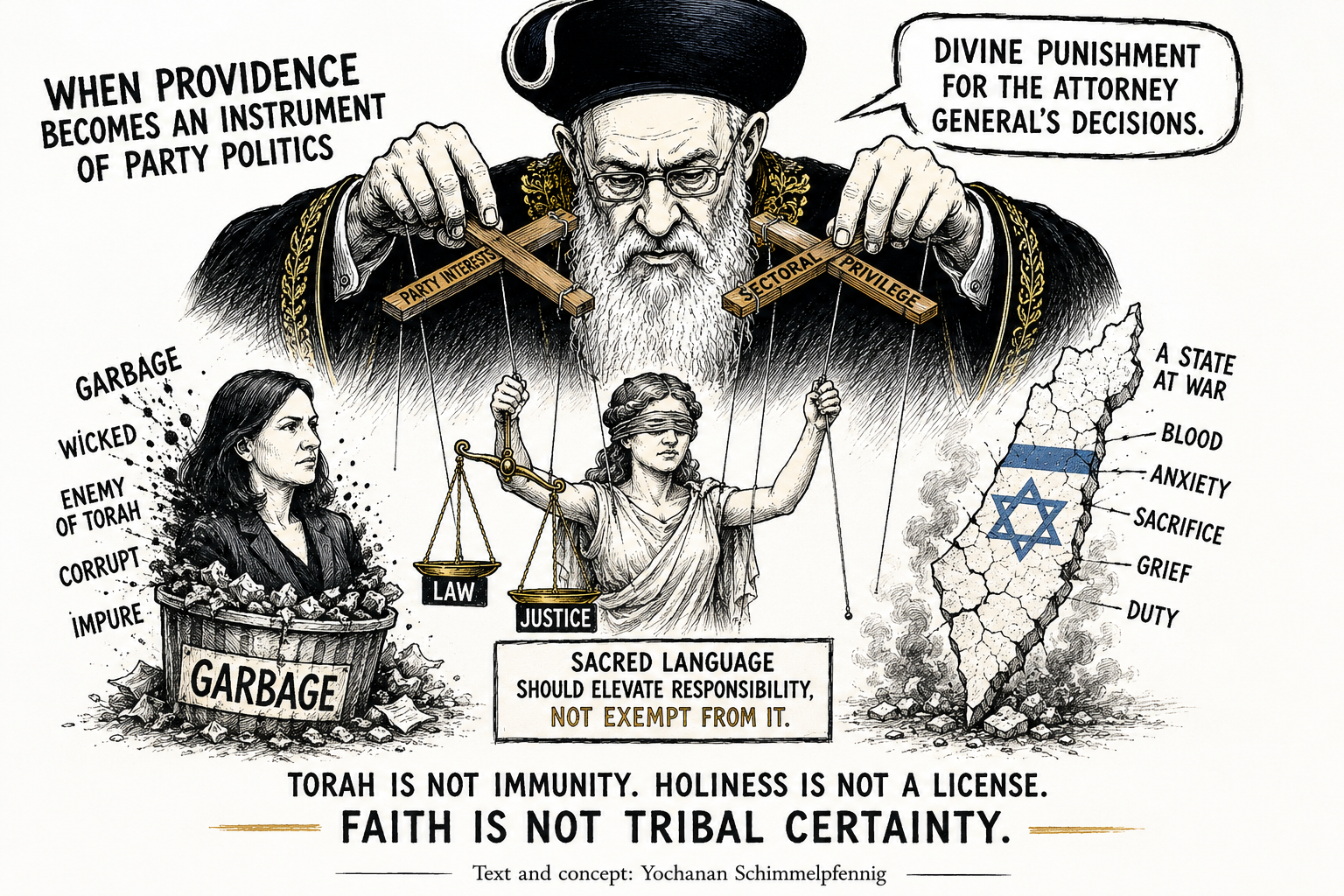
Text and concept: Yochanan Schimmelpfennig
When Providence Becomes a Party Instrument
There is a dangerous moment in Jewish political life when theology ceases to be an opening toward judgment, humility, and self-examination, and becomes instead a blunt instrument of factional revenge.
The recent claim that Donald Trump’s supposed turning away from Israel is a divine punishment for the attorney general’s decisions regarding enforcement against ultra-Orthodox draft evaders belongs precisely to this dangerous category. It is not merely an unfortunate remark. It is a symptom.
The problem is not that a rabbi speaks politically. Judaism has never been a religion of private spirituality sealed off from public life. The prophets were not wellness coaches. They spoke to kings, courts, merchants, priests, armies, and corrupt elites. But the prophetic voice does not say: God agrees with my party, therefore the legal official opposing my camp is wicked. The prophetic voice begins elsewhere: with trembling, with responsibility, and with the unbearable question of whether Israel itself has become deaf to justice.
That is why language matters. To call the attorney general “garbage” is not a minor rhetorical excess. It reveals the deeper logic of the argument. The legal order is no longer treated as a contested but necessary structure of national responsibility. It is degraded into impurity. The opponent is not merely mistaken; she is refuse. And once civic disagreement is translated into impurity, politics becomes a purification ritual. That road is always catastrophic.
There is also a deeper theological error here. To invoke divine punishment in order to defend one social group from civic obligation is to reduce Torah to immunity. But Torah is not a magical shield placed above one sector while others bury their children, guard borders, carry trauma, and sustain the civic body under impossible pressure. If Torah protects Israel, it cannot do so by authorizing indifference to the asymmetry of sacrifice.
The question of Haredi military service is complex. No serious person should pretend otherwise. Torah study has real civilizational weight in Jewish history. The preservation of learning after destruction, exile, and catastrophe is not a decorative matter. It is one of the reasons the Jewish people survived. But precisely because Torah study is sacred, it cannot be turned into an administrative exemption from the moral burden borne by the rest of the people.
A state at war cannot survive if one part of society speaks the language of destiny while another part pays the invoice of destiny in blood, anxiety, disability, and grief.
The most troubling element is the personalization of metaphysics. A geopolitical development is immediately interpreted as heaven’s reaction to the attorney general. This is not theology. It is spiritualized partisanship. It presumes access to the divine calculus with a confidence that should terrify anyone formed by Jewish sources. Jewish tradition is full of warnings against false certainty. Job’s friends also had explanations. They were very eloquent. They were also wrong.
This is not merely bad politics. It is the beginning of a religious logic in which law becomes impurity, disagreement becomes betrayal, and God is turned into the private property of a faction. Every tradition that walks this path eventually degrades itself.
One may criticize the attorney general. One may criticize judicial activism. One may criticize the state’s handling of the draft. But when criticism becomes a declaration that heaven itself has punished Israel because a legal official acted against one’s camp, the speaker has crossed from politics into a kind of theological narcissism.
The irony is severe. Those who claim to defend Torah may end up weakening its public dignity by making it appear as an instrument of sectoral pressure. The result is not kiddush Hashem. It is the opposite: the public image of Torah as a language used to evade reciprocity, to sanctify insult, and to convert civic duty into persecution.
Israel does not need less Torah. It needs Torah spoken with more fear of heaven and less appetite for factional victory.
At this moment, the true religious question is not whether the attorney general is wicked. It is whether Israel can still distinguish between holiness and privilege, between prophecy and propaganda, between the study of Torah and the political exploitation of Torah’s prestige.
A Judaism that cannot bear the burden of shared responsibility will not save the state. And a state that allows sacred language to become a weapon against its own legal and civic structure will not remain spiritually healthy.
The danger is not that politics has entered religion. In Jewish life, it was always there.
The danger is that religion is being emptied of judgment and filled with tribal certainty.
That is not faith.
It is party politics wearing a tallit.
Yochanan Schimmelpfennig