
When Reason Became a Host for Antisemitism – Voltaire’s Legacy
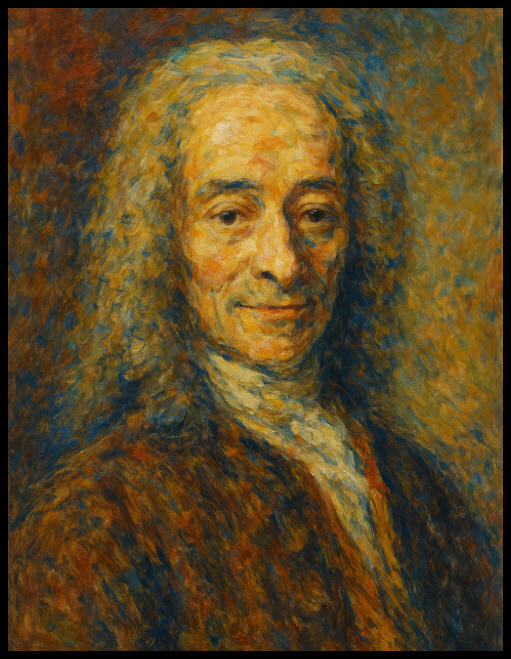
The Enlightenment promised liberation, but its greatest voice helped give Jew-hatred a new and enduring home.
“They are, all of them, born with raging fanaticism in their hearts, just as the Bretons and the Germans are born with blond hair.”
— Voltaire, Philosophical Dictionary (1764)“The Jew is as useful as another citizen.”
— Voltaire, correspondence (c. 1770s)
Voltaire, the Enlightenment’s greatest apostle of reason, also carried one of Europe’s oldest diseases: antisemitism. His writings dripped with contempt for Jews as “barbarous” and “fanatical,” even as he argued they should be granted equal citizenship. The contradiction is striking. He prescribed civic inclusion while spreading a cultural contagion that poisoned it from within.
For centuries Jew-hatred had been a religious malady, rooted in theology and church dogma. Voltaire stripped away the theology and dressed the prejudice in the clothes of “reason.” That shift made the disease appear modern, rational, even scientific. Because his authority was unmatched, antisemitism slipped into the bloodstream of universities and intellectual circles with the prestige of the Enlightenment itself.
From there, the infection mutated. Fichte reworked it into German nationalism. Renan recast it as racial science. Treitschke thundered from Berlin’s lecture halls that “the Jews are our misfortune,” making antisemitism an academic debate rather than a shameful prejudice. Race theorists like Dühring, Gobineau, and Chamberlain built entire pseudo-scientific systems around it. Heidegger and Schmitt embedded it in philosophy and law. Each stage gave the old hatred a new host, ensuring it would endure long after religion lost its grip.
The result was a more virulent strain: theology had once condemned Jews spiritually, but reason and scholarship condemned them racially, culturally, and politically. Even as Europe secularized, antisemitism flourished—mutating with every inoculation of progress, always adapting, always surviving.
That shadow lingers. In elite universities today, antisemitism rarely comes as crude slurs. It emerges in subtler forms: tolerated hostility, political rhetoric, or academic frameworks that disguise animosity as critique. The debates since 2023 show that the virus still circulates in the very institutions meant to cultivate knowledge and tolerance.
Antisemitism is not easily cured by reason. Voltaire himself proves it. Even as he defended Jewish citizenship, he made their acceptance socially toxic by branding them with contempt. The Enlightenment did not eradicate the disease. It made it more respectable, more pervasive, and more enduring.
That is the paradox of Voltaire’s legacy: the light of reason promised liberation, but it also gave antisemitism its strongest host. The Enlightenment did not cure an ancient hatred. It helped it survive.