When Redemption Goes Wrong
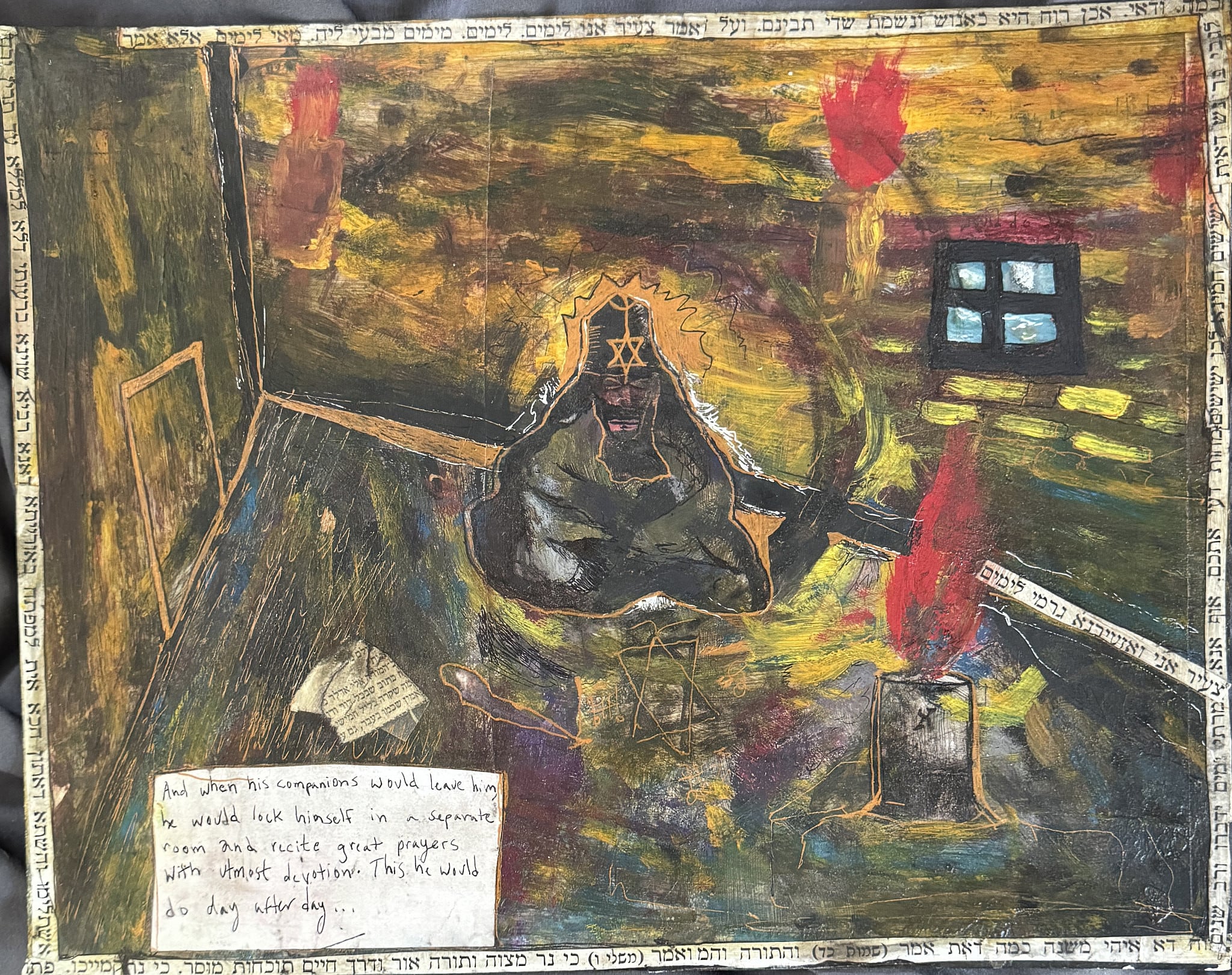
Yosef della Reina, Rav Kook, and the religious responsibility to remain open to correction
There is an old Jewish story about a man who decides that the world has suffered long enough.
His name is Yosef della Reina.
In the version of Ma’aseh Yosef della Reina I have been reading, he gathers five disciples and sets out to overcome the powers of evil and raise the Shekhinah from exile.
The angels acknowledge his intentions. They also warn him that the undertaking exceeds him.
He persists.
Eventually, they give him instructions. Within the world of the story, his knowledge and powers are real. He overcomes extraordinary obstacles and captures Samael and Lilith, the demonic powers he has sought to subdue.
Success makes him confident that the warnings were mistaken.
Then Samael asks for a little of the frankincense della Reina is carrying.
Despite instructions to give the captives nothing, he offers it. Samael burns it. The gesture becomes an idolatrous offering. The restraints break, and the undertaking collapses, bringing catastrophe upon his disciples.
A man seeking to overcome evil has strengthened it. (Link to the story) (Hebrew original Wikisource),
This is a legend. I read it as a story about the spiritual dangers that can accompany an entirely sincere desire to save the world.
The detail that troubles me is the combination of genuine accomplishment and disastrous judgment.
What happens when our successes persuade us that we have outgrown the need to listen?
When a mistake looks like a tikkun
Rabbi Moshe Chaim Luzzatto, the Ramchal, explores a related danger in Kin’at Hashem Tzeva’ot.
In his discussion of the biblical Joseph and Potiphar’s wife, Ramchal describes Joseph initially imagining that a union with her could bring illumination to the Shekhinah within the klippot, the forces that conceal and obstruct holiness.
Joseph has a spiritual explanation for what he is tempted to do.
He thinks it could accomplish a tikkun, a repair.
Then the image of his father appears and corrects him:
“כי אין זה תקון, אלא קלקול רב ועצום.”
“For this is no rectification, but a great and terrible corruption.”
—Ramchal, Kin’at Hashem Tzeva’ot, part II, “Yosef and Potiphar’s Wife.” Ramhal
The religious interpretation is itself part of the temptation.
That possibility should give anyone who uses sacred language some pause.
We usually recognize self-justification more easily when it sounds selfish. We become less suspicious when it speaks fluently about redemption, collective destiny, or repairing the world.
The spiritual vocabulary may be entirely sincere.
It still needs examination.
Ramchal is discussing a sexual transgression, and della Reina’s story concerns a magical attempt to bring redemption. Neither text supplies a ready-made judgment about contemporary Israeli politics. A story’s demons also provide no category for classifying an actual human population.
I am drawing a more limited connection: a person can understand an undertaking as holy and still misunderstand what holiness requires.
That question belongs inside religious commitment. Anyone who takes the sacred seriously has reason to be concerned about the authority we claim in its name.
Yosef is already holy
In my recent essay, “What Is Zionism For?,” I explored Rav Kook’s interpretation of Mashiach ben Yosef and Mashiach ben David: the relationship between Jewish national restoration and the spiritual purpose of that restoration. The Times of Israel Blogs
I want to sharpen an important part of that argument.
For Kook, Yosef already possesses holiness. The national body has intrinsic religious significance. David’s task involves a union in which material strength and spiritual life sustain and elevate one another. In HaMisped B’Yerushalayim, Kook explicitly describes the two forces becoming integrated within Davidic kingship. Wikisource
That matters.
Jewish national life need not wait for moral perfection before it can have sacred meaning. A people needs the material conditions through which its life can unfold.
I can affirm that and still ask how a particular political program expresses it.
The sacredness of Jewish belonging cannot decide every question about a settlement, a military action, a governing institution, or another people’s rights. Those decisions involve facts, consequences, competing obligations, and human judgment.
Something precious can be pursued badly.
Something necessary can be endangered by the very people who seek to secure it.
The religious question becomes more demanding once we take the holiness of the undertaking seriously. We become responsible for the possibility of betraying something we genuinely love.
Kook himself gives us language for that responsibility.
In Shemonah Kevatzim 1:75, he writes:
“אסור ליראת שמים שתדחק את המוסר הטבעי של האדם.”
“Fear of Heaven must not suppress a person’s natural morality.”
He goes on to explain that genuine religious awe elevates our moral capacities. A religious disposition that diminishes our inclination to do good is defective. Wikisource
This passage does not make my moral intuitions infallible. People can disagree profoundly about what goodness requires, including how to defend lives under threat.
But it makes moral criticism something a religious person must hear.
A troubling consequence cannot be dismissed simply because the project producing it has a sacred name.
The holiness of making room
In Orot HaTehiyah 18, Kook describes three necessary forces in Jewish life: holiness, nationhood, and humanity. He associates them with religious, nationalist, and liberal currents.
Each contributes something indispensable. Each also needs the others to restrain its tendency toward excess.
Kook asks us to recognize value even in another current’s criticism of the one we hold most dear. That criticism can help preserve our own commitment from distortion. Wikisource
Near the end of the passage, he introduces tzimtzum, self-limitation.
The practical expressions of religious life sometimes need to limit themselves to make room for the other forces. Kook distinguishes these expressions from the highest holiness, which encompasses the whole. He then says of this self-limitation:
“שהצמצום הזה עצמו אף הוא מכלל עבודתו.”
“This very self-limitation is itself part of its service.”
—Orot HaTehiyah 18. Wikisource
Making room can itself be sacred work.
That is a substantial challenge to any movement inclined to measure faithfulness entirely through the expansion of its own influence.
It challenges my liberalism too. I have to take religious particularity and Jewish national life seriously, including when they complicate my preferred account of universal human flourishing.
A religious nationalist faces a corresponding demand: universal human concern must have enough authority to affect the decisions being made.
Kook is discussing forces within Jewish life here. Applying this passage to territorial claims or our relationship with Palestinians requires further argument.
But the principle opens a question we need to ask:
What would lead us to recognize that a particular limit serves the very holiness we are trying to express?
A movement can affirm this principle in theory while ensuring that it never changes anything in practice.
There is always another reason to expand. Another emergency. Another opportunity that may never return.
The test comes with an actual decision.
After the Holocaust
At this point, someone could reasonably object that these reflections underestimate the urgency of Jewish survival.
After the Holocaust, how could Jews leave their future dependent on other people’s willingness to protect them? Was the creation of a state itself an act of responsibility that religious hesitation might have prevented?
I take that objection seriously.
Caution can become an excuse for failing to act. Waiting for perfect clarity can have terrible consequences. A people cannot make its survival contingent on achieving an uncontested account of redemption.
Rav Yehuda Amital offers a particularly searching way to hold these concerns together.
In his 1996 talk, “The Religious Significance of the State of Israel,” Amital recalls that Kook’s writings sustained him in a Nazi labor camp. He describes Israel’s role in providing refuge and renewing Jewish life as grounds for profound religious gratitude. Yeshivat Har Etzion
Yet he also writes:
“Rav Kook’s optimism is the optimism before Auschwitz and Hiroshima.”
Amital argues that subsequent history requires reassessing Kook’s expectations about humanity’s moral development. He insists that the actual state must be evaluated in light of its actual conduct. Yeshivat Har Etzion
He continues to use the language of redemption. He recognizes the gathering of Jews in their homeland as a beginning of redemption while emphasizing how much remains unfinished. Fighting poverty, caring for the vulnerable, and treating non-Jews respectfully belong to the work still before us. Yeshivat Har Etzion
That combination matters enormously to me.
The Holocaust can deepen our commitment to Jewish self-determination and our humility about claiming to understand the course of history.
A state can be necessary, precious, and worth defending while remaining subject to judgment.
Its necessity leaves many political decisions open. It does not determine every future border, authorize every expansion, or establish the wisdom of every leader who invokes Jewish survival.
Those decisions need their own justifications.
To bring Yosef della Reina into this conversation is therefore to ask what keeps necessary action from becoming overconfident action.
How do we protect our ability to recognize a mistake while retaining the courage to act?
Who gets to correct us?
A sacred project needs more than sincere intentions and people who believe in it.
It needs people who can challenge its decisions and be heard.
It needs ways of attending to consequences that its own language may obscure.
For me, this has implications beyond private spiritual reflection. It means taking independent judgment, public scrutiny, honest reporting, and the testimony of affected people seriously. It means allowing a grievance to be examined even when the person bringing it rejects our understanding of history.
A Palestinian family’s account of what a particular policy does to its life deserves a hearing. So does an Israeli family’s account of the dangers it faces. We have to investigate, distinguish, and judge.
We cannot perform that work if we already know what every person must represent.
Nor can spiritual language replace it.
The existence of a covenant does not tell us whether a particular official has told the truth. A vision of redemption does not establish that a particular seizure of land is justified. A genuine threat does not settle every question about the means used to confront it.
Faithfulness requires attention to the particulars.
I bring egalitarian commitments and a concern for both peoples’ self-determination to this discussion. I am responsible for arguing for those commitments. These texts do not contain a finished contemporary political program that I can simply claim as my own.
They do, however, challenge the assumption that spiritual confidence removes the need for moral scrutiny.
And the scrutiny has to reach me too.
My concern about religious nationalism can become an excuse to underestimate danger. My confidence in dialogue can outrun the willingness of others to participate. My preference for compromise can make me overlook a situation in which compromise will fail to protect people.
I need to remain answerable to those possibilities.
Self-correction is demanding because it can require us to disappoint our own camp. We may have to acknowledge that someone we distrust has identified a real problem. We may have to revise an argument after making it publicly.
There is a kind of faithfulness in being willing to do that.
The warning we can still hear
The sources I have been reading leave me with a question about the spiritual life of movements.
Who is allowed to say, “You have misunderstood what this moment requires”?
And what would enable us to hear them?
A person can be wrong about a policy while remaining faithful to a people. A movement can change course while preserving the purpose that brought it into being.
Sometimes protecting that purpose will require decisive action.
Sometimes it will require restraint.
We need the courage for both, and enough humility to recognize that the choice will not always be obvious.
I continue to believe in Jewish national renewal. I also believe that its religious significance becomes more credible when it produces responsibility, moral seriousness, and a capacity for repair.
The question is whether our sacred commitments can genuinely alter what we are prepared to do.
Can they lead us to reconsider an ambition?
Can they require restitution?
Can they give another person’s suffering enough weight to interrupt our plans?
Can they allow us to say, without abandoning what we love, that we were mistaken?
I return to Yosef della Reina with those questions.
Who will tell us when we are wrong?
And will our understanding of holiness leave us able to listen?