NAnews - Nikk.Agency Israel News
When Russia Rewrites a Museum, It Is Rewriting the People Who Live Around It
When Russia Rewrites a Museum, It Is Rewriting the People Who Live Around It
There is a mistake we often make when we talk about cultural destruction during war. We imagine a burned museum, a shattered church, a stolen painting or an archive carried away in boxes. These are visible crimes. They can be photographed, counted and, eventually, presented as evidence.
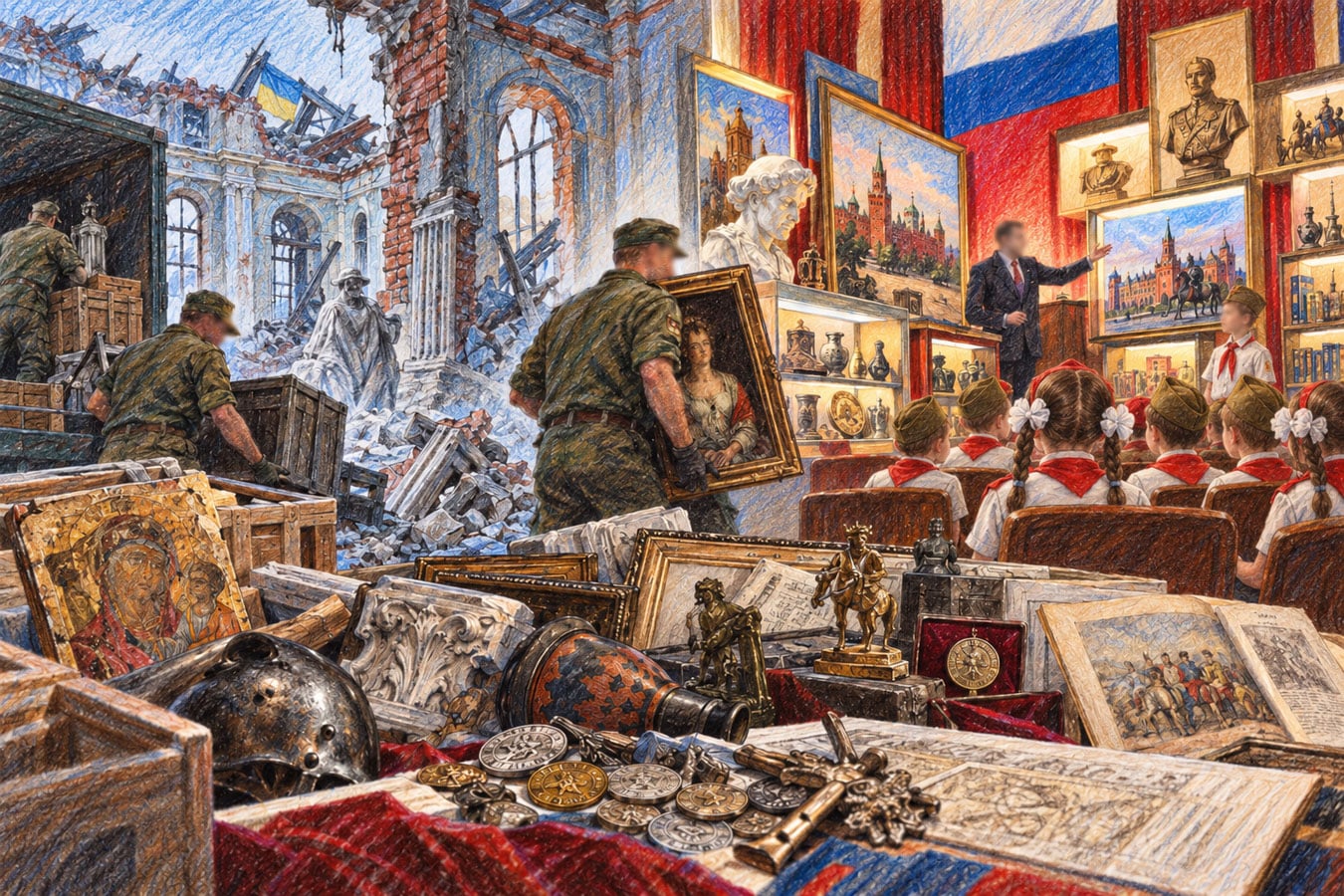
But there is another form of destruction that is quieter and, in some ways, more dangerous. The museum remains open, the exhibits are still there and children are still brought inside. Only the story has changed.
This is what Ukrainian researchers are now documenting in museums located in territories occupied by Russia. I recently examined this process in detail for NAnews in the article “Raphael Lemkin and the Museums: How Russia Rewrites Memory in Occupied Ukraine”, which looks at the work of the Raphael Lemkin Society and the NeMo Ukrainian Heritage Monitoring Lab.
The story deserves particular attention in Israel because the man whose name this Ukrainian organization carries was Raphael Lemkin. And Lemkin understood something that Israelis perhaps understand better than most societies: destroying a people is not only about killing its members. It is also about attacking the structures through which that people understands who it is.
The Jewish lawyer who gave the crime a name
Raphael Lemkin was a Polish-Jewish jurist who coined the word “genocide” and spent years fighting to have it recognized in international law. He lost 49 members of his family in the Holocaust, including his parents. But Lemkin’s understanding of the destruction of a group was never limited to mass murder alone.
He wrote about a coordinated attack on what he called the “essential foundations” of the life of national groups — their institutions, culture, language, religion and social structures. That distinction matters when we look at Ukraine today. It does not mean that every attack on a museum should automatically be legally defined as genocide; legal definitions require evidence, intent and careful analysis. But Lemkin gives us a useful question: what happens when an occupying power does not simply seize territory, but starts reorganizing the memory of the people living there?
First comes the territory. Then comes its past.
According to research by Ukrainian heritage specialists and the Raphael Lemkin Society, Russia’s policy toward museums in occupied Ukrainian territories increasingly follows a recognizable pattern. Military control comes first, followed by administrative and legal incorporation. Ukrainian museums and collections are placed inside Russian institutional structures, museum objects are entered into Russian systems, and collections can be removed, transferred or reclassified.
Then the narrative begins to change. An institution that once presented the history of a Ukrainian city may begin to explain that city through a Russian imperial or Soviet framework. Events about the current war appear, Russian soldiers become part of museum programming, the occupation is described through the language of “liberation,” and the invasion itself is presented as a struggle against “Nazism.”
Children are also brought into these spaces. This is why the argument over museums is not an obscure professional disagreement between curators. A museum tells a child who lived here before him, which state built this city, which language belongs here, who is considered a hero, who is an enemy, what happened in the past and, eventually, who the child himself is supposed to become.
Israelis should recognize this mechanism
There is an obvious danger when making historical parallels involving the Holocaust: different events can easily be flattened into false equivalence. So I want to be precise. A Ukrainian museum under Russian occupation is not Babi Yar, and Russian museum policy is not the Holocaust.
The comparison is not between the crimes themselves. The connection is in something else: the struggle over who receives the right to name the past. Jewish history offers painful examples of what happens when others take control of that right.
For decades after World War II, Soviet memorial culture often subsumed specifically Jewish victims of Nazi mass murder under the general category of murdered “Soviet citizens.” The people had not disappeared from the historical record entirely, but their identity had. Babi Yar is perhaps the clearest example: the Nazis murdered 33,771 Jews there on September 29 and 30, 1941, yet for years Soviet commemoration resisted acknowledging the specifically Jewish character of that crime.
The facts were not necessarily erased. They were reformulated. And formulations matter. A museum plaque matters, the name assigned to a victim matters, and the language in which a schoolchild learns the history of his city matters.
Sometimes the museum itself becomes the battlefield
In occupied Ukrainian territories, researchers have documented museums being drawn into political and military narratives that have little to do with their original purpose. Local-history institutions begin holding events connected with Russia’s war, security structures appear in museum activities, archival material is reinterpreted through contemporary political narratives, and historical figures are selected and presented in ways that support the claim that Ukrainian identity is artificial, extremist or inherently connected to “Nazism.”
A museum that once preserved local memory becomes something else. It becomes an institution for manufacturing political memory. And this process does not require destroying every exhibit.
In fact, keeping the museum open may be more useful. A ruined museum tells people that something has been destroyed. A functioning museum with a rewritten narrative can persuade the next generation that nothing was destroyed at all.
Jewish heritage is part of this story too
There is another reason Israelis should pay attention. The heritage being removed, appropriated or reinterpreted in Ukraine is not only ethnically Ukrainian heritage. It is also Jewish heritage.
NAnews has previously investigated cases involving Ukrainian Jewish artifacts that disappeared and later surfaced in Russian museum contexts. The investigation, “Museum Robbers: How Moscow Steals and Appropriates Unique Artifacts of Ukraine’s Jewish Heritage”, shows why the issue of cultural appropriation in occupied Ukraine also concerns Jewish history directly.
This distinction is important because for centuries what is today Ukraine was home to enormous Jewish communities. Synagogues, cemeteries, manuscripts, ritual objects, photographs, community archives and family histories are not marginal additions to Ukrainian history. They are part of it.
When heritage from those territories is removed and incorporated into another national narrative, the question of ownership is therefore not only Ukrainian. It is also Jewish.
Russia does not need to destroy every historical object
One example cited by the Raphael Lemkin Society is Chersonesus in occupied Crimea, a UNESCO World Heritage site. The issue there is not simply whether ancient stones survive. It is how the site is interpreted.
A place with Greek, Roman, Byzantine and medieval histories can be reorganized around a modern political narrative presenting it primarily as a foundational site of Russian Orthodox and Russian state history. The object survives, but the meaning is captured.
This is a crucial distinction. Cultural appropriation is not always the theft of an object. Sometimes it is the theft of the explanation attached to that object.
Documentation may look boring. It is not.
Much of the work being done by Ukrainian researchers today sounds almost bureaucratic: save a screenshot, archive a museum’s Telegram post, identify the lecturer, find the regulation under which a Ukrainian collection was transferred, compare a photograph with a prewar inventory, record what children were told during an excursion, or recover the catalogue of a museum whose building was destroyed.
But history is often reconstructed exactly this way — one document at a time, one photograph at a time, one inventory number at a time. This is also how evidence survives when political systems later insist that something never happened.
Lemkin’s warning was larger than one century
Raphael Lemkin gave humanity a legal vocabulary for one of its worst crimes. But his intellectual legacy also forces us to look earlier in the process: at the school, the language, the archive, religion, monuments, books, museums and the stories a society is allowed to tell about its own grandparents.
For Israelis, this should not be an abstract academic debate. Jewish history teaches us that memory does not preserve itself. Someone preserves it, someone catalogues it, someone writes the plaque, and someone decides which identity of the murdered person will be mentioned and which will disappear.
And sometimes someone else arrives, takes control of the museum and begins telling the story differently. A painting can be stolen in minutes. Changing the memory of an entire society takes longer, and for that you do not necessarily need to close the museum. Sometimes you need to keep its doors open.
Related Topics
Related Posts