An Aging Jewish Feminist
When Sacred Texts Wound: The Troubling Legacy of Parshat Emor
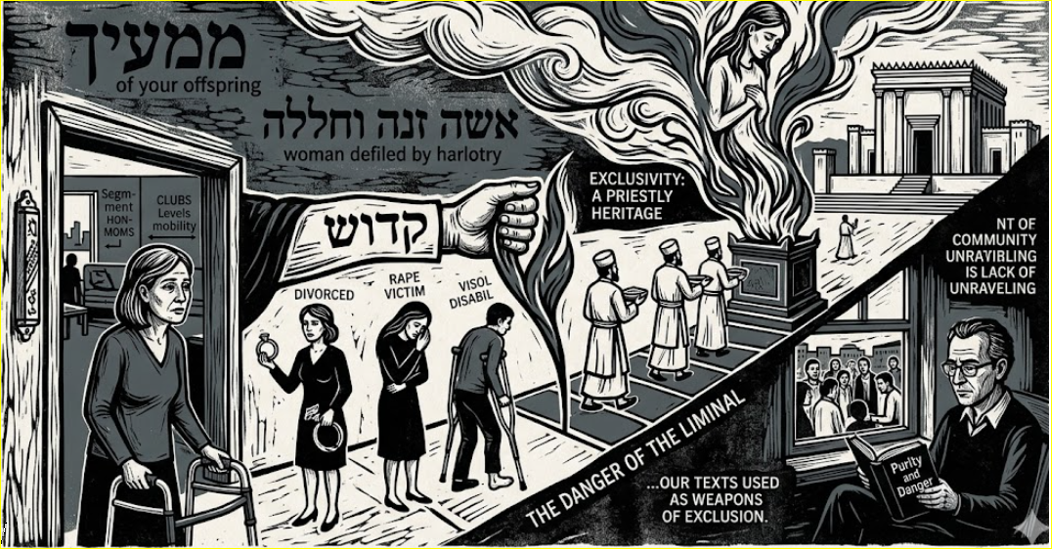
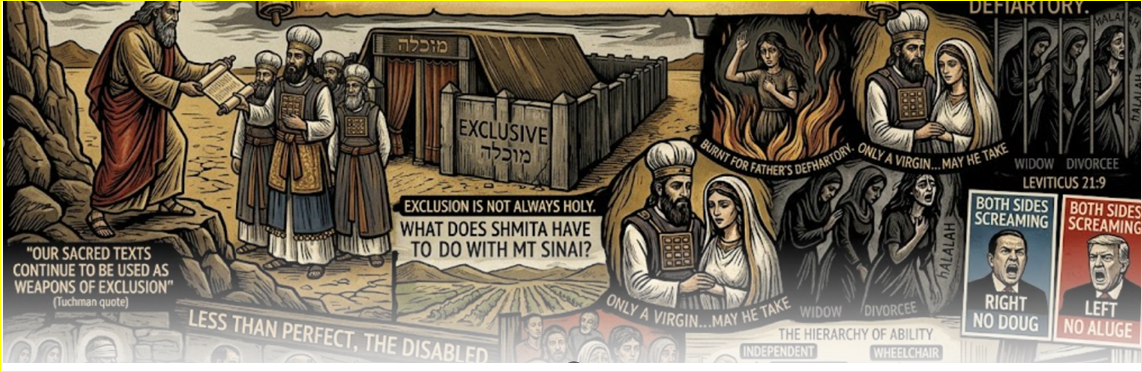
Parshat Emor includes many disturbing passages—texts whose implications still reverberate today. When I used to teach English, I would explain to my students that the word “exclusive,” though often positive in Hebrew (suggesting something special), is built on a more troubling premise: what makes something “special” is precisely that it excludes. It leaves others out. It is not shared. That idea, unfortunately, lies at the heart of the priesthood described in this parsha. God instructs Moses:
Speak to the priests, the sons of Aaron, and say to them: None shall defile himself for any [dead] person among his kin, except for the relatives that are closest to him: his mother, his father, his son, his daughter, and his brother; also for a virgin sister, close to him because she has not become someone’s [wife], for her he may defile himself. But he shall not defile himself as a kinsman by marriage, and so profane himself (Leviticus 21: 1-4).
In practice, this means that a Cohen today may attend only the funerals of immediate relatives—but not that of a married sister, because she is no longer considered part of his primary kin—also perhaps, because she is not a virgin. This concern with boundaries and exclusions intensifies as the chapter continues.
Non-Virgins Forbidden to Priests
The Torah limits whom a priest may marry:
They shall not take [into their household as their wife] a woman defiled by harlotry (אשה זנה וחללה), nor shall they take one divorced from her husband. For they are holy to their God (Leviticus 21:7).
Here, the text introduces two terms—zonah and ḥalalah. Are they synonymous? Or do they distinguish between a willing participant and a woman violated against her will? The ambiguity is striking—and troubling. In traditional communities, these distinctions still carry weight. A Cohen who takes his lineage seriously will not marry a divorcee. But the text goes even further. It asks: what happens when the “transgression” is within the priest’s own household?
When the daughter of a priest defiles herself through harlotry, it is her father whom she defiles; she shall be put to the fire (Leviticus 21:9).
Since it is her father (who owns her) he is the one defiled and she is burnt alive. And it gets worse when it comes to the High Priest, for the only person he can marry is a virgin:
He may take [into his household as his wife] only a woman who is a virgin. A widow, or a divorced woman, or one who is degraded by harlotry—such he may not take. Only a virgin of his own kin (מעמיו) may he take as his wife— that he may not profane his offspring among his kin, for I God have sanctified him (Leviticus 21:13-15).
The text is vague enough to invite interpretation, yet precise enough to enforce exclusion. At this point, a pattern begins to emerge: holiness is defined through separation, through the elimination of anything perceived as impure or incomplete.
The “Less Than Perfect”: Disability and Disqualification
Immediately following these marital laws, we read:
No man of your offspring throughout the ages who has a defect shall be qualified to offer the food of his God. No one at all who has a defect shall be qualified: no man who is blind, or lame, or has a limb too short or too long; no man who has a broken leg or a broken arm; or who is a hunchback, or a dwarf, or who has a growth in his eye, or who has a boil-scar, or scurvy, or crushed testes. No man among the offspring of Aaron the priest who has a defect shall be qualified to offer God’s offering by fire; having a defect, he shall not be qualified to offer the food of his God (Leviticus 21:16-21).
Why this juxtaposition? Why move from sexual “purity” to physical “perfection”? Here, I am reminded of the rabbinic question: “What does Shmita have to do with Mount Sinai?”—a way of asking, what is the connection between seemingly unrelated laws? In this case, the connection may lie in a shared anxiety about imperfection. Non-virgins, the disabled—both represent a deviation from an idealized norm. They disrupt the illusion of wholeness. And what disrupts is often perceived as dangerous. Sacrifices must be perfect. Animals with defects are not kosher. The system depends on maintaining clear boundaries between pure and impure, whole and broken.
Purity and Danger
When I was in graduate school in 1966, Purity and Danger: An Analysis of Concepts of Pollution and Taboo by Mary Douglas was published. It became a foundational text for understanding Leviticus. Douglas argued that societies organize themselves through binaries: pure/impure, inside/outside, life/death. What threatens these categories—what exists “in between”—is experienced as dangerous. That idea resonated deeply with my own studies of the grotesque in literature. The liminal, the ambiguous, the not-easily-classified—these are the states that unsettle us most.
Seen through this lens, the laws in Parshat Emor are not random. They are part of a larger system that seeks to eliminate ambiguity. The mezuzah on the threshold, for example, marks a boundary: it protects, but it also declares identity—who is in, and who is out. Over time, I came to a troubling realization: those who cling most tightly to ideals of purity, perfection, and absoluteness may be more dangerous than those who can tolerate complexity and contradiction—who have the ability to hold on to two opposing truths at the same time.
From Ancient Text to Contemporary Reality
If virginity is equated with purity, what does that imply about those who are not virgins—widows, divorcees, survivors of assault? According to Jacob Milgrom, the term ḥalalah may refer to a raped woman (someone who has been penetrated, pierced, fatally wounded). If so, the implications are devastating.
And the proximity of these laws to those excluding people with disabilities raises an even more disturbing question: are both categories seen as “damaged,” as falling outside the bounds of acceptability? To bring this into contemporary terms: how do we treat those who have been wounded—physically, emotionally, psychologically? Survivors of violence? Those living with trauma? With PTSD?
We like to believe we have moved beyond these ancient categories. We speak openly about mental health. We recognize trauma. And yet, our systems are overwhelmed. There are not enough professionals to care for those in need. Communities fray under the strain. We remain far better at fighting wars than at caring for their victims.
Metaphors That Refuse to Stay Metaphors
It is tempting to dismiss these biblical laws as metaphors, relics of a bygone world. We don’t have a priesthood anymore that sacrifices animals and then shares their food with a select few. What does any of this have to do with us. However, metaphors are not just metaphors–they shape reality.
The logic of exclusivity versus inclusivity still permeates our thinking. We continue to marginalize those who are different. In some societies, women are still killed for “family honor.” The ancient text is not as distant as we might like to believe.
As Rabbi Lauren Tuchman, who is blind, writes: “Our sacred texts continue to be used as weapons of exclusion.” She challenges us to ask whether a “broken body” is seen as a broken person—and what that reveals about our own assumptions. Her challenge is not to dismiss these texts, but to confront them. To ask: in what ways do we still silence those whose experiences make us uncomfortable?
This question extends beyond the religious sphere into our political lives. We speak past one another. We shout, rather than listen. We refuse to grant legitimacy to opposing voices. Not every viewpoint deserves acceptance—but every person deserves to be heard.
A Personal Reflection: Connecting the Dots
So what is the connection between non-virgins, widows, divorcees, and those with disabilities? Perhaps it is this: each represents a departure from an idealized norm. Each carries a reminder—of loss, of vulnerability, of mortality. And that reminder unsettles us.
The widow, for example, embodies loss. She reminds others of death, of absence, of the fragility of life. Since I became a widow a year and a half ago, I have felt this acutely. People check in, often with the assumption that I am “not okay”—because I no longer fit the norm. I was, as we say, welcomed into a “club.” In my support group, we faced a question: should newly widowed members remain? We decided yes—because, eventually, all of us would face that reality. Shared experience became a source of strength.
More recently, after moving to a retirement community in Tivon, I noticed another hierarchy—this one based on physical ability. When I first arrived, I used a walker. People largely ignored me. When I stopped using it, their behavior changed. Suddenly, I was visible again. I began to observe others: those who risk falling rather than use assistance; those accompanied by caregivers; those in wheelchairs; those who seem withdrawn and are almost entirely overlooked.
It took my granddaughter’s simple question—“Why do you always stop to talk to that woman?”—to make me fully aware of how easily people become invisible. And I must admit: when my own mother moved into a retirement home, she hated it. Her reason? She hated old people.
Toward Nuance
Nuance is difficult. It requires dialogue. It requires us to recognize the dignity of those who are different. Instead, we retreat into certainty. We shout. We refuse to listen. But listening is precisely what we lack. Not just hearing words, but truly hearing the other. Because if we did—if we allowed for complexity, for contradiction, for humanity—who knows what we might learn. Or who we might become.
Shabbat shalom
Related Topics