When the dog whistle becomes a shout
“You know who the real problem is.”
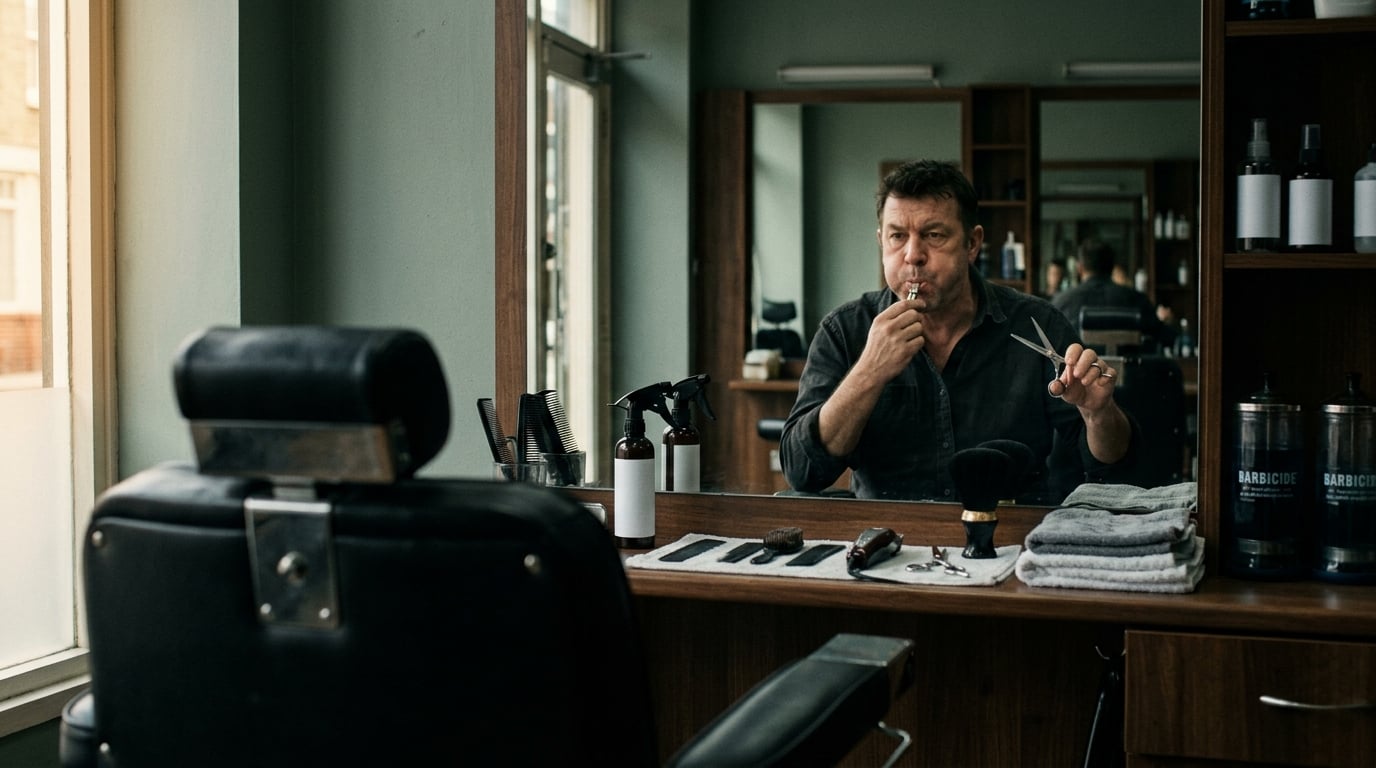
He said it to the mirror, scissors still in his hand, a few seconds after I’d told him where my thick hair came from. I felt it before I understood it. The adrenaline. The pit in my stomach. The certainty that I was about to be somewhere I had not been since before my family made aliyah in 2001.
“It’s the hat people.”
Rewind
Every year I fly to London for the same conference, at around the same time. This year the dates landed on top of two others: my wife’s birthday, and Yom Kippur. We fasted, we broke the fast, and the next morning I had a haircut booked at a barber near our hotel in Shepherd’s Bush. I’d found it before we flew out. It’s the kind of place you would walk straight past unless you were looking for it.
A word on my accent, because this story turns on it. I have lived in Israel most of my life, but I don’t sound like it. My accent is South African, the genuine article, smoothed over by a private English education and years of international travel. Over time I’ve developed a simple strategy. When someone asks where I’m from, I tell them Israel. When someone asks where my accent is from, I tell them South Africa. Both answers are true. The question decides which one you get.
The barber, a white, middle-aged man, greeted me warmly, and we started chatting.
“I can’t quite place your accent.”
South African, I told him.
He wanted to know what it was like there these days. He’d heard there were problems. I gave him my usual answer: a beautiful country with a lot of problems. Crime, corruption, the economy. He nodded.
“Trump is a big problem. He’s out of control.”
I chuckled, said the world had gone mad recently, and kept it short. I wasn’t in the mood for politics.
He kept cutting, reassuring me every few minutes that he wasn’t taking too much off the top. He asked my age and told me I looked good for it. “You have incredibly dense hair for a 40-year-old.” Half joking, I told him that was my Portuguese-Moroccan genes doing their work.
He went quiet for a couple of seconds. Then he looked at me through the mirror.
The whistle
“It’s the hat people.”
“The what?”
“You know. The people who wear hats.”
“I have no idea who you mean.”
I knew exactly who he meant. Every Jew reading this knows exactly who he meant. That is how a dog whistle works. It is pitched so the people it’s meant for hear it clearly, and everyone else can swear they heard nothing at all.
So I played dumb, and I made him say it.
“Who are the people who wear hats?”
“The Jews. They control everything. Those Zionists want to control the world with their money. They own America, they tell Trump what to do, and they’re killing innocent children in Gaza.”
Hat people. Zionists. Jews. Three names for the same people, and he went through all of them in under a minute. First the whistle, then the shout.
Why he felt safe
Think about what he had in front of him. A man with a South African accent, from the country that took Israel to court in The Hague. A man who had just credited his good looks to Moroccan genes. He added it up in a couple of seconds and decided he was among friends.
He didn’t drop his guard by accident. He dropped it because he was sure there were no Jews in the room.
He was wrong on every count, and more wrong than he could have known. The Moroccan side of my family is Moroccan Jewish. The Portuguese side traces back to the Ibn Yahya family, physicians and advisors to the kings of Portugal, until Portugal decided it no longer wanted its Jews. Seven hundred years ago, one of them, Don Shlomo ibn Yahya of Lisbon, warned his community not to flaunt its wealth, because he knew exactly what their neighbors would say about Jews and money.
A barber in Shepherd’s Bush said it to me in 2026.
Every answer I gave that man was true. Every one of them led straight back to the people he was describing.
The calculation
At this point I had a thousand thoughts running through my head. Do I reveal who I am to a man holding sharp objects to my head? Do I argue? Do I tell him this conversation isn’t appropriate? Do I get up and walk out, half a haircut and all? Do I sit tight until he’s finished, then tell him exactly who he just said all that to, and exactly what that makes him?
I ran every one of those calculations while trying very hard not to break the illusion that I wasn’t the target of his hatred.
“I don’t know much about that,” I told him. “I just think most people want to live in peace with their neighbors and keep their families safe.”
He paused again. For a moment I was sure he’d worked it out.
“Yes, but they are obsessed with power,” he went on. “What compels a person to want to control other people? To tell them what to do, how to live, and hurt them if they don’t obey?”
I laughed, silently. He had just described life under the Taliban, or in the Islamic Republic of Iran, perfectly, and pinned it on the Jews.
“Where are you from originally?” I asked him. “How long have you lived here?”
“Macedonia. I’ve been in London 25 years. But they’re going to start World War Three, so I’m going back to Macedonia soon to farm sheep. That way I know I’ll be safe.”
With the spotlight now on him instead of me, I let him finish the cut.
Paying up
When it came time to pay, I considered asking him how big a tip he’d like from a Zionist. I resisted. I still wasn’t somewhere safe, and I doubted I’d find many allies nearby if it escalated.
I paid with my corporate card. Most card readers now ask whether you want to pay in local or home currency, and they show a flag, so that people who can’t read English can still choose. I didn’t want him to see an Israeli one. Much like a century ago, outing yourself as a Jew or an Israeli can be a death sentence.
That wasn’t going to happen today. Not on my wife’s birthday.
Justice will be served one day. Just not today.
Back at the hotel, I told my wife we were getting out of the area, now.
“You look great,” she said. “He cut your hair so nicely.”
“That was one haircut I will never forget.”
What I heard
I’ve always said that when your enemies talk, you should listen to every word. That morning, less than 24 hours after breaking my Yom Kippur fast, I heard the unvarnished truth: the world has not changed. When their guard is down, the dog whistle becomes a deafening mix of blood libels and conspiracy theories that nobody could mistake for anything else.
All weekend, we had talked about how good it felt to get away. Away from the war, the politics, the noise of being a Jew and an Israeli after October 7th. Forty minutes in a barber’s chair taught me that there is no away. Wherever we go, the demonization that has hunted us for 3,000 years is waiting in the next chair.
The opinions of diplomats, politicians, and people of influence mean very little to me, especially when the cameras are rolling. It’s the guy working at a McDonald’s in Paris whose opinion I pay attention to.
This time, it was a Macedonian barber in Shepherd’s Bush.