
Crisis Communicator, Droll Dragon
When the Enemy of My Enemy Becomes My Ideology
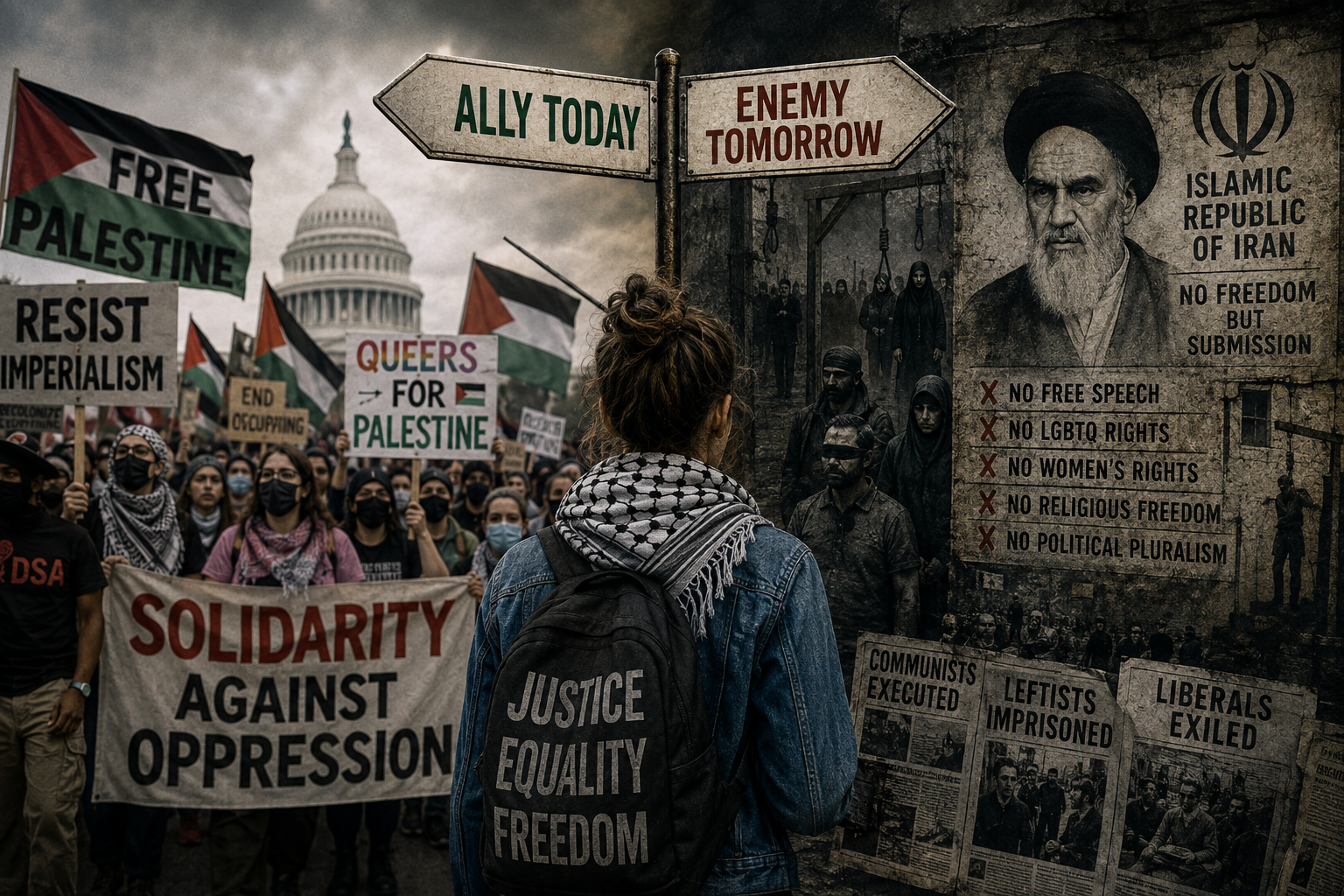
The enemy of my enemy is still my enemy (AI)
History has a habit of repeating itself. Not because the circumstances are identical, but because people, particularly people acting in political movements, have a habit of making the same mistakes.
One of those mistakes is confusing a common enemy with a common cause.
The old saying, “The enemy of my enemy is my friend,” has become one of the most dangerous assumptions in politics. Temporary alliances are often necessary. Nations form them. Political parties form them. Activists form them. There is a profound difference, however, between working with someone to achieve a limited objective and convincing yourself that you share the same values.
That distinction has become increasingly blurred in American politics. Today, portions of the progressive movement find themselves marching alongside organizations and activists whose stated beliefs are fundamentally incompatible with the very principles progressives claim to defend. The coalition is held together by opposition to American foreign policy, capitalism, colonialism and what is broadly described as Western power. The most durable adhesive, however, has become hostility toward Israel, increasingly accompanied in some corners by an antisemitism that would be instantly condemned if directed toward almost any other minority.
Shared opposition has become a substitute for shared values, and the irony is difficult to ignore.
The same movement that demands unwavering commitments to women’s rights, LGBTQ equality, religious freedom and pluralistic democracy has shown remarkable reluctance to question allies whose own ideologies reject many of those principles outright. The contradictions are excused because the political moment demands unity against a common adversary.
We have seen this before, so let’s share a little history. Let’s take Iran, which has somehow become a shining beacon for some progressive anti-Western protest despite being governed by a regime that stands against much of what those same progressives claim to believe.
The revolution that overthrew Shah Mohammad Reza Pahlavi in 1979 was not simply an Islamist uprising. Marxists, communists, secular liberals, nationalists, students, intellectuals and Islamists participated in the movement that brought down the monarchy. They had profoundly different ideas about what Iran should eventually become, but they shared powerful enemies: the Shah, American influence, Western imperialism and the economic system they believed sustained them.
For many on the Iranian left, Ayatollah Ruhollah Khomeini therefore appeared to be a fellow revolutionary. The parallel to today’s Western progressive coalition is not exact, but the political instinct should sound familiar. He condemned Western imperialism. He attacked inequality. He opposed American influence. To many leftists, those themes sounded familiar, and they interpreted his rhetoric through their own political framework.
Khomeini, however, was never leading a socialist revolution. He was leading an Islamic one.
His objective was not a secular republic built around competing political ideas, individual autonomy and religious pluralism. He envisioned an Islamic Republic in which Shiite Islamic principles and clerical authority would exercise enormous power over the state.
The left believed it had found an ally. I believe Khomeini understood that he had found useful idiots. That distinction eventually proved fatal for some of those fellow revolutionaries.
The most instructive example may be Iran’s communist Tudeh Party. Even after the Shah was gone, Tudeh continued supporting the Islamic Republic. Its leaders believed Khomeini’s hostility toward the United States and Western influence made the Islamists partners in their anti-imperialist struggle. They were so consumed with the enemy they shared that they failed to understand what their supposed ally intended to build.
Khomeini’s government was perfectly happy to accept their support while it was useful. Then it wasn’t.
In 1983, the Islamic Republic arrested Tudeh’s leadership and roughly a thousand of its active members and outlawed the party. Members were imprisoned and some were eventually executed. The communists who had welcomed Khomeini’s revolution discovered, much too late, that opposing the same enemy did not mean they were fighting for the same future.
There may be no better historical example of the enemy of my enemy becoming my ideology, right up until my new friend decides that I am his enemy too.
Tudeh was hardly alone. Once the Shah was gone and Khomeini’s forces consolidated power, newspapers were closed. Liberal organizations were pushed aside. Universities became targets of an Islamic cultural revolution. Communist, socialist and other political organizations that had marched alongside the Islamists found themselves increasingly marginalized, outlawed, imprisoned or driven into exile. Some of their members were executed.
The revolution did what Khomeini had told people an Islamic revolution was supposed to do. He was not secretly building a Western liberal democracy. The people who imagined otherwise heard the parts of his message they wanted to hear and dismissed the rest.
Does any of this sound familiar?
That history should make us uncomfortable today.
I watch demonstrations in the United States where, among crowds assembled under progressive banners, Hamas symbols have appeared and flags of the Islamic Republic have been carried. I watch people who identify themselves as socialists, feminists, LGBTQ activists and defenders of minority rights excuse movements whose leaders reject freedoms those activists exercise every day.
Does anyone carrying those banners know what happened to the Iranian leftists who once marched beside the Islamists whose revolution created the Islamic Republic?
The contradiction becomes even harder to comprehend when LGBTQ activists romanticize the Iranian regime or Islamist movements. Iran criminalizes consensual same-sex relations, and its laws permit punishments that can include flogging and death. The Islamic Republic continues to conduct public executions. This is not a theoretical disagreement over tax policy or the appropriate size of the welfare state. These are fundamentally different ideas about individual freedom and the relationship between citizens, religion and government.
Yet here in America we see “Queers for Palestine” and similar movements aligning themselves politically with people whose worldview would deny them many of the freedoms they are exercising while marching.
The question for Western progressives should therefore be painfully simple: Why would you defend abroad an ideology that would deny you at home the very freedoms you are marching to protect?
That is where the lesson of Iran matters. Had many of today’s Western activists stood beside Iran’s revolutionary left in 1979, they might have discovered much too late what their ideological predecessors learned firsthand: the revolution they were helping to create did not necessarily have a place for them once they were no longer useful.
None of this suggests that every Muslim shares Islamist beliefs. They do not. Islam and Islamism are not interchangeable, and Muslims themselves have often been among the victims of radical Islamist movements. Nor does any of this suggest that every progressive embraces the Iranian regime, political Islam or terrorism. Those would be lazy generalizations and they would miss the point.
The danger lies elsewhere.
It lies in the willingness to suspend critical thinking because someone happens to oppose the same nemesis.
Political movements should always ask difficult questions of their allies. Do they believe in free speech? Religious liberty? Equal rights for women? Equal protection under the law? Freedom of conscience? Political pluralism? Do they believe that someone who rejects their religion has the same right to live freely as someone who embraces it?
Those should not be difficult questions for liberals. If they become uncomfortable simply because an ally also opposes Israel, capitalism, American foreign policy or even President Donald Trump, then principles have already begun giving way to political convenience. At some point, the contradiction becomes hypocrisy.
That should concern liberals as much as conservatives.
There is another troubling development that makes this more than a conversation about protesters in the streets. Many mainstream Democratic leaders appear increasingly unwilling to confront these contradictions. Whether that comes from electoral calculation, fear of alienating parts of their coalition, or genuine ideological sympathy will vary from politician to politician. I cannot know what is in their heads. I can judge what they do.
Recent controversy over congressional scrutiny of alleged Muslim Brotherhood networks and influence in the United States illustrates the problem. Rather than welcome scrutiny of whether radical political organizations are operating or building influence here, some Democrats and their allies have responded by warning that such inquiries promote Islamophobia. It is intellectually dishonest.
It is especially difficult to accept when some of the same political voices are reluctant to acknowledge how the extraordinary hostility directed toward Israel and Zionism has, in some demonstrations and political movements, spilled openly into antisemitism. If examining Islamist extremism is dangerous because it might encourage hatred of Muslims, why isn’t examining rhetoric that demonizes Jews and Israel equally urgent when it encourages hatred of Jews?
The principle should work both ways.
Instead, too many mainstream political leaders appear afraid to ask the question at all. Perhaps they fear losing votes. Perhaps they fear activists. Perhaps they have accepted the argument that scrutinizing Islamism means attacking Muslims. Whatever the motivation, refusing to examine an uncomfortable political alliance because the people involved are part of your coalition is not tolerance.
It is cowardice. Ignoring uncomfortable questions has never made them disappear, and history teaches something remarkably consistent; that coalitions built solely on shared enemies rarely survive victory.
Eventually, every movement must answer a far more important question than whom it opposes: What does it actually believe?
Once opposition becomes the organizing principle of a political movement, something subtle begins to happen. The enemy of your enemy stops being your temporary ally. He becomes your moral compass.
Eventually, if you are not careful, he becomes your ideology.
With another political storm gathering, perhaps everyone marching beneath these contradictory banners should ask themselves a simple question: Is the world their allies actually want to build one in which freedom-loving, pluralistic men and women, gay and straight, transgender and religious, secular and observant, would want to wake up?
Iran’s leftists learned what can happen when nobody seriously asks that question until after the revolution.
Related Topics
Related Posts