
Writing on Jewish life, relationships, trauma, and resilience
When the Knicks Finally Won, New York Remembered How to Believe
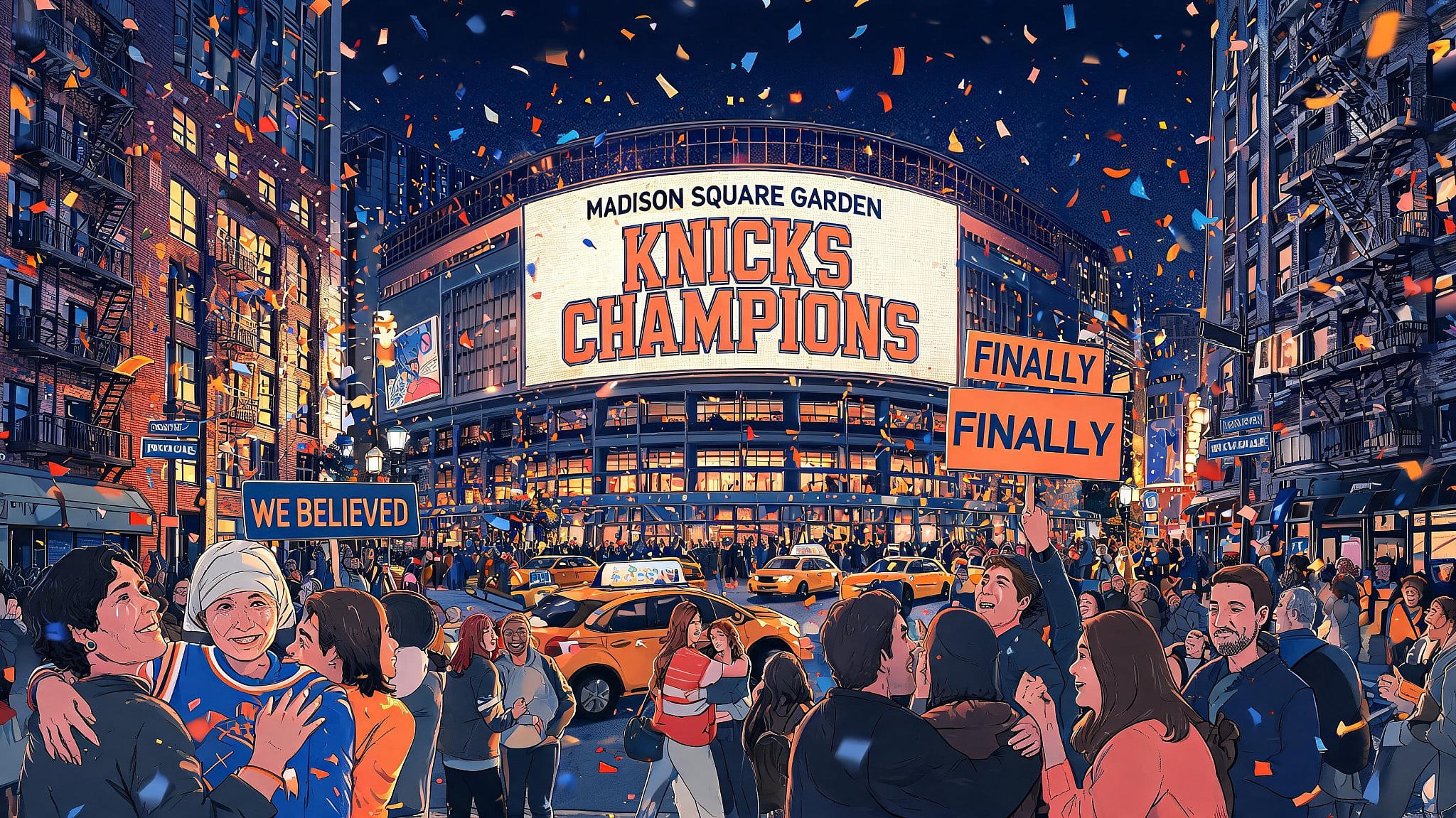
Illustrative. AI image created by the author.
There are forms of waiting that become part of a people’s emotional vocabulary.
Jews know this in sacred ways.
Israelis know this in painful ways.
And Knicks fans, in their far less sacred but still deeply irrational way, know it too.
For 53 years, New York Knicks fans waited for a championship. They waited through bad trades, broken promises, strange draft nights, false messiahs, very expensive disappointment, and seasons that felt less like basketball than group therapy with worse lighting.
They waited through the jokes.
They waited through “maybe next year.”
They waited through the particular cruelty of being a Knicks fan: having Madison Square Garden, basketball’s grandest stage, and too often no ending worthy of the building.
And then, in San Antonio, the waiting ended.
The New York Knicks are NBA champions.
That sentence still looks strange on the page. Beautiful, but strange. Like finding an old prayer book and realizing the words still know you.
For Israelis watching from afar, this was not our championship in the literal sense. No Israeli player lifted the trophy. No Israeli flag was draped across the scorer’s table. The parade will not roll down Dizengoff or Ben Yehuda.
But New York is not just another American city for Jews. It is a capital of Jewish memory, argument, comedy, anxiety, ambition, and pastrami. It is the place where so many Jewish families arrived carrying little more than names, recipes, grief, and impossible expectations for their children.
New York and Israel are connected by more than flights, fundraising dinners, and relatives who call at inconvenient hours. They are connected by an emotional vocabulary: resilience, noise, impatience, loyalty, and the ability to complain passionately about the very thing one loves most.
In that sense, the Knicks have always been a very Jewish team.
Not because of religion.
Because of temperament.
They make you suffer. They make you hope. They test your faith. They ask for devotion without providing adequate evidence. Every few years, they show signs of redemption, then wander again in the wilderness. Honestly, the franchise could have used Moses — although, given Knicks history, management probably would have traded him for two second-round picks and a protected future asset.
But this team was different.
This team did not feel like a fantasy. It felt like work.
Jalen Brunson gave New York steadiness without arrogance. OG Anunoby gave quiet answers to loud questions. Karl-Anthony Towns gave the city skill, size, and a story of resilience. Around them was a team New Yorkers could recognize: imperfect, bruised, stubborn, and still showing up.
That is why this championship lands differently.
It is not only about winning.
It is about repair.
The Knicks did not erase 53 years of heartbreak. Nothing does that. Repair is not pretending the wound never happened. Repair is what happens when the wound finally becomes part of a larger story — not the end of the story.
That is a lesson far beyond basketball.
Since October 7, Israelis and Jews around the world have carried grief, fear, anger, and exhaustion. We have learned again that history does not stay in books. We have learned again that safety is precious, fragile, and never guaranteed by slogans. We have learned again that joy can feel almost disloyal when so much pain remains.
And yet joy matters.
Not because it cancels grief. It does not.
Joy matters because it refuses to let grief become the only voice in the room.
A Knicks championship will not heal Israel’s wounds. It will not answer the unbearable questions of war, leadership, security, loss, or what comes after survival. Basketball is not life, despite what certain people in Queens may have suggested during the fourth quarter.
But moments of shared joy still have a place.
They remind us that human beings were not built only to endure. We were also built to cheer, to laugh, to hug strangers, to call our fathers, to remember people who did not live to see the day, and to say, through tears if necessary: I wish you were here for this.
That may be the most Jewish part of all.
Every celebration has ghosts at the table.
Somewhere tonight, Knicks fans are thinking of parents and grandparents who took them to games, taught them how to keep score, yelled at the television, cursed the front office, and insisted, against all available evidence, that one day the Knicks would come back.
Somewhere, a son is remembering his father.
Somewhere, a daughter is remembering the sound of her mother screaming at a missed free throw.
Somewhere, a family is laughing because the person they miss most would have known exactly what to say tonight, and it probably would not have been suitable for publication in The Times of Israel.
That is what sports can do at its best.
It gives memory somewhere to go.
For New York’s Jewish community, this championship will feel like a neighborhood simcha. Not because every Jew is a Knicks fan. Some are Nets fans, which is proof that free will includes suffering. Some are Lakers fans, which raises separate theological concerns. And some Israelis may have watched the Finals simply to see Victor Wembanyama do things that appear to violate zoning laws.
But the Knicks are New York’s team in a way that transcends standings. They belong to subway platforms, delis, barbershops, bodegas, yeshiva gyms, office elevators, and family group chats that should have been muted years ago.
They belong to a city that knows how to absorb pain without becoming quiet.
That is why the image of the Knicks winning in San Antonio feels almost perfect. They did not need the Garden to validate them. They carried New York with them. They carried all that noise, history, neurosis, and hope into someone else’s building and finished the job.
There is something powerful about that.
Home is not only a place. Sometimes home is what a team remembers under pressure.
Tonight, the Knicks remembered who they were.
They were not flawless. They were not inevitable. They were not spared fear. But they stayed connected. They stayed disciplined. They stayed together.
That is usually how repair works.
Not with magic.
With trust.
With truth.
With people who keep showing up when leaving would be easier.
So yes, it is only basketball.
But anyone who says “only basketball” has probably never watched a city exhale after holding its breath for half a century.
Tonight, New York exhaled.
And somewhere between San Antonio and Jerusalem, between Madison Square Garden and every Jewish home where someone stayed up too late to watch, there was a small reminder that waiting does not always end in disappointment.
Sometimes the team comes back.
Sometimes the wound becomes a story.
Sometimes, after 53 years, the prayer is answered.
The Knicks are champions.
And for one night, New York remembered that hope does not always have to be defended.
Sometimes it simply gets the last shot.
Related Posts