When the Right Leaves Likud
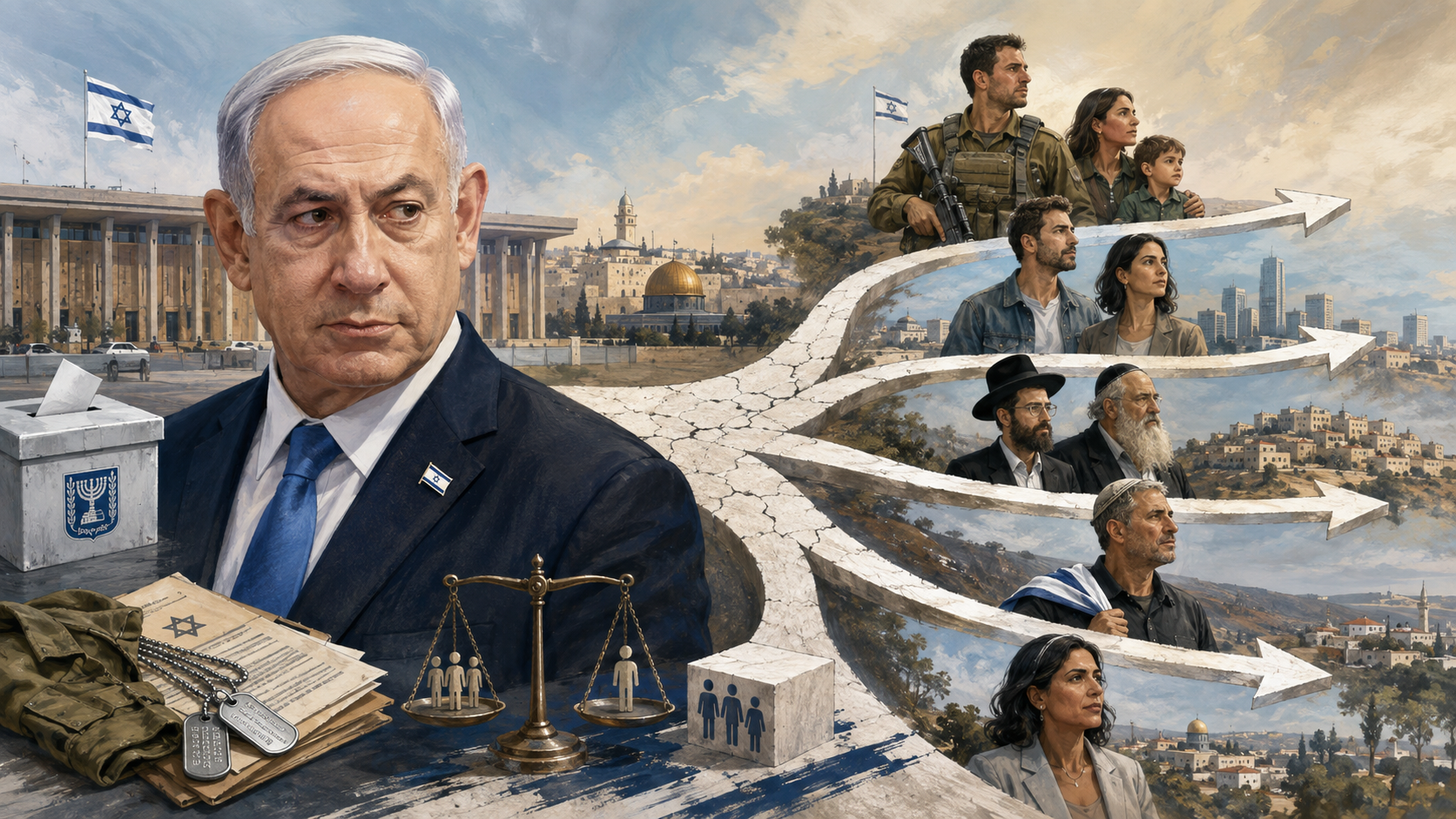
A few weeks before the Israeli elections on October 27, a question is starting to arise: what if the main electoral danger for Benjamin Netanyahu ultimately comes not from the left, but from the right itself?
For several weeks, new parties have been appearing on the Israeli political scene. Some will probably remain marginal. Others may disappear even before the elections. But their proliferation deserves attention, as it may reveal something deeper than a simple electoral reshuffling. Part of the Israeli right seems to be looking for a new political home.
It has not become left-wing. It generally remains firm on security issues, deeply Zionist, and often very wary of a Palestinian state. But it also seems to want something else: a state that functions better, more political accountability, a better distribution of duties, and above all, less dependence on sectoral parties. This may be where the real novelty lies.
For a long time, Likud was the great home of the Israeli right. One could be secular, traditionalist, religious, economically liberal or more socially populist and still vote Likud. Netanyahu greatly benefited from this ability to bring together different sensibilities within a single party. But this monopoly is beginning to be challenged.
Avigdor Liberman has long occupied the space of a clearly secular right. Yoaz Hendel and Chili Tropper are seeking to build a political offer that notably highlights reservists and military service. Former Likud officials like Gilad Erdan or Yuli Edelstein are also looking for their own political space. The ”Times of Israel” even speaks of the emergence of a possible “third bloc” of right-wing parties seeking to position themselves between Netanyahu’s camp and the traditional opposition.
The arrival of Ofer Winter makes this phenomenon even more interesting. Winter is hard to classify as representative of a secular or moderate right. He is a former religious general, very firm on security and territorial issues. Yet, at the launch of his ”Amcha Yisrael party”, he also spoke of integrating Haredim into the army, of Arab citizens wanting to participate more in the state, and of a necessary political transformation after October 7. His list includes religious people, secular people, and Arab-Israeli activist Yoseph Haddad.
That’s why speaking only of a “secular right” seems insufficient. What may emerge is rather a civic right: a right that says we want a militarily strong Israel, but also a more balanced contract between the state and its citizens.
Military service could become the symbol of this evolution. After several years of war, reservists and their families have paid a considerable price. In this context, the question of Haredi exemptions is no longer just an old quarrel between religious and secular. It becomes a much simpler question: who really bears the burden of the state?
The figures show that this question now runs deep within the right. A survey cited by the Israel Democracy Institute indicated that 73% of Likud voters surveyed supported the application of sanctions against Haredim subject to conscription but refusing to serve. This is important, because an Israeli can be very right-wing on Gaza, Iran, Hezbollah or national security and still wonder why his son is doing several hundred days of reserve duty while other parts of the population continue to benefit from exemptions.
This question is not really a left or right issue. It is a question of social contract.
A social dimension may also gradually appear. The cost of living, housing, the situation of reservists’ families, small businesses weakened by war, or infrastructure in the periphery are no longer secondary subjects. A rather particular electorate could thus form: security-focused externally, but much more demanding of the state internally. A kind of “duty for protection” right: if the state asks more of its citizens, they also ask more of the state.
It is precisely this phenomenon that could become dangerous for Benjamin Netanyahu. The Prime Minister has always been particularly effective when he could present the election as a simple choice: him or the left. But this strategy becomes more complicated when his competitors themselves come from the right.
It is difficult to present Ofer Winter as a dangerous leftist. Equally hard to place Bennett or Liberman in the traditional left. Netanyahu’s problem could thus gradually become this: how to keep right-wing voters who no longer necessarily want him, without changing ideological family?
However, this does not automatically mean Netanyahu’s defeat. Fragmentation can also save him. If several small right-wing parties remain below the 3.25% electoral threshold, tens of thousands of votes can be lost. Some new parties could also decide after the elections to finally join a Likud-led coalition.
That’s the paradox: the new right can take voters away from Netanyahu while possibly allowing him to remain Prime Minister.
But beyond electoral arithmetic, something nevertheless seems to be evolving. October 7 has probably changed part of Israelis’ relationship with their political class. The question is no longer just: are you right or left? It also becomes: who assumes responsibilities? Who serves? Who pays? Who decides? And does the state demand the same sacrifices from everyone?
It may be around these questions that a new Israeli right is slowly beginning to build itself. A right that is security-focused but civic. A Zionist right, but less dependent on religious parties. A right that could be more social on domestic issues. A right that does not necessarily seek to overthrow Likud ideologically, but to contest its monopoly.
And it is probably here that the real danger for Benjamin Netanyahu lies. Because he could discover in the October 27 elections that some voters have not left the right.
They have simply left Likud.